
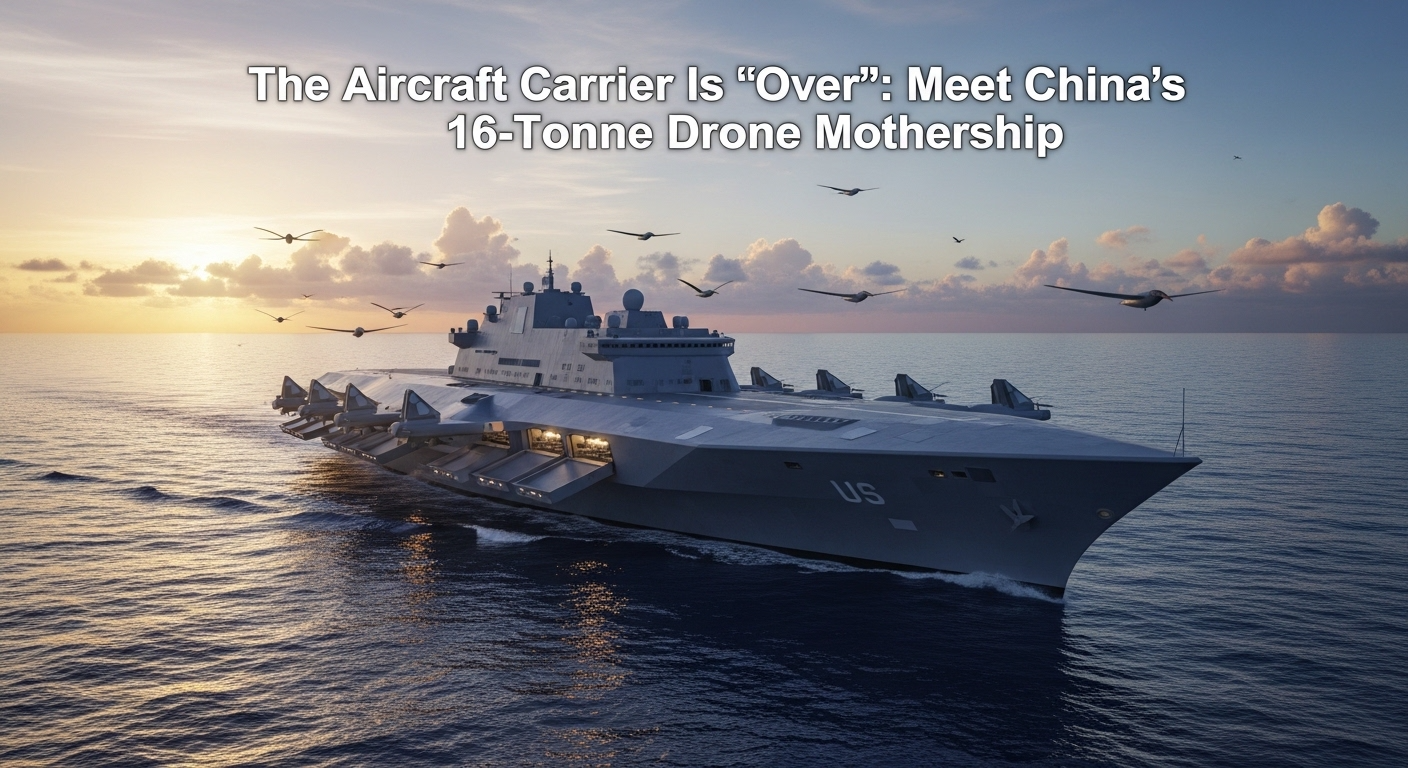
For more than 80 years, the aircraft carrier has symbolized global dominance at sea. From the Pacific battles of World War II to modern Indo-Pacific deployments, floating airbases have defined power projection.
But a new Chinese platform is challenging that legacy.
Beijing has unveiled the Jiutian, a 16-tonne unmanned aerial “drone mothership” reportedly capable of operating at ranges exceeding 7,000 kilometers. Rather than launching manned fighter jets from a vulnerable deck, the Jiutian is designed to deploy and coordinate swarms of smaller autonomous drones — a concept that could fundamentally alter naval warfare.
Some analysts are calling it evolutionary. Others are calling it revolutionary.
From Floating Airbases to Flying Swarm Hubs
Traditional aircraft carriers function as mobile runways. They require:
- Massive logistical support
- Escort fleets for protection
- Fuel, maintenance, and air crews
- Highly vulnerable flight deck operations
The Jiutian concept flips that model.
Instead of serving as a base for manned aircraft, it acts as a command-and-control aerial node, launching coordinated waves of unmanned aerial vehicles (UAVs) designed for reconnaissance, electronic warfare, and precision strikes.
The difference is strategic as much as technological.
Aircraft carriers project concentrated power.
Drone motherships project distributed power.
What We Know About the Jiutian
While full specifications remain limited, reported characteristics include:
- Weight: ~16 tonnes
- Operational Range: 7,000+ km
- Mission Role: UAV launch and swarm coordination
- Payload Capacity: Designed to carry multiple smaller drones
Rather than risking pilots, the Jiutian leverages autonomy and networked warfare. It can theoretically release waves of smaller drones — some potentially as light as 100 kg — to execute simultaneous tasks across a wide battlespace.
This aligns closely with China’s broader anti-access/area denial (A2/AD) doctrine in the Western Pacific.
The Power of Swarming
Swarm tactics are based on one core principle: overwhelm through numbers and coordination.
Instead of sending one or two high-value aircraft, dozens — potentially hundreds — of smaller UAVs operate simultaneously. Even advanced air defense systems can struggle when faced with saturation attacks.
The probability challenge becomes mathematical:P(atleastonepenetration)=1−(1−p)n
As the number of attacking drones (n) increases, the probability that at least one penetrates defenses rises dramatically — even if each individual drone has a low success rate (p).
This is the essence of cost-imposing strategy.
Asymmetric Warfare in Action
China’s development of the Jiutian reflects a broader embrace of asymmetric warfare — a strategy designed to counter a stronger opponent by targeting vulnerabilities rather than matching strengths.
The United States and its allies still dominate in:
- Carrier strike groups
- Nuclear submarines
- Blue-water naval logistics
- Carrier-based air superiority
But aircraft carriers are:
- Extremely expensive
- Highly visible
- Strategically symbolic
- Potentially vulnerable to long-range precision systems
The Jiutian aims not to replace carriers directly — but to complicate their operation and raise the cost of deploying them.
Why 7,000 Kilometers Matters
Range is everything in modern warfare.
A 7,000 km operational radius allows launch platforms to remain well outside traditional naval engagement zones while still projecting drone swarms deep into contested regions.
This distance challenges conventional interception timelines and stretches defensive coverage.
In strategic terms, it widens the engagement envelope — forcing adversaries to defend more space with finite resources.
Is the Aircraft Carrier Really “Over”?
Not quite.
Aircraft carriers remain unmatched in:
- Sustained air operations
- Power projection during humanitarian missions
- Visible deterrence
- Multi-role strike flexibility
However, the rise of drone mothership concepts like the Jiutian introduces a disruptive element:
- Lower cost per strike unit
- Reduced risk to personnel
- Distributed lethality
- Network-centric operations
Rather than replacing carriers outright, platforms like the Jiutian may force navies into hybrid models — combining traditional fleets with autonomous swarm systems.
Western Response: Adapting to the Swarm
Western militaries are already investing heavily in:
- Directed-energy weapons
- Advanced electronic warfare systems
- AI-assisted defense coordination
- Counter-UAV interception technologies
The future naval battlespace may look less like WWII carrier duels and more like a contest of:
Algorithms
Sensors
Electronic disruption
Autonomous coordination
In this environment, software becomes as decisive as steel hulls.
Key Strategic Terms Explained
| Term | Meaning |
|---|---|
| Drone Mothership | A large UAV designed to deploy and control smaller drones |
| Swarm Tactics | Coordinated multi-drone operations to overwhelm defenses |
| Asymmetric Warfare | Strategy targeting opponent weaknesses rather than strengths |
| Cost-Imposing Strategy | Making adversary systems expensive or risky to deploy |
| Distributed Lethality | Spreading offensive capability across multiple smaller units |
The Bigger Picture
The unveiling of the Jiutian is less about one aircraft and more about a shift in doctrine.
Naval power is evolving from:
Centralized, platform-heavy dominance
to
Networked, distributed, algorithm-driven operations.
The aircraft carrier is not obsolete — but it is no longer untouchable.
And that psychological shift alone may be as significant as any missile or drone.
Final Assessment
Is the aircraft carrier “over”?
No.
Is its uncontested dominance over?
Possibly.
The Jiutian represents a new phase in maritime competition — one defined by autonomy, range, and mathematical saturation rather than sheer tonnage.
The next era of naval warfare may not be decided by the largest ship at sea — but by the most intelligent swarm in the sky.