
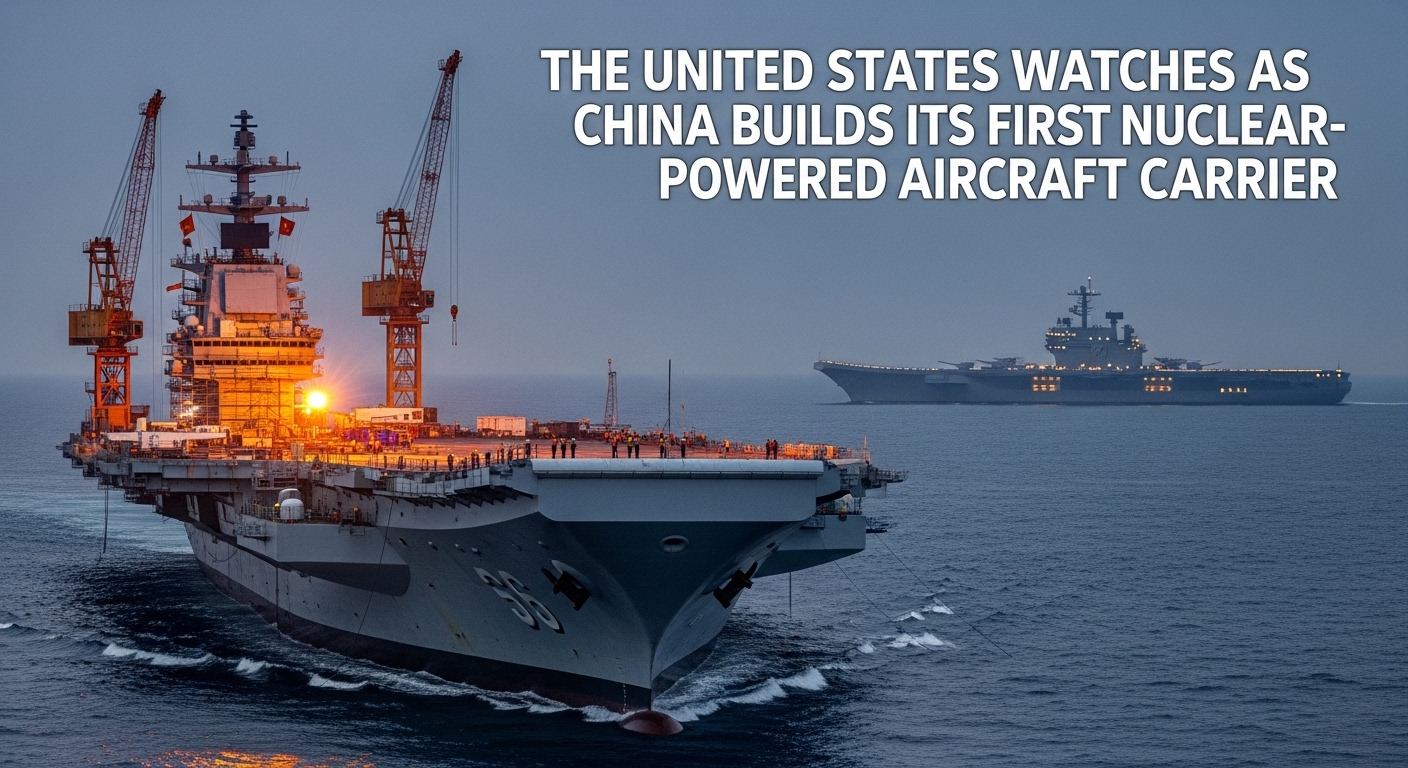
In early 2026, satellite imagery from shipyards in Dalian, China, triggered serious discussion inside the U.S. defense establishment. Analysts believe China is constructing what may become its first nuclear-powered aircraft carrier — a capability currently mastered primarily by the United States and France.
If confirmed, this would represent one of the most significant shifts in naval power in decades.
To understand why this matters, we must look at history, technology, strategy, and regional implications.
China’s Naval Rise: From Coastal Defense to Blue-Water Ambitions
For most of the 20th century, the People’s Liberation Army Navy (PLAN) focused on coastal defense. It lacked the infrastructure, doctrine, and industrial base for sustained global operations.
That began to change in the 2000s.
China commissioned:
- Liaoning (refitted Soviet hull)
- Shandong
- Fujian
The Fujian, launched in 2022, already marked a major step with electromagnetic catapults (EMALS-like system). But all three are conventionally powered.
A nuclear carrier would be different entirely.
Why Nuclear Propulsion Changes Everything
The U.S. Navy’s carrier dominance rests heavily on nuclear propulsion. Its Nimitz-class aircraft carrier and Gerald R. Ford-class aircraft carrier vessels are nuclear-powered.
Nuclear propulsion provides:
Virtually Unlimited Range
No need for refueling every few days.
Long Endurance
Ships can operate at sea for months.
Massive Power Generation
Critical for:
- Advanced radar
- Directed-energy weapons (future)
- Electronic warfare
- Electromagnetic catapults
The Physics Behind Nuclear Power at Sea
At its core, propulsion relies on energy conversion:E=mc2
This equation illustrates why nuclear reactions are so energy-dense. Even a tiny mass converted into energy produces enormous output. That’s why nuclear carriers can operate for decades on a single reactor core.
Compared to conventional fuel combustion, nuclear propulsion delivers vastly greater energy density.
Strategic Implications for the United States
The United States Navy operates 11 nuclear aircraft carriers. These are central to American global power projection.
If China fields even one operational nuclear carrier, it signals:
- Permanent blue-water navy status
- Sustained Pacific presence
- Greater reach into the Indian Ocean
- Potential operations beyond Asia
This affects U.S. alliances in:
- Japan
- Australia
- India
- Philippines
It also complicates U.S. force posture around Taiwan Strait.
The Taiwan Factor
The Taiwan scenario is central to U.S.–China military planning.
Aircraft carriers serve three purposes in such a crisis:
- Air superiority
- Sea control
- Power projection
A nuclear-powered Chinese carrier could:
- Maintain continuous operations near Taiwan
- Avoid dependence on vulnerable refueling ships
- Operate further east into the Pacific
That would challenge U.S. carrier strike groups traditionally deployed from bases in Guam and Japan.
Regional Arms Race Acceleration
Following China’s naval buildup:
Japan
Japan is upgrading the JS Izumo and JS Kaga to operate F-35B fighters.
India
India continues development around the INS Vikrant and long-term indigenous nuclear ambitions.
Australia
Australia’s AUKUS agreement includes nuclear-powered submarines.
This creates a feedback loop of deterrence and counter-deterrence.
The Technical Hurdles China Faces
Building a nuclear carrier is extremely difficult.
China must master:
- Naval reactor miniaturization
- Radiation shielding
- Complex ship integration
- Carrier aviation training
- Blue-water logistics
- Combat coordination
Operating a carrier is more than building it. It requires:
- Carrier strike group escorts
- Submarine protection
- Logistics chain
- Continuous pilot training
The U.S. has been refining this doctrine since World War II.
Cost and Industrial Capacity
A nuclear aircraft carrier costs between $10–15 billion (U.S. estimate). Beyond construction:
- Reactor development
- Maintenance infrastructure
- Specialized workforce
- Training pipeline
China’s state-led shipbuilding capacity gives it advantages in scale. But nuclear naval engineering remains among the most complex undertakings in defense technology.
Nuclear Risks and Environmental Concerns
Unlike nuclear weapons, naval reactors are designed for propulsion only.
Still, risks include:
- Reactor accidents
- Damage during combat
- Maintenance failures
- Environmental contamination
China has operated nuclear submarines, but a carrier-scale reactor is significantly larger and more complex.
Geopolitical Impact
If operational by the early 2030s, a Chinese nuclear carrier could:
- Normalize PLAN global deployments
- Expand presence in Africa and Middle East
- Influence South China Sea disputes
- Challenge U.S. Seventh Fleet dominance
The United States Navy would need to adapt force distribution.
This may involve:
- More distributed naval formations
- Increased submarine emphasis
- Greater unmanned systems integration
- Stronger alliances
Is This the End of U.S. Naval Supremacy?
Not immediately.
The U.S. still leads in:
- Carrier experience
- Global logistics network
- Combat-tested doctrine
- Allied integration
But the era of uncontested dominance may be fading.
Naval power historically shifts slowly — but when it shifts, it reshapes global order.
The Bigger Strategic Picture
This development is not just about a ship.
It represents:
- China’s ambition for maritime parity
- Transition from regional power to global competitor
- Structural change in Indo-Pacific security
The next decade could define:
- Whether deterrence holds
- Whether an arms race accelerates
- Whether diplomacy stabilizes competition
Final Assessment
China’s potential nuclear-powered carrier would:
- Enhance endurance and reach
- Strengthen strategic signaling
- Raise regional security anxiety
- Force U.S. strategic recalibration
However, operational capability matters more than construction.
Building a nuclear carrier is a milestone. Mastering carrier warfare is a generational endeavor.
The Pacific is entering a new strategic era — not of immediate conflict, but of intensified competition.
If you want, I can next analyze:
- A direct military comparison: U.S. vs China carrier strike groups
- A Taiwan conflict simulation scenario
- Or the economic sustainability of long-term naval competition