
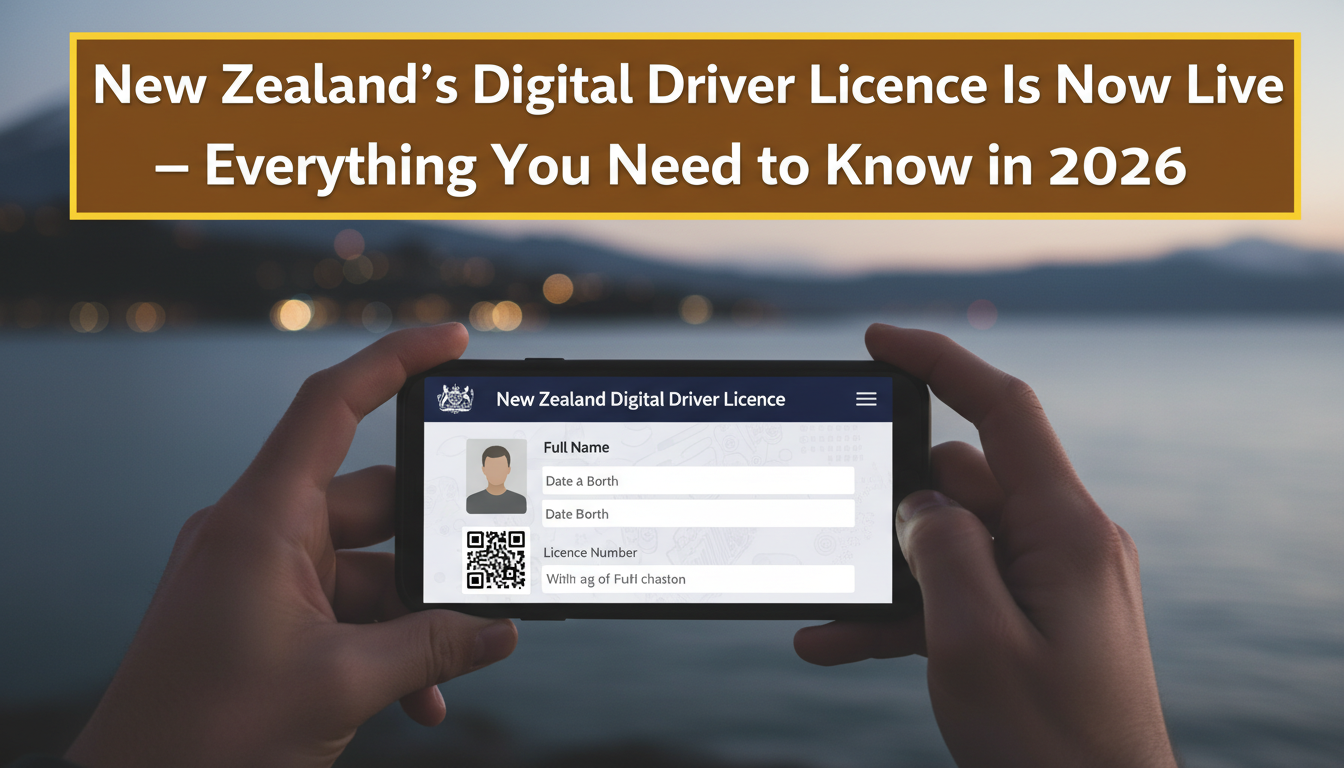
For as long as most Kiwis can remember, showing your driver’s licence has meant reaching for your wallet. That familiar routine is now officially a thing of the past. New Zealand has launched its digital driver licence system, allowing motorists across the country to carry and present their licence directly from their smartphone — no wallet required.
The rollout, managed by the New Zealand Transport Agency Waka Kotahi, represents one of the most significant updates to driver identification the country has seen in decades. It’s part of a broader push to modernise government services and bring New Zealand in line with the growing global trend toward digital identity.
Here’s what the change means for you, how the system works, and what you still need to know before leaving your physical card at home.
What Exactly Is the Digital Driver Licence?
Simply put, the digital driver licence is an officially recognised electronic version of your physical card. It carries the same legal standing as the plastic licence you’re used to carrying, under regulations that have been updated to accommodate this new format.
Through a government-approved app linked to Waka Kotahi’s systems, drivers can securely store their licence details on their smartphone and present them whenever required — whether that’s during a police traffic stop, at a licensed venue for age verification, or anywhere else an official form of ID is accepted.
The digital licence is not a static image or a screenshot of your card. It is a live, encrypted document that reflects your actual current licence status in real time. If your licence is suspended, expired, or has conditions applied to it, the digital version updates immediately to reflect that. This makes it far more accurate and tamper-resistant than a physical card that could be outdated or altered.
How Does It Actually Work?
Once the app is downloaded and your identity is verified through the setup process, your licence information is securely stored on your device using encryption. Biometric security — such as fingerprint or face recognition — is strongly encouraged to ensure only you can access and display your digital licence.
When you need to show your licence, you simply open the app and present your details or a scannable QR code. Officials and authorised venues can then verify the information instantly. Importantly, the system is designed to work even in areas with limited mobile coverage — offline display functionality is built in, so a lack of internet connection in a rural area won’t leave you stranded.
One important clarification: screenshots of the digital licence are not considered valid proof of identity. The licence must be displayed through the official app to be legally accepted.
Who Can Use It?
The digital driver licence is available to all holders of a valid New Zealand driver’s licence — including full licence holders, restricted licence holders, and learner drivers where applicable. The key requirement is simply that your licence must be current and active. If your physical licence has expired or been suspended, you will not be able to activate a valid digital version.
Switching to the digital licence is not mandatory. Physical cards remain perfectly valid and will continue to be issued through the normal process. The digital option is an addition to the existing system, not a replacement — at least for now.
Do You Still Need Your Physical Card?
Legally, if you have the approved digital version on your phone, you are no longer required to carry the physical plastic card. However, transport authorities and most driving experts are recommending that during this early rollout period, drivers keep both — just in case.
The most obvious risk is a dead phone battery or a damaged device. If your smartphone is unavailable for any reason during a traffic stop or ID check, you may still be asked to produce your physical licence. Until the digital system is fully embedded into everyday enforcement and verification processes, carrying both gives you a reliable safety net.
Physical Licence vs Digital Licence — A Quick Comparison
| Feature | Physical Licence | Digital Licence |
|---|---|---|
| Can be lost or stolen | Yes | No physical card to lose |
| Updates in real time | No | Yes — reflects status instantly |
| Requires a wallet | Yes | No — phone only |
| Security level | Basic card security | Advanced encryption + biometrics |
| Works without internet | Yes | Yes — offline display supported |
| Can be remotely disabled | No | Yes — if phone is lost or stolen |
What Happens If You’re Pulled Over by Police?
The process during a traffic stop is straightforward. When an officer asks to see your licence, you open the official digital licence app, navigate to your licence display, and either show the screen or allow the officer to scan the QR code for verification. The officer’s device can then confirm your details instantly through the real-time validation system.
The key thing to remember is that you must use the official app — not a photo, not a screenshot, and not a third-party app. Only the government-approved application generates a legally valid display that officers are authorised to accept.
What About Privacy?
Privacy concerns around any digital ID system are completely understandable, and Waka Kotahi has addressed them directly. According to the agency, data within the digital licence is encrypted and only the minimum necessary information is shown during a verification check. The app does not track your location during standard use, and you remain in control of when and to whom your licence is displayed.
That said, privacy advocates recommend that drivers take a few minutes to review the app’s permissions before activating the digital licence — as they would with any app that handles sensitive personal data. Understanding what data the app accesses, and under what circumstances, is good practice for protecting your digital identity.
If your phone is ever lost or stolen, access to your digital licence can be remotely disabled, preventing anyone else from using your credentials. This is a meaningful security advantage over a physical card, which offers no such protection once it leaves your hands.
Why Is New Zealand Making This Change?
The move to digital driver licences is part of a wider government strategy to modernise public services and reduce dependence on physical documents. Lost or stolen licences cost both individuals and the system time and money each year. Fraudulent physical licences, while not common, represent a genuine security vulnerability that digital encryption significantly reduces.
Waka Kotahi has pointed to the global trend toward digital identity as another driving factor. Countries and jurisdictions around the world — from the United States to parts of Europe and Australia — are introducing or expanding digital ID programmes. New Zealand’s rollout positions the country as a proactive participant in that shift rather than a late adopter.
For everyday drivers, the benefit is simple: one less thing to carry, and one less thing to lose.
What Drivers Around the Country Are Saying
Early reactions from New Zealand motorists have been broadly positive, though many are taking a cautious, wait-and-see approach. Auckland driver Sarah Thompson summed up the enthusiasm well, saying the change makes complete sense given how much of daily life — from payments to boarding passes — is already managed through smartphones.
Meanwhile, Christchurch motorist Liam O’Connor reflected the view of many older or more cautious drivers: welcoming the convenience in principle while planning to keep the physical card on hand until the system proves itself in everyday use. That kind of measured response is exactly what transport authorities expect during any major transition period.
Frequently Asked Questions
Is the digital licence legally valid?
Yes. Under updated New Zealand regulations, the digital driver licence holds the same legal status as the physical card.
Do I have to switch to the digital licence?
No. It’s optional. Your physical licence remains valid and will continue to be issued.
Is there a fee to activate the digital licence?
Activation is generally free. Standard licence fees for renewal or replacement still apply as usual.
Can bars and venues accept it as proof of age?
Yes, approved venues can verify your age and identity using the digital licence app.
What if I lose my phone?
You can remotely disable access to your digital licence to prevent misuse. Your physical licence remains valid in the meantime.
Can I use it overseas?
No. The digital driver licence is for use within New Zealand only.
What if I’m in a rural area with no signal?
The app includes offline display functionality, so you can show your licence without an active internet connection.
Is a screenshot of the digital licence valid?
No. Screenshots are not accepted. Only the live display through the official app is legally valid.
New Zealand’s digital driver licence rollout in 2026 is a genuine step forward — more secure, more convenient, and more reflective of how people actually live and move through daily life. For most drivers, activation will be quick, free, and immediately useful.
Physical licences aren’t going away anytime soon, and there’s no pressure to make the switch immediately. But for those who spend more time tapping their phone than reaching for their wallet, the digital licence is a natural and overdue evolution.
Your phone might just be the only thing you need to take on the road from here on out.