
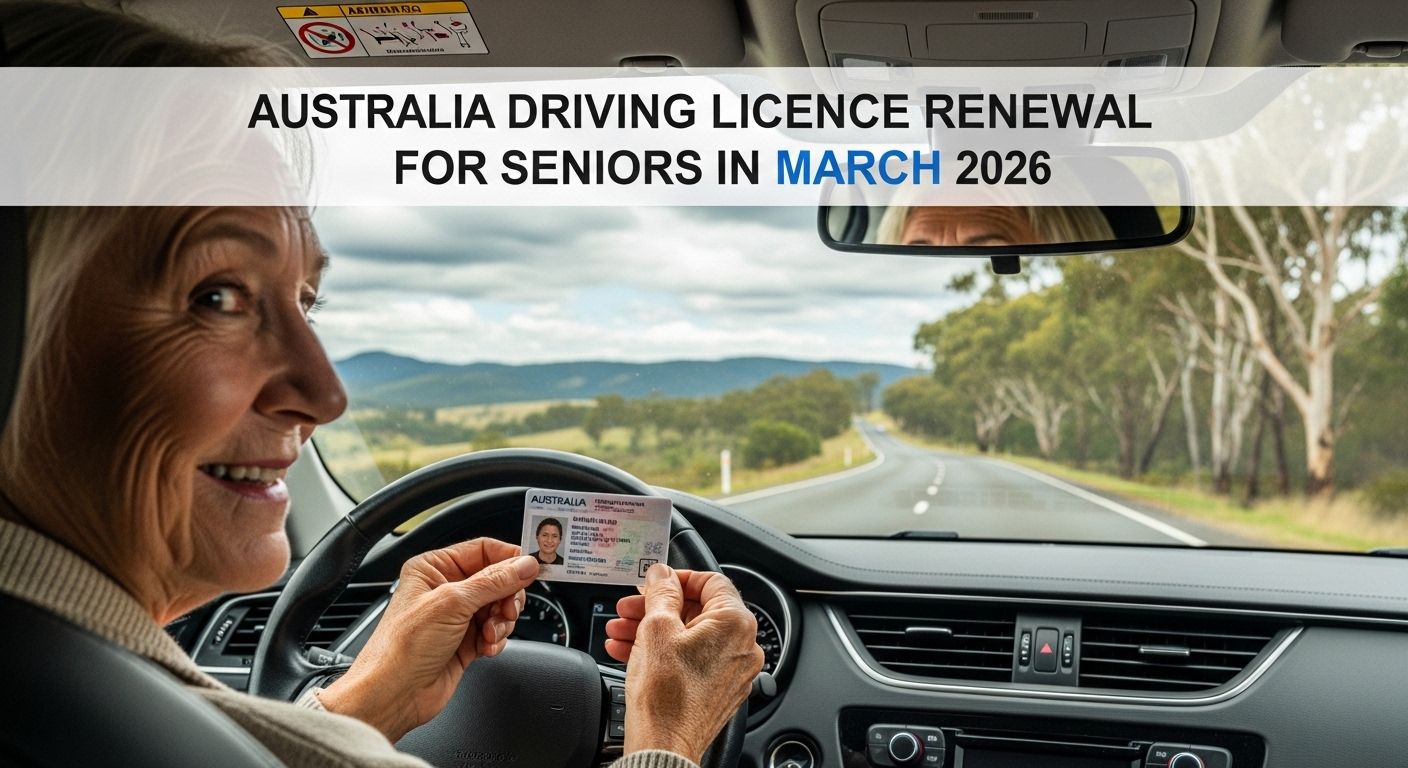
For 69-year-old Brisbane resident Helen Carter, her driver’s licence is about far more than getting from A to B. “I don’t want to rely on anyone for groceries or medical appointments,” she says. Driving is her independence, her routine, and her connection to daily life.
As she approached her renewal this year, she was not entirely sure what rules applied to drivers her age. She is far from alone in that uncertainty. Thousands of Australian seniors navigate the licence renewal process every year without a clear picture of what is actually required of them.
This guide covers everything drivers aged 65 and over need to know about Australia’s licence renewal rules in March 2026, from medical requirements and renewal periods to digital options and state-by-state differences.
Who Controls Driving Licence Rules in Australia?
Driver licensing in Australia is managed at the state and territory level, which is why the rules are not identical everywhere. The National Transport Commission provides national guidance, but each state sets and enforces its own specific requirements.
Depending on where you live, your licensing authority is one of the following.
- Transport for NSW in New South Wales
- VicRoads in Victoria
- Department of Transport and Main Roads in Queensland
- Department of Transport in Western Australia
- Other state and territory transport agencies in South Australia, Tasmania, the ACT, and the Northern Territory
Core road rules are consistent nationwide, but renewal periods, medical certificate requirements, and age thresholds vary. If you have moved interstate recently, it is worth checking the rules that apply in your current state rather than assuming they match where you lived before.
Does Turning 65 Automatically Change Your Licence Rules?
The short answer is: not dramatically, and not in most states. Turning 65 does not automatically trigger a medical assessment, a mandatory driving test, or a licence restriction in the majority of Australian jurisdictions.
What does begin to change around this age in some states is the renewal period. Some states start moving senior drivers toward shorter renewal cycles after 65, meaning you may need to renew more frequently than you did during your working years.
The key threshold for stricter medical requirements is typically 75, not 65. That is the age at which annual medical assessments, shorter licence validity periods, and in some cases on-road driving evaluations become a standard part of the renewal process across most states.
Policy analyst Michael Reeves puts it plainly. “The system is not about removing licences at 65. It is about ensuring ongoing capability as drivers age.”
Renewal Period Changes for Senior Drivers in 2026
The renewal cycle is the first practical change most senior drivers notice as they move through their sixties and into their seventies. Here is how it generally works across Australia in 2026.
Drivers under 75 can typically renew for 5 or 10 years depending on their state. Drivers who have reached 75 and over commonly move to annual renewals in most jurisdictions, with medical certification required as part of the process.
The table below gives a general overview of how requirements typically differ across age groups.
| Factor | Under 65 | Over 65 Typical |
|---|---|---|
| Renewal period | 5 to 10 years | 1 to 5 years, varies by state |
| Medical certificate | Not usually required | May be required from age 75 |
| Online renewal | Yes | Yes if no medical required |
| Mandatory driving test at 65 | No | No, state dependent after 75 |
These are general guidelines. Always check the specific rules with your state’s transport authority, as the exact ages and requirements differ between jurisdictions.
Medical Requirements: What to Expect as You Get Older
Medical fitness is the central principle behind senior driver licensing in Australia. The rules are not designed to take licences away from older people. They are designed to make sure that everyone on the road, regardless of age, is genuinely fit to drive safely.
Typical medical requirements that apply at various age thresholds include the following.
- A GP medical certificate, required in most states from around age 75 onward
- Vision testing to confirm adequate eyesight for safe driving
- Disclosure and reporting of relevant medical conditions including diabetes, heart conditions, and neurological disorders
- Specialist reports if your GP identifies conditions that require further assessment
One important point that applies at every age: Australian drivers are legally required to report medical conditions that could affect their ability to drive safely. This obligation exists regardless of whether you are 45 or 85. Failing to report a relevant condition can affect your insurance coverage and expose you to legal liability if an incident occurs.
A spokesperson for VicRoads has stated that the priority is road safety while maintaining independence for older Victorians who are medically fit to drive. That balance is the goal of the system across every state.
What Happens at Age 75 and Beyond?
Age 75 is the threshold where licence renewal becomes more structured in most Australian states. The specific requirements vary, but the general framework that applies to drivers aged 75 and over commonly includes the following.
- Annual licence renewal rather than multi-year renewals
- An annual medical assessment completed by a GP or specialist
- A possible on-road driving evaluation in specific cases where health or capability concerns are identified
- Shorter licence validity periods compared to younger drivers
John Matthews, 76, from Sydney, recently went through the renewal process for the first time under the annual assessment requirement. “I had to get a medical from my GP, but the process was straightforward,” he says. “It is reassuring to know I can still drive as long as I am fit.”
His experience reflects what most seniors report when they plan ahead. The process is manageable. The anxiety around it is usually worse than the reality.
Read More: https://onetreegrill.site
Digital Licences and Online Renewal in 2026
One of the most practical improvements in 2026 is the expanded availability of digital and online options for licence renewal. For seniors who are comfortable with technology, these updates reduce the need for in-person visits to service centres.
Most states now offer the following digital options.
- Online renewal applications through state transport authority portals
- SMS and email reminders sent before your licence expiry date
- Optional digital driver licences accessible through official state apps on smartphones
- Online medical declaration submissions in some jurisdictions
For seniors who prefer face-to-face service, in-person renewal at a transport service centre remains fully available in every state. Digital options are an addition to the existing system, not a replacement for it.
If you have not already set up renewal reminders through your state’s transport authority portal, it takes less than five minutes and removes the risk of accidentally letting your licence lapse.
Why Accidental Licence Expiry Is a Serious Risk
Letting your licence expire, even by accident, carries real consequences that many seniors do not fully appreciate until it happens to them. Driving on an expired licence is treated as driving unlicensed in every Australian state, which can result in fines, demerit points, and in some cases vehicle impoundment.
Depending on how long the licence has been expired, you may need to reapply rather than simply renew, which can involve additional testing requirements. Insurance coverage may also be affected, meaning an accident on an expired licence could leave you without cover.
Setting a calendar reminder for 60 to 90 days before your expiry date gives you enough time to book any required medical appointments, complete paperwork, and process the renewal without stress or last-minute rushing.
The Science Behind Senior Driver Safety Rules
The rules for senior drivers are not based on age prejudice. They are based on transport safety research that looks honestly at where crash risks actually come from across different driver demographics.
The research picture is nuanced. Older drivers are generally significantly safer than younger drivers when it comes to risk-taking behaviour. Speeding, aggressive driving, drink driving, and distraction-related incidents are far more common in younger age groups.
However, certain age-related health changes can affect driving capability in ways that are not always obvious to the driver themselves. Slower reaction times in complex or unexpected traffic situations, reduced peripheral vision, and the effects of medications on concentration are all factors that the medical assessment process is designed to identify.
The goal of the system is not to catch people out. The goal is to support safe driving for as long as possible while making sure the roads are safe for everyone, including the senior drivers themselves.
State-by-State Overview: Key Differences to Know
Because licensing is state-managed, the details differ across jurisdictions in ways that matter practically. Here is a general overview of the key differences seniors should be aware of in 2026.
In New South Wales, drivers aged 75 and over must complete annual medical assessments. Drivers aged 85 and over must also complete an on-road driving assessment as part of renewal.
In Victoria, VicRoads requires medical reports for drivers with certain conditions and has a structured assessment process for drivers where health concerns are identified by a GP.
In Queensland, the Department of Transport and Main Roads applies increasing medical assessment requirements from age 75, with annual renewal cycles for older drivers.
In Western Australia, drivers aged 80 and over face stricter medical and potential practical assessment requirements as part of the renewal process.
For every state, the authoritative source is always the relevant state transport authority website. Rules change periodically and the details matter, so checking directly is always worth the five minutes it takes.
Defensive Driving Refresher Courses: Worth Considering
A practical option that many senior drivers overlook is a defensive driving refresher course. These are not tests and they are not mandatory. They are voluntary programs that help drivers update their skills, build confidence, and identify any habits that may have developed over years of driving.
Several programs specifically designed for senior drivers are available across Australia, often offered through NRMA, RAA, RACQ, and similar motoring organisations in their respective states. Many are low-cost or free for members.
Helen Carter in Brisbane has already looked into a refresher course after her renewal experience this year. “I figured it could only help,” she says. “If anything, it made me more confident that I am still a safe driver.”
What Senior Drivers Should Do Right Now
Whether your renewal is six months away or two years away, taking a few practical steps now removes the stress and risk of being caught unprepared.
- Check your current licence expiry date immediately if you are not sure when it falls
- Confirm the specific renewal requirements that apply in your state for your age group
- Book a GP appointment early if you are approaching 75 or will need a medical certificate for your next renewal
- Make sure your contact details are current with your state transport authority so renewal reminders reach you
- Consider signing up for a defensive driving refresher course through your state motoring organisation
- Explore online renewal and digital licence options if you are comfortable with technology
Planning two to three months ahead is enough time to manage every step of the process comfortably, even if a medical assessment is involved.
Frequently Asked Questions About Senior Licence Renewal in Australia 2026
Q1. Do I automatically lose my driving licence when I turn 65 in Australia? No. Turning 65 does not automatically trigger licence cancellation or major restrictions in any Australian state. The focus is on medical fitness, not age alone.
Q2. Is a medical certificate required at age 65? Not in most states. Medical certificate requirements typically begin from age 75, though this varies by jurisdiction. Check with your specific state transport authority.
Q3. Can I renew my licence online if I am over 65? Yes, if no medical certificate is required as part of your renewal. Most states offer online renewal for eligible drivers. If a medical assessment is required, you will need to complete that separately before finalising your renewal.
Q4. Is there a mandatory driving test when you turn 65? No automatic driving test applies at age 65 in any Australian state. On-road assessments may become part of the renewal process in specific circumstances at older ages, typically 85 and above in some states.
Q5. What changes at age 75 for Australian drivers? In most states, turning 75 triggers annual medical assessment requirements and a move to shorter licence renewal cycles. The specific requirements vary by state.
Q6. Can my GP effectively cancel my driving licence? GPs cannot cancel a licence directly, but they are legally required to report conditions that could affect driving safety to the relevant transport authority. The licensing authority then makes the decision about any licence conditions or cancellation.
Q7. Are licence renewal fees higher for senior drivers? Fees vary by state but are generally consistent across age groups. Check your state transport authority website for current fee schedules.
Q8. What if I develop a medical condition between renewals? You are legally required to report any medical condition that could affect your ability to drive safely, regardless of when your next renewal falls. This obligation applies at all ages.
Q9. Can I appeal if my licence is restricted or cancelled? Yes. Every state has a review or appeal process for licence decisions. Your state transport authority can provide details on how to initiate a review.
Q10. Are digital driver licences mandatory for seniors? No. Digital licences are entirely optional in every Australian state. Physical licences remain fully valid and in-person service at transport centres continues to be available.
Q11. What happens if my licence expires accidentally? Driving on an expired licence is treated as driving unlicensed and can result in fines and other penalties. Depending on how long it has been expired, you may need to reapply rather than simply renew. Act immediately if you discover your licence has lapsed.
Q12. Do rural and regional seniors face different rules? The core licence rules are the same nationwide, but access to GP services and transport service centres may be more limited in regional areas. Planning ahead is especially important for rural drivers who need medical assessments.
Q13. Does age affect car insurance independently of licence rules? Yes. Insurance premiums and policy conditions are set independently by insurers and are not directly tied to licensing rules. Speak with your insurer about how your age may affect your coverage.
Q14. Are there driving programs specifically for senior drivers in Australia? Yes. Several state motoring organisations including NRMA, RACQ, and RAA offer refresher and assessment programs designed specifically for senior drivers. Many are low cost or free for members.
Q15. Where can I find the official rules that apply in my specific state? Always check directly with your state transport authority. In NSW that is Transport for NSW, in Victoria it is VicRoads, in Queensland it is the Department of Transport and Main Roads, and in WA it is the Department of Transport.
For Helen Carter in Brisbane and the hundreds of thousands of Australians over 65 who depend on their licence for daily independence, the message from March 2026 is clear and reassuring.
Turning 65 does not mean giving up the keys. The system is built around fitness to drive, not age as an arbitrary cutoff. Medical assessments exist to support safe driving for as long as possible, not to take licences away from capable drivers who simply happen to be older.
Plan ahead, know your state’s specific rules, book your GP appointment early if you need one, and use the digital tools available to make the process as smooth as possible. Your independence on the road is worth protecting, and the system in 2026 is designed to help you do exactly that.