
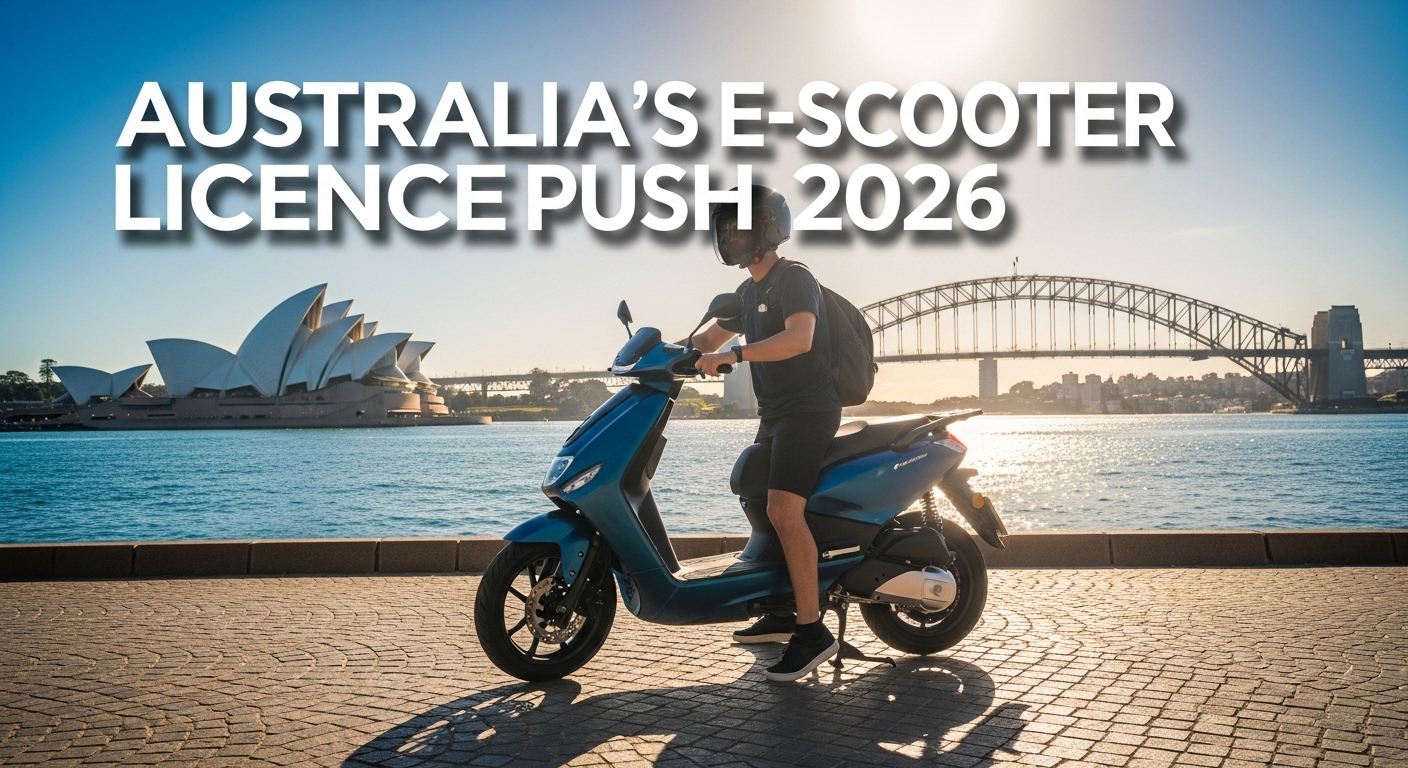
On a busy Sydney waterfront path, 19-year-old university student Liam Chen swerved hard to avoid a pedestrian and nearly did not make it. “I didn’t even realise there were different rules for e-scooters,” he admitted afterwards. “You just hop on and go.”
That combination of rapid uptake, limited awareness, and inconsistent rules across states is exactly what is driving a serious national policy conversation in 2026. Australian policymakers are now actively considering mandatory licensing or permit requirements for electric scooter riders, and the outcome could reshape how millions of Australians use one of the fastest-growing forms of urban transport.
Here is what is being proposed, why it is happening now, and what it could mean for you.
What Is Actually Being Proposed
No single federal law governs e-scooters in Australia. That patchwork of state-by-state rules is a large part of the problem, and it is what is driving calls for coordinated national reform.
Transport ministers from several states have raised formal concerns about rising injury rates and the confusion created by rules that change as soon as a rider crosses a state border. The reforms being discussed are significant in scope.
Key proposals currently under consideration include:
- Introduction of a mandatory e-scooter permit or licence for riders above a certain age.
- A minimum age increase from 16 to 18 in some jurisdictions.
- Compulsory online safety training or a short theory assessment.
- Tighter speed limits specifically in pedestrian-heavy CBD zones.
- Nationally consistent helmet requirements and possible compulsory insurance.
Nothing has been legislated yet. But the consultations are active, the injury data is compelling, and the political appetite for action is stronger in 2026 than it has been at any previous point in the e-scooter era.
Why This Is Happening Now
The timing of the policy push is not arbitrary. The numbers behind it are moving in a direction that demands a response.
Australian Bureau of Statistics data shows hospital admissions related to personal mobility devices have increased steadily over recent years. State transport authorities report a rise in emergency department presentations linked to e-scooter accidents, increasing pedestrian complaints in CBD areas, and persistent confusion among riders about where e-scooters can legally operate.
A spokesperson from Transport for NSW was direct about the challenge: “We are seeing strong growth in e-scooter use, particularly among young adults.” The environmental and congestion benefits are acknowledged, but safety, the spokesperson said, must remain the priority.
The fundamental tension is that e-scooters scaled faster than regulation. Hire schemes launched, private ownership exploded, and the rule books simply did not keep pace. The 2026 policy push is an attempt to close that gap before the injury statistics get worse.
How the Rules Currently Differ State by State
The current framework is a genuinely confusing picture. A rider who is fully compliant in Queensland may be breaking the law in New South Wales simply by crossing the border.
Some states allow private e-scooters on roads with speed caps applied. Others restrict use to shared paths or designated trial zones only. Speed limits typically range between 20 and 25 km/h depending on the jurisdiction, though enforcement varies considerably. Helmet use is mandatory nationwide, but how strictly that requirement is enforced on the ground differs between states.
This lack of uniformity is the central argument for a national framework comparable to driver licensing standards, which apply consistently regardless of which state a driver is in.
The Real People Behind the Debate
The policy discussion is not abstract. Real people are affected on both sides of the argument, and their experiences illustrate why this is not a simple problem with a simple solution.
Brisbane pedestrian advocate Helen Morris describes the footpath environment in high-density areas as chaotic. “You’ve got scooters moving faster than bikes in some areas,” she says. “There needs to be accountability.” Her concern is shared by older pedestrians, parents with young children, and people with mobility impairments who find shared paths increasingly difficult to navigate safely.
The counter-argument comes from riders like Aaron Patel, a delivery worker in Melbourne who relies on his e-scooter as affordable work transport. “For some of us, scooters are affordable transport,” he says. “If you add fees and tests, it could make it harder to earn a living.” For gig economy workers, any additional compliance cost or barrier to access has direct financial consequences that extend beyond inconvenience.
Both perspectives are legitimate, and any workable policy will need to account for both.
Read More: https://onetreegrill.site
What the Rules Could Look Like: Before and After
| Rule Area | Current Framework | Proposed Changes |
|---|---|---|
| Licensing | No licence required | Permit or theory test required |
| Minimum age | 16 in many states | Possible increase to 18 |
| Speed limit | 20 to 25 km/h | Lower limits in CBD pedestrian zones |
| Insurance | Not mandatory in most states | Possible compulsory third-party cover |
| Enforcement | State-based fines, varied | Nationally consistent penalties |
If adopted, changes are expected to be phased in gradually during late 2026 or into 2027, rather than taking effect immediately on a single date.
The Government’s Position
Officials from Infrastructure Australia have framed the situation in terms of a broader transport transition. “With micromobility expanding rapidly, consistent safety standards are essential,” one policy adviser noted, describing licensing as one option among several being evaluated.
Not everyone in government is convinced that licensing is the right answer. Some state leaders are cautioning against overregulation, pointing out that bicycles do not require licences despite serving similar transport functions and operating in similar environments. The bicycle comparison is one that licence sceptics return to frequently.
The government’s challenge is to design a response that meaningfully reduces injury rates without creating so much regulatory friction that it drives riders off e-scooters and into cars, which would defeat the environmental and congestion arguments that made the vehicles attractive in the first place.
Would Licensing Actually Make E-Scooters Safer?
This is the question that divides transport safety researchers most sharply, and the honest answer is that the evidence is genuinely mixed.
Arguments in favour of licensing are reasonable. A permit system could ensure that riders at least know the road rules before operating a vehicle in shared public spaces. Training requirements might reduce the specific category of collisions involving riders who simply did not know what they were supposed to do. Registration could improve accountability in hit-and-run incidents, which currently involve vehicles that are virtually impossible to trace after the event.
Arguments against are equally reasonable. Administrative costs can be substantial relative to the safety benefit achieved. Enforcement is genuinely difficult, particularly for private scooters. Licensing requirements can discourage use of eco-friendly transport alternatives in ways that produce unintended consequences for congestion and emissions.
Dr. Melissa Grant, a transport safety researcher, offered a perspective that aligns with comparable international evidence: “Education campaigns often improve compliance more effectively than strict licensing systems.” The implication is that mandatory safety information, delivered at the point of purchase or hire, might achieve more than a permit system with its associated costs and barriers.
What It Would Mean for Riders If Licensing Passes
If a mandatory permit or licence requirement is introduced, the compliance process is expected to be simpler than a standard driver’s licence but still involves real steps that riders would need to complete.
The likely requirements would include:
- Completing an online safety module covering road rules, shared path behaviour, and intersection procedures.
- Passing a short theory assessment based on that material.
- Paying a small administrative fee to register the permit.
- Carrying proof of compliance, which could be digital or physical, when riding.
For young riders, a minimum age increase to 18 in certain jurisdictions would be a more significant change than the permit process itself. A 16-year-old who currently rides legally in their state could find themselves excluded from e-scooter use if the age floor rises.
What It Would Mean for Drivers and Pedestrians
For motorists, clearer e-scooter integration into road rules could reduce the ambiguity that currently exists at intersections and merge points. Knowing what an e-scooter rider is supposed to do, and having some confidence that they know it too, makes the shared road environment more predictable.
Pedestrians in shared zones could benefit from lower enforced speeds, more consistent compliance with footpath rules, and a reduction in the faster-than-expected approach speeds that create most near-miss incidents on pedestrian paths.
The complication, which critics are right to raise, is that pushing e-scooters off footpaths without a corresponding expansion of protected bike lanes simply moves the conflict to roads where risks can be higher rather than eliminating it. Infrastructure investment needs to accompany regulatory change for the overall outcome to be genuinely safer.
What to Do Right Now If You Ride an E-Scooter
Current rules remain in place until any changes are officially announced and legislated. There is no reason to stop riding, but there are practical steps every rider should take now.
- Check your specific state’s current e-scooter rules, as they vary and are updated periodically.
- Always wear a helmet. It is already mandatory nationwide and remains the single most effective safety measure available.
- Respect speed limits in shared zones, particularly in areas with high pedestrian traffic.
- Monitor official state transport authority announcements for updates on licensing proposals as consultations progress.
- Consider taking out voluntary insurance coverage even though it is not yet required in most jurisdictions. If you are involved in an incident, the financial exposure without insurance can be significant.
For parents of teenage riders, the potential minimum age increase from 16 to 18 is the development most worth monitoring. If that change passes, it would affect access immediately for riders in that age bracket.
Frequently Asked Questions
1. Is an e-scooter licence required in Australia right now? No. Currently no Australian state requires a specific licence for private e-scooter use. The proposals under discussion have not yet been legislated.
2. When could licensing become mandatory? If approved through state or national consultations, changes could roll out in late 2026 or into 2027. The timeline depends on how quickly policy decisions are made and how implementation is structured.
3. Would the e-scooter licence be like a standard driver’s licence? No. Proposals suggest a simplified permit or theory-based certification, significantly less involved than a full driving licence, likely completed online rather than requiring a practical test.
4. Will the minimum riding age change? Some states are actively considering raising the minimum age from 16 to 18. This has not been confirmed, but it is a live part of the policy discussion.
5. Are helmets already mandatory for e-scooter riders? Yes. Helmet use is required nationwide, though enforcement intensity varies between states and local areas.
6. Would insurance become compulsory? It is under consideration as part of the reforms. It is not currently mandatory in most jurisdictions, but compulsory third-party insurance is one of the proposals being evaluated.
7. Do shared hire e-scooters operate under different rules than private ones? Yes. Hire scooters typically operate under trial permits and local council agreements that include specific operating zones, speed limits, and parking requirements. Rules for hire schemes are generally more tightly defined than for private e-scooter ownership.
8. How fast can e-scooters legally go in Australia? Currently between 20 and 25 km/h depending on the state and the specific area being ridden in. Proposed changes would lower limits in CBD and pedestrian-heavy zones specifically.
9. Why is the government reviewing these laws now rather than earlier? Rising injury rates and the inconsistency between state regulations have created pressure that has been building for several years. The injury data in 2026 has crossed a threshold that makes maintaining the status quo politically difficult for transport ministers.
10. Would licensing actually reduce e-scooter accidents? Experts disagree on this. Some research supports licensing as effective, while other evidence suggests education campaigns at point of sale or hire are more cost-effective. The international data is mixed and context-dependent.
11. Could fines for e-scooter offences increase? Yes. National consistency in penalties is part of the discussion, and consistency typically means alignment upward toward the stricter state standards rather than downward toward more lenient ones.
12. Are bicycles affected by any of these proposals? No. The current discussions focus specifically on electric scooters. Bicycles are explicitly not part of the licensing conversation, which is a point that some reform sceptics use to question the consistency of the policy rationale.
13. Could licensing requirements affect delivery workers who use e-scooters? Yes, potentially significantly. Additional compliance costs and age-related access restrictions could create real barriers for gig economy workers who rely on e-scooters as affordable work transport. This concern is recognised in the consultation process.
14. How can members of the public provide feedback on the proposals? State transport authorities are conducting public consultations and inviting submissions. Check your state’s transport department website for specific submission processes and deadlines.
15. Should current e-scooter riders stop riding while consultations are underway? No. Current rules remain in place until any changes are officially announced, legislated, and given a commencement date. Riding legally under current rules is appropriate while the policy process runs its course.