
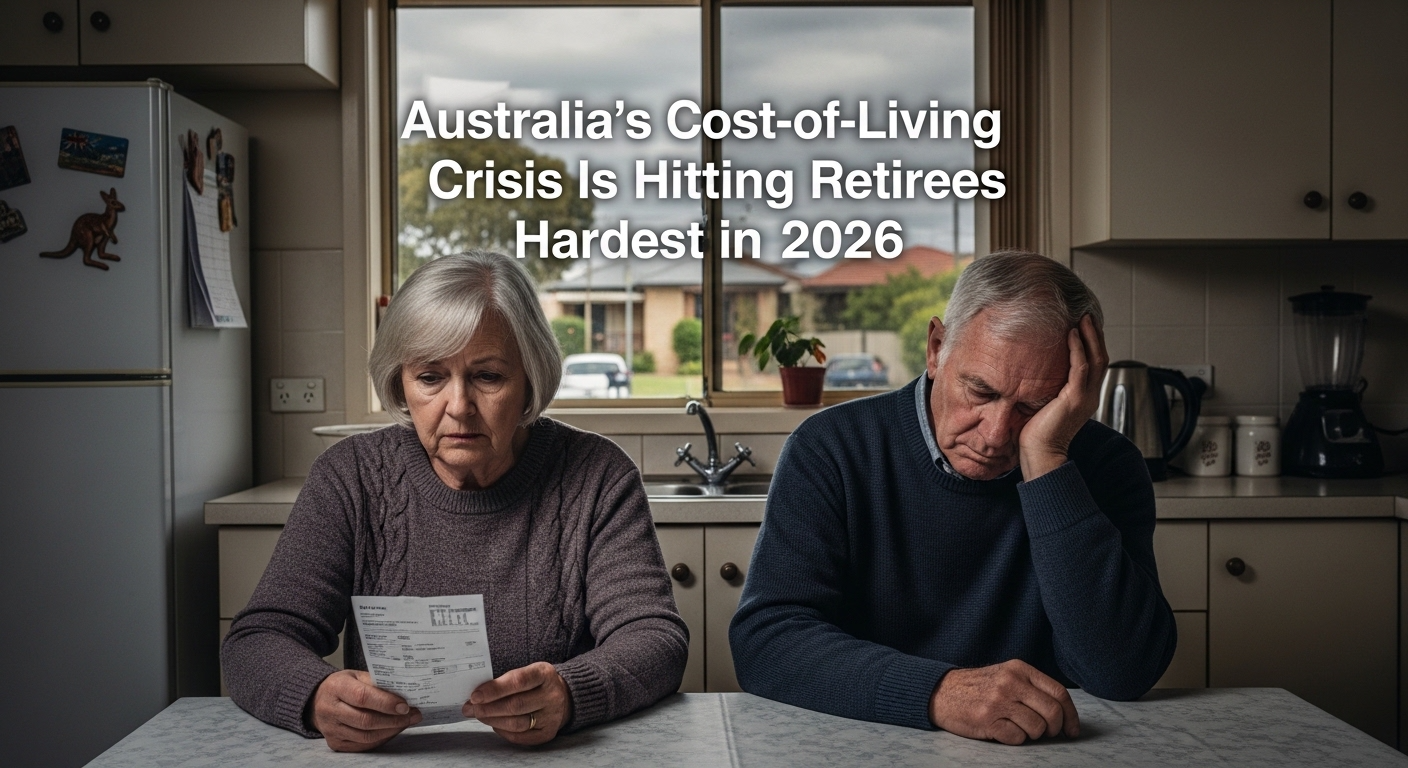
Margaret Collins never imagined she would be counting coins at the supermarket checkout at 72. The Brisbane grandmother lives on the Age Pension, and her weekly grocery bill has climbed so sharply in 2026 that fresh berries and branded cereal have quietly disappeared from her trolley.
“You work all your life and think retirement will be stable,” she says. “But every month feels tighter than the last.”
Across Australia, retirees are absorbing the sustained impact of a cost-of-living crisis that has not resolved as quickly as many economists predicted. Inflation has eased from its earlier peak, but the prices that matter most to pensioners, food, power, insurance, rent, and healthcare, remain significantly higher than they were just a few years ago.
Why 2026 Is Still So Difficult for Pensioners
The cost-of-living crisis did not begin in 2026, but many of its effects are proving stubbornly persistent well into this year. Several economic forces are converging to maintain pressure on older Australians living on fixed incomes.
Essential services, the categories that make up the bulk of a retiree’s spending, have increased at a faster rate than discretionary spending. This is the key asymmetry that makes the current environment particularly hard for pensioners. A fall in the price of clothing or entertainment does not help someone whose budget is dominated by power bills and prescription costs.
Independent economist Dr. Helen Murray explains the dynamic precisely: “Even if inflation slows overall, retirees don’t necessarily benefit if the categories they spend most on remain expensive.” That is the situation many older Australians find themselves in right now.
The Five Cost Pressures Hitting Retirees the Hardest
Understanding where the financial pain is concentrated helps in finding the most effective responses. Five categories are doing most of the damage to retiree budgets in 2026.
Groceries remain elevated well above pre-crisis levels despite some cooling in the headline inflation rate. The specific items that pensioners depend on most, fresh produce, dairy, and basic proteins, have not returned to where they were.
Electricity and gas prices have stabilised compared to the peak, but they remain significantly higher than they were two or three years ago. For older Australians, heating in winter and cooling in summer are not optional expenditures. They are health necessities, which makes energy costs a particularly acute pressure.
Home and contents insurance premiums have risen sharply, particularly in areas with elevated natural disaster risk. Many retirees are seeing annual premium increases that outpace their pension indexation by a considerable margin.
Rental costs in capital cities continue to rise, and the impact on retired renters is severe. Unlike working households that can increase earnings, pensioners renting in major cities have no mechanism for expanding their income to match rent increases.
Healthcare out-of-pocket costs, including dental, specialist appointments, and some prescription costs, have grown noticeably. Public health covers the basics, but the gaps are wide enough that ageing Australians face real costs that compound over time.
Why Retirees Cannot Simply Absorb These Increases
Workers facing cost-of-living pressure have options that retirees do not. They can seek a pay rise, take on overtime, change employers, or add a second income stream. None of those mechanisms are readily available to someone living on a fixed pension.
The Age Pension is indexed twice per year to account for cost-of-living changes. But indexation adjustments lag behind real-time price movements, which means there are extended periods where pension recipients are absorbing higher costs before any compensating payment increase arrives.
For retirees with limited superannuation balances or savings beyond their pension, there is no buffer to absorb the gap. Unexpected expenses such as a dental emergency or a car repair can derail a carefully managed budget in ways that take months to recover from.
Real Stories: How Pensioners Are Actually Managing
Peter Lawson, 69, from regional Victoria, describes the practical reality of managing on a fixed income when energy costs rise. His electricity bill increased by nearly 20 percent compared to two years ago.
“We don’t live extravagantly,” he says. “But heating the house in winter is non-negotiable at our age.” Peter and his wife now plan grocery trips around discount announcements and track government rebate timelines. “We’ve never been this careful,” he adds.
The hardest situation belongs to retirees who are renting. Susan Ahmed, 74, rents a small unit in Sydney’s western suburbs. Her rent increased twice in 18 months. “If it goes up again, I don’t know what I’ll cut next,” she says. “There’s nothing left to trim.”
Housing experts have identified older renters as one of the fastest-growing financially vulnerable groups in Australia, a population that receives less policy attention than it warrants given the scale of the problem.
Read More: https://onetreegrill.site
Where Retiree Spending Actually Goes
Understanding the spending structure of a retired household explains why cost increases hit so hard. The numbers are stark when you look at what proportion of income goes to non-negotiable expenses.
| Expense Category | 2024 Situation | 2026 Situation |
|---|---|---|
| Electricity | Rising sharply | Stabilised but still elevated |
| Groceries | Peak inflation | Prices remain well above pre-crisis levels |
| Rent | Rapid increases | Continued upward pressure in most cities |
| Insurance | Moderate growth | Significant premium increases |
| Healthcare | Gradual rise | Noticeable out-of-pocket cost growth |
Around 40 to 50 percent of a retiree’s income typically goes to housing and utilities alone. Groceries account for another substantial portion. Healthcare costs rise progressively with age. The margin for discretionary spending is thin, which means that when essential categories rise, there is almost nowhere to cut without affecting wellbeing.
What the Government Has Done in 2026
The federal government has introduced several measures aimed at easing cost pressures for older Australians. A spokesperson for the Social Services portfolio acknowledged the pressure: “We recognise the pressure many retirees are under and have taken steps to ensure pension payments keep pace with living costs.”
Those steps include:
- Indexation increases to the Age Pension, applied twice yearly.
- Energy bill relief rebates for eligible households, including pensioners.
- Adjustments to Commonwealth Rent Assistance for eligible renters.
- Expanded bulk billing incentives designed to reduce GP out-of-pocket costs.
Advocacy groups broadly welcome these measures but consistently note that the support, while meaningful, does not fully offset the real-world price increases pensioners are experiencing in their daily lives.
The gap between what indexation provides and what actual price increases demand is the core policy challenge that remains unresolved in 2026.
What Retirees Can Actually Do Right Now
Knowing the problem is real helps, but practical action is what makes the difference for a household trying to manage on a fixed income. There are several steps worth taking now.
Review your entitlements thoroughly. Many retirees are not receiving all of the support they are eligible for. This includes the full or part Age Pension if income and asset thresholds are met, Commonwealth Rent Assistance for renters, federal and state-based energy relief rebates, state concession cards covering transport and utilities, and community health and dental subsidies in some states. Even small supplements compound meaningfully over a full year.
Reassess your household budget category by category. Recurring costs like insurance policies, internet plans, and phone contracts are often negotiable or switchable to cheaper providers. Staying with the same insurer or telco out of habit often costs more than a brief comparison and phone call would resolve.
Seek community support without hesitation. Local councils and community organisations often provide food assistance, utility hardship programmes, and financial counselling that many eligible pensioners do not access because they are unaware of it or reluctant to ask. These services exist precisely for this situation.
Consider speaking with a financial adviser about whether your superannuation drawdown strategy or asset structure could be adjusted to improve your eligibility for pension supplements. Small structural changes sometimes unlock entitlements that meaningfully improve monthly cash flow.
Is Relief Coming?
Some economists project modest economic stabilisation in the second half of 2026, but the structural factors that are keeping essential costs high are not resolving quickly.
Housing shortages continue to sustain rental price pressure across capital cities. Global energy markets remain volatile. Healthcare demand from an ageing population continues to grow. These are not short-term cyclical pressures that ease with the next quarterly inflation figure.
Australia’s demographic trajectory makes the issue more urgent with each passing year. By 2030, a significantly larger share of the population will be over 65, increasing reliance on government support systems and placing greater weight on the adequacy of Age Pension settings.
Without sustained policy reform that addresses both pension adequacy and the structural costs of housing and energy, the financial stress that Margaret, Peter, and Susan are experiencing in 2026 is likely to be felt by more Australians in the years ahead, not fewer.
Frequently Asked Questions
1. Why are retirees more affected by the cost-of-living crisis than working Australians? Because they live on fixed incomes that cannot be increased through work, and because they spend a larger proportion of their income on essential categories like groceries, energy, and healthcare, which have risen faster than discretionary spending.
2. Has the Age Pension actually increased in 2026? Yes. The Age Pension is indexed twice per year to reflect living cost changes. However, advocacy groups note that indexation adjustments may lag behind real-time price increases, creating periods of financial strain between adjustments.
3. Are energy rebates still available to pensioners in 2026? Yes. Federal and state-based energy relief programmes are available for eligible households, including pensioners. Check your state’s energy authority website and Services Australia for current eligibility and application details.
4. What support is available for pensioners who are renting? Eligible renters may qualify for Commonwealth Rent Assistance in addition to their Age Pension. However, housing advocates note that the assistance has not kept pace with the scale of rent increases in major cities.
5. Are grocery prices still rising in 2026? While the rate of increase has slowed, many grocery prices remain significantly higher than pre-crisis levels. Pensioners who depend heavily on fresh food and basic staples are particularly affected.
6. Can a retiree work part-time to offset cost-of-living pressure? Yes, but income from part-time work can affect Age Pension entitlements under the income test. Services Australia can provide advice on how different income levels affect pension payments before you commit to any work arrangement.
7. How are healthcare costs affecting retirees specifically? Out-of-pocket costs for dental treatment, specialist appointments, and some prescription medicines have risen in many regions. Public health coverage addresses the basics but leaves gaps that many older Australians are finding increasingly difficult to absorb.
8. What support exists beyond the Age Pension itself? Key supplements include concession cards, Commonwealth Rent Assistance, energy supplements, and remote area allowances where applicable. Many pensioners are eligible for multiple forms of support and may not be receiving all of them.
9. How often is the Age Pension reviewed and adjusted? Twice per year, typically in March and September, based on movements in the Consumer Price Index and the Pensioner and Beneficiary Living Cost Index.
10. Is home ownership protective against cost-of-living pressure? Partially. Owning a home removes rent pressure, which is significant. But home owners still face rising utility costs, insurance premiums, council rates, and home maintenance expenses, all of which have increased substantially.
11. Are insurance premiums rising everywhere or only in certain areas? Premiums have risen broadly, but areas with higher natural disaster risk exposure, including flood plains, bushfire-prone regions, and some coastal areas, have seen the most significant increases.
12. What should someone approaching retirement plan for in this environment? Budget for higher-than-expected essential costs, maintain an emergency buffer separate from superannuation, review all available entitlements before retiring, and consider speaking with a financial adviser about how asset structure affects pension eligibility.
13. Are policy reforms expected to address retiree cost pressures? Advocacy groups are calling for reforms to pension adequacy, housing policy, and energy cost relief. Policy debates are active but no comprehensive reform package has been confirmed as of early 2026.
14. Where can pensioners seek immediate help if they are struggling financially? Services Australia is the primary contact for information about pension entitlements and supplements. Financial counselling is available free of charge through the National Debt Helpline. Local councils and community organisations often provide food assistance and utility hardship support.
15. Is the cost-of-living situation expected to improve later in 2026? Some economists project modest stabilisation, but structural cost pressures in housing, energy, and healthcare are unlikely to resolve quickly. Retirees are advised to plan for sustained elevated costs rather than assume a near-term return to pre-crisis price levels.