
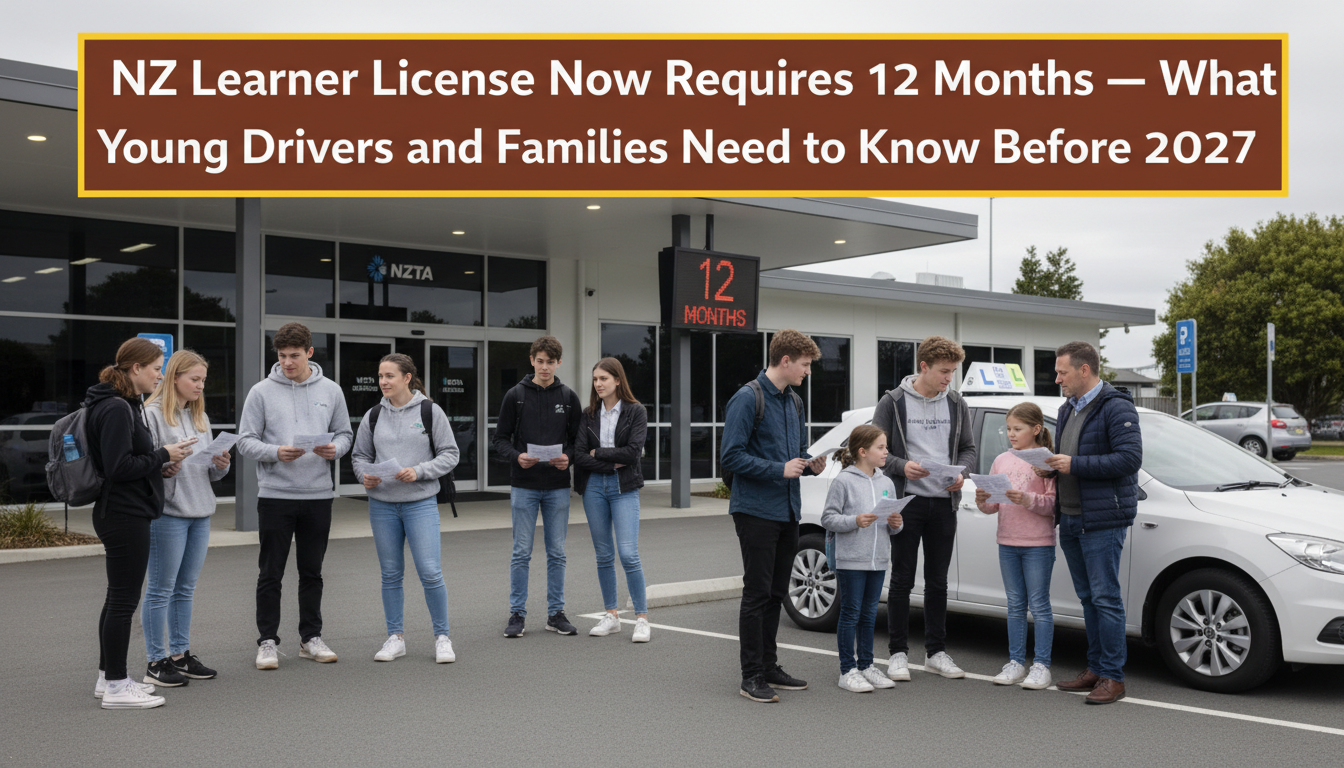
When Wellington student Ethan Clark, 16, passed his learner licence theory test last month, his first thought was how quickly he could move to the next stage. His older sister had done it in six months. His friends were talking about booking their restricted tests before the end of the year. The plan seemed straightforward.
Then he found out the rules had changed.
Under reforms being rolled out by Waka Kotahi NZ Transport Agency ahead of a broader licensing overhaul in 2027, learner drivers will now need to hold their learner licence for a minimum of 12 months before they are eligible to sit the restricted licence practical test. That is double the six-month minimum that previously applied to most learner drivers, and the change removes the shortcut that previously allowed earlier progression through approved driving courses.
“It feels like forever when you’re 16,” Ethan said. “But I get that it’s about safety. I guess it gives me more time to actually practice properly.“
Ethan’s measured response reflects a maturity that, ironically, is exactly what the reform is designed to develop. The 12-month learner rule is not about making life harder for young drivers. It is about giving them more time to build the kind of experience that research consistently shows reduces crash risk in the early years of independent driving. For families planning around a teenager’s licence progression, for young people with employment or study plans that depend on driving, and for the broader community that shares the road with novice drivers, this change matters and is worth understanding clearly.
What the Previous System Looked Like and Why It Is Changing
Under the system that applied before this reform, learner drivers in New Zealand could progress to the restricted licence stage after a minimum of six months. More significantly, drivers who completed an approved driving course could in some cases progress even earlier, with the course credit reducing the mandatory wait time and allowing faster movement through the graduated licensing stages.
On paper, six months sounds like a meaningful period of supervised learning. In practice, the actual number of hours behind the wheel that many learner drivers accumulated during that six months varied enormously. Some learner drivers practised regularly, built up genuine experience across different road conditions and environments, and arrived at their restricted test genuinely ready. Others practised minimally, completed the required time without developing real competency, and progressed to solo driving while still fundamentally inexperienced.
New Zealand’s crash data for young drivers tells that story clearly. Drivers aged 16 to 19 are consistently and significantly over-represented in serious crash statistics relative to their share of the driving population. The first year of solo driving, in particular, carries the highest risk. Research from multiple countries shows that the single most effective intervention for reducing novice driver crash rates is increasing the amount of supervised practice time before independent driving begins.
A Waka Kotahi spokesperson stated the evidence base plainly: international research consistently shows that longer supervised learning periods improve driver safety outcomes, and the 12-month rule is designed to support safer long-term driving habits from the beginning of a person’s driving life.
What Changes in Practice From the New Rule
The most immediate change is the extension of the mandatory learner period from six months to twelve. This applies to all learner drivers progressing through the standard graduated licensing pathway. The early progression shortcut that allowed course completion to substitute for time has been largely removed, meaning the twelve months is a genuine requirement rather than a starting point that can be negotiated down.
The emphasis on supervised practice during the learner period is also strengthened under the new framework. Previously, supervised driving was recommended but the quality and quantity of that supervision was not formally tracked or verified for most drivers. The reformed approach places greater emphasis on structured, documented practice across a range of conditions, with the expectation that learner drivers are not simply waiting out the clock but actively building their skills.
The types of driving experience that matter most are those that are systematically underrepresented in the average learner’s practice hours: night driving, motorway driving, rural road driving, wet weather driving, and driving in genuinely busy urban traffic. These are the conditions where inexperienced drivers most commonly encounter situations they are not prepared for, and they are precisely the conditions that tend to be avoided or minimised during a supervised learner period if no structured requirement exists.
Road safety educator Liam Robertson, who has worked with young drivers and their families for years, describes the reform as closing a gap that has long existed between what the learner system was designed to achieve and what it was actually producing. “Crash risk drops significantly when young drivers accumulate more supervised hours,” he explains. “The first twelve months of holding a learner licence are the most critical period for skill development. Extending that phase is not a punishment. It is the most evidence-based thing we can do to reduce the number of young people killed and seriously injured on our roads.”
The Safety Numbers That Drive This Reform
Understanding why regulators have been willing to accept the inconvenience this change causes requires looking at the data that motivates it. New Zealand has one of the higher rates of young driver fatalities among developed countries on a per-capita basis. Drivers aged 16 to 24 account for a disproportionate share of serious crashes, particularly on rural roads and in situations involving speed, night driving, or multiple passengers.
The relationship between supervised driving hours and crash risk in the first years of independent driving is one of the most well-established findings in road safety research. Studies from Australia, the United Kingdom, Canada, and the United States all point in the same direction: the more supervised practice hours a driver completes before solo driving begins, the lower their crash rate in the subsequent years. The effect is not marginal. It is substantial and durable.
Countries that have introduced longer learner periods comparable to what New Zealand is now implementing have seen measurable reductions in young driver crash rates over the years following those reforms. New Zealand’s decision to move to a 12-month minimum is not an experiment. It is following a path that has already demonstrated its effectiveness in comparable road environments.
For families who find the extended timeline frustrating, the honest context is that the inconvenience of an extra six months on a learner licence is modest compared to the alternative outcomes the reform is designed to prevent.
How the Timeline Compares Before and After the Reform
| Feature | Previous Rule | New Rule |
|---|---|---|
| Minimum learner period | 6 months for most drivers | 12 months, no exceptions for most applicants |
| Early progression via course | Available in some cases | Largely removed under the new framework |
| Supervised practice requirement | Recommended but not formally tracked | Strongly emphasised with structured expectations |
| Progression speed | Faster, more flexible | Slower, more structured and consistent |
| Link to 2027 reforms | Not applicable | First stage of a broader licensing overhaul |
The three-stage structure of learner, restricted, and full licence remains in place. The 12-month rule changes when drivers move between the first two stages, not the overall structure of the graduated licensing system.
What This Means for Families and Parents
For parents, the 12-month learner rule has practical implications that go beyond the change to a test date. Christchurch parent Sarah Ng was in the middle of planning and budgeting for her daughter’s licence progression when the change was announced. The family had been expecting to cover test fees, additional driving lessons, and the cost of adding a new driver to the car insurance by a certain point in the year. The extended timeline has required a rethink.
“We were budgeting for driving lessons and a test this year,” Sarah said. “Now we’re looking at another six months of additional practice. It changes what we need to plan and pay for.”
The financial implications for families are real. An additional six months of supervised practice means more fuel costs if parents are doing the supervision themselves, or more paid lesson costs if a professional driving instructor is involved. Insurance arrangements may need to extend for a longer period under learner driver terms. And for families with multiple children progressing through the licensing system at different times, the cumulative effect on the household budget can be considerable.
On the other side of that ledger, however, is the financial benefit of a safer driver. Young drivers who are involved in serious crashes face costs that dwarf the cost of additional supervised practice: repair bills, insurance excess payments, possible legal costs, and in serious cases, the financial and personal consequences of injury. The investment in more thorough supervised practice is, from a financial perspective, likely to pay for itself many times over if it prevents even a single serious crash.
The Impact on Employment, Study, and Rural Independence
Not every young person experiences delayed progression to a restricted licence as simply an inconvenience. For some, the timing of their licence has direct consequences for their employment prospects, their apprenticeship start dates, or their ability to function independently in rural communities where public transport does not exist.
A young person who has been offered an apprenticeship or a job that requires a restricted or full licence, and who cannot start until they hold that licence, faces a tangible financial and career cost from the extended learner period. In rural and regional areas, the ability to drive independently is not a convenience but a basic requirement for accessing employment, education, healthcare, and social connection. For young people in those environments, being on a learner licence for an additional six months has a different weight than it does for a city teenager with regular bus or train access.
These are legitimate concerns and they deserve acknowledgment. The reform is not without cost to some young people, and the policy does not pretend otherwise. The case being made by Waka Kotahi is that those costs are outweighed by the safety benefits across the population of young drivers as a whole, and by the long-term reduction in crash risk for the drivers themselves once they do progress to independent driving with a more robust foundation of experience.
For young people in rural areas in particular, the practical response is to start the learner process as early as eligible and to treat the 12-month period as an active training programme rather than a waiting period. The more productive use of the extended learner phase, the less disruption the delay causes to employment or study plans.
How This Connects to the Broader 2027 Licensing Reform
The 12-month learner rule is the first visible element of a broader set of driver licensing changes that Waka Kotahi has confirmed will continue through 2027. The full scope of those changes is still being confirmed, but what is known includes planned updates to restricted licence testing requirements, potential revisions to the passenger and night driving conditions that apply to restricted drivers, modernisation of the digital booking and assessment systems, and the introduction of enhanced hazard perception assessments as part of the licensing evaluation process.
For young people currently on a learner licence, the important implication of the broader reform timeline is that the landscape they are progressing into is still being shaped. The restricted licence stage they will reach after their 12-month learner period may look somewhat different from the restricted stage that exists today. Staying informed about those developments as they are confirmed is worthwhile, particularly for families doing long-term planning around licence timelines and costs.
The core three-stage structure of the graduated licensing system is not changing. Learner to restricted to full licence remains the pathway. What is changing is the depth of experience and the length of time required at each stage before progression, and the rigour of the assessment processes that gate that progression.
Practical Steps for Young Drivers Starting the Process Now
If you are a young person who has recently obtained your learner licence, or if you are planning to apply for one in the near future, the most valuable thing you can do with the knowledge of the 12-month requirement is to treat it as an opportunity rather than an obstacle.
Start your learner licence as early as you are eligible, since the clock on the 12-month requirement begins from the date your learner licence is issued. Every week that passes between becoming eligible and actually applying is time that could have been counting toward your restricted licence progression.
Build your supervised practice hours deliberately and across a wide range of conditions. Keep a log of your sessions, including the date, duration, road types covered, and conditions driven in. This log will not only help demonstrate your commitment when the time comes to apply for your restricted test, but it will also give you an honest picture of which types of driving you have covered and which areas still need work.
Do not treat the 12-month period as dead time. Work with a driving instructor periodically throughout the learner phase, not just in the weeks before your restricted test. Professional instruction helps identify habits and errors that supervised family driving does not always catch, and investing in a few professional sessions across the full 12 months produces better results than a cramming approach immediately before the test.
Stay current with the Waka Kotahi website and any communications about the 2027 reforms. The requirements you will face at the restricted licence stage may have evolved from what applies today, and knowing what is coming gives you time to prepare for it rather than encountering it as a surprise.
Frequently Asked Questions
Does the 12-month rule apply to all learner drivers or just young people?
The reform applies to all learner drivers progressing through the standard graduated licensing pathway. While the most visible impact is on young drivers, adult learners obtaining their first licence also follow the updated timeline.
Can I still use a driving course to progress earlier?
Under the new framework, the course-based early progression shortcut has been largely removed. The 12-month minimum applies regardless of whether an approved course is completed.
What if I already have a learner licence obtained before the rule changed?
Transitional arrangements apply depending on the timing of your licence issue and your planned progression date. Contact Waka Kotahi directly to understand how the rules apply to your specific situation.
Will the restricted licence test itself change?
Further updates to restricted licence testing are expected as part of the broader 2027 reforms. Details have not yet been fully confirmed. Staying informed through the Waka Kotahi website is the best way to track developments.
Does this apply across all of New Zealand?
Yes. The graduated licensing system is managed nationally by Waka Kotahi and the 12-month rule applies throughout New Zealand.
Will the change make licence fees more expensive?
No direct link between the 12-month rule and fee increases has been announced. Separate fee changes for 2026 have actually reduced costs in some upgrade categories.
What is the best way to make use of the 12-month learner period?
Consistent, structured supervised practice across a wide variety of conditions, supplemented by periodic professional driving instruction, is the most effective approach. Quality of practice matters more than simply accumulating hours.
Read More Latest News and Updates
Visit onetreegrill.site for More Updates
A Longer Wait, A Safer Driver
Ethan Clark will get his restricted licence. It will just take longer than he expected when he sat down for his theory test. In the months ahead, if he uses the time well, he will arrive at that restricted test with more hours behind the wheel, more confidence in a wider range of conditions, and a lower statistical probability of being involved in the kind of crash that ends, or permanently changes, a young person’s life.
That is the intended outcome. And the evidence from countries that have walked this road before New Zealand suggests it is a realistic one.
For young drivers, the message is simple: start early, practice consistently, and use the 12 months to become genuinely ready rather than just eligible. For families, the message is equally clear: the extra investment in time and supervised practice is not a burden the system is placing on your household without reason. It is one of the most meaningful things that can be done to protect the young person you care about in the years ahead.
If you or your child has recently obtained a learner licence, start the clock, start the practice, and stay informed about the 2027 reforms through the Waka Kotahi website.