For Auckland retail worker Maria Thompson, contributing enough to KiwiSaver each year to qualify for the government match has always been a deliberate habit. She knows the rules, tracks her contributions, and makes sure she hits the threshold before the end of the contribution year in June. The government contribution that lands in her account afterward has always felt like a reward for doing the right thing.
“I’d make sure I put in enough each year to get the full match,” she said. “It was like a little bonus for being disciplined about saving. It made the effort feel worthwhile.”
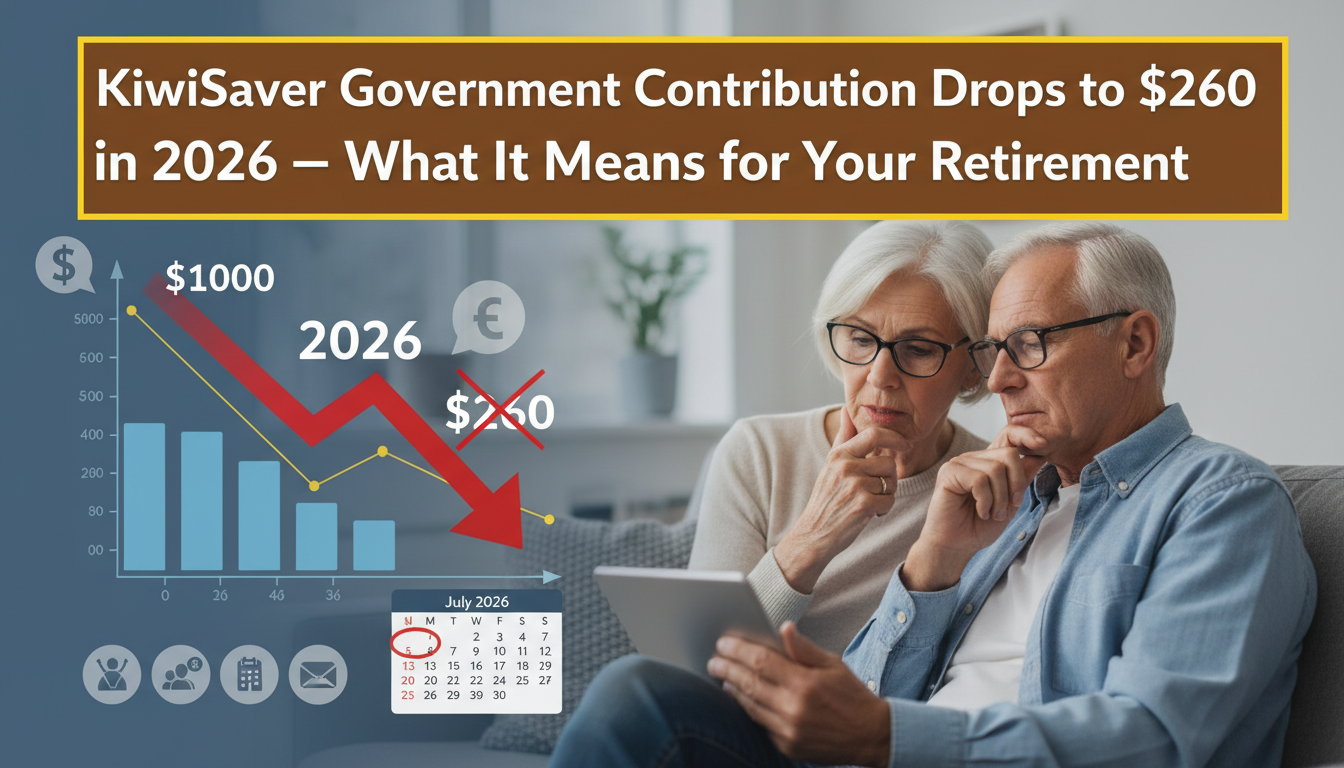
In 2026, that bonus has been cut in half.
Under confirmed changes to KiwiSaver settings taking effect this year, the maximum annual government contribution available to eligible members has been reduced from $521.43 to $260. For the millions of New Zealanders who have built their retirement savings strategy around the expectation of receiving the full government match each year, the reduction is not dramatic enough to be catastrophic on its own. But it is significant enough to matter, particularly when viewed through the lens of what compounding means over a full working life.
This article explains exactly what has changed, why the government made this decision, who is most affected, and what savers should do in response.
What the Government Contribution Is and How It Has Always Worked
To understand why the reduction matters, it helps to understand what the government contribution to KiwiSaver actually does. KiwiSaver is New Zealand’s voluntary workplace retirement savings scheme, and it operates through a combination of three funding streams: the member’s own contributions, the employer’s mandatory contributions, and the government’s annual contribution.
The government contribution has historically worked as a matching incentive. For every dollar a member contributes up to a certain threshold, the government adds fifty cents, up to a maximum annual payment. To qualify for the full contribution, a member needed to have contributed at least $1,042.86 of their own money during the KiwiSaver year, which runs from 1 July to 30 June. Members who contributed less than that still received a proportional government contribution based on how much they put in.
The logic behind this structure was to create a meaningful incentive for low and middle income earners in particular to prioritise retirement saving. For someone earning a modest wage and contributing the minimum three percent to KiwiSaver, the government contribution represented a real and tangible boost to their annual savings that they would not have achieved through their own contributions alone. It was designed to make the habit of saving feel worthwhile from the beginning of a person’s working life.
That structure has not been abolished. But the amount at the top of it has been cut substantially.
What Has Actually Changed in 2026
From the 2026 contribution year, the maximum government contribution available to eligible KiwiSaver members is $260 per year. The previous maximum was $521.43. The reduction amounts to approximately $261 per year for members who were previously receiving the full contribution.
The minimum personal contribution required to qualify for the full government match remains in place, though the amount you need to contribute to receive the full $260 is now lower than the previous threshold, proportionally. The eligibility rules around age, which apply to members aged between 18 and 65, remain unchanged. The payment continues to be made annually after the contribution year ends, administered through Inland Revenue.
Employer contribution requirements are entirely separate from the government contribution and are not affected by this change. Employers are still required to contribute a minimum of three percent of an employee’s gross salary to their KiwiSaver account. That employer contribution remains one of the most compelling reasons to participate in KiwiSaver, and it is completely unaffected by what the government has done to its own annual contribution.
A Treasury spokesperson acknowledged the change while framing it within the government’s broader fiscal management approach. The statement offered was that KiwiSaver remains a cornerstone of retirement savings in New Zealand and that the adjustment reflects fiscal priorities while maintaining support for long-term saving. Critics of the reduction note that framing a cut of more than fifty percent as “maintaining support” stretches the meaning of those words considerably.
Why the Government Has Made This Decision
The official justification for reducing the government contribution points to two main factors: fiscal sustainability and the maturity of the KiwiSaver scheme. The government’s argument is that KiwiSaver participation is now well established across the New Zealand workforce, meaning the original purpose of using a generous government contribution to incentivise sign-ups and early participation has largely been achieved. With a large and stable membership base and billions of dollars in assets under management, the scheme no longer needs the same level of financial encouragement to sustain participation.
The fiscal dimension of the decision reflects the broader reality of New Zealand’s public finances in 2026. With growing pressure on government spending across multiple fronts, including NZ Super, healthcare, housing, and infrastructure, policymakers have been looking for areas where expenditure can be reduced without eliminating programmes entirely. Cutting the KiwiSaver government contribution rather than removing it allows the government to claim it is maintaining the scheme’s support structure while reducing its annual cost.
Critics of the decision, including financial advisers, retirement advocacy groups, and opposition politicians, have pushed back on this framing with two main arguments. The first is that the people most sensitive to the size of the government contribution are lower income earners who are least likely to increase their own contributions to compensate for the reduced incentive. The second is that describing a fifty percent cut as a responsible fiscal adjustment understates the cumulative long-term impact on individual retirement balances. Both arguments have merit and neither has been adequately addressed in the government’s public communications about the change.
How Much Will Savers Actually Lose Over Time
The annual reduction of $261 can sound relatively small in isolation. In the context of a mortgage, a grocery bill, or an energy bill, $261 per year does not command much attention. But retirement savings do not work in annual snapshots. They work across decades, and the mathematics of compounding means that relatively small annual differences accumulate into very large differences in final balances.
Consider a worker who is 35 years old in 2026 and plans to retire at 65. They have thirty years of KiwiSaver contributions ahead of them. If the government had continued contributing $521 per year over that period, the direct total of government contributions alone would be approximately $15,600. At the new $260 rate, the direct total over thirty years is $7,800. The difference in direct contributions is $7,800.
But the real gap is larger than that. Those government contributions do not sit idle. They are invested in managed funds alongside the member’s own contributions and the employer contributions, and they generate investment returns year after year. The compound effect of an additional $261 per year invested in a growth fund over thirty years, at typical long-term return rates, can represent tens of thousands of dollars in final balance difference. Financial adviser Megan Patel has worked through this calculation with multiple clients and her conclusion is consistent: the annual reduction does not sound dramatic, but over decades, compounding magnifies the difference into something that meaningfully affects the retirement outcome.
For younger workers in particular, this is the most important framing. The further you are from retirement, the larger the compounding impact of changes to your annual savings. A 25-year-old who loses $261 per year in government contributions for forty years of working life faces a compounding gap that a 60-year-old facing the same annual reduction does not.
Old Contribution vs New: Side by Side
| Feature | Previous Setting | New Setting from 2026 |
|---|---|---|
| Maximum government contribution per year | $521.43 | $260 |
| Annual reduction for full contributors | Not applicable | Approximately $261 less per year |
| Minimum member contribution to qualify | $1,042.86 | Adjusted proportionally |
| Employer contribution requirement | Minimum 3% of gross salary | Unchanged |
| Payment timing | Annual after contribution year ends | Unchanged |
| Eligibility age range | 18 to 65 | Unchanged |
The government contribution is separate from employer and member contributions. Employer obligations are unaffected by this change. KiwiSaver remains worthwhile for most workers primarily because of the employer contribution, which is unrelated to the government match reduction.
Who Feels the Impact Most Sharply
The reduction does not affect all KiwiSaver members equally. The groups that feel its impact most sharply share a common characteristic: they are the people for whom the government contribution represented the largest proportional boost to their annual savings, and the people who have the least capacity to compensate for its reduction by simply contributing more themselves.
Low income earners who contribute the minimum three percent of a modest salary may see their annual KiwiSaver contributions after government top-up fall below what they had been counting on in their retirement planning. For these savers, the government contribution was not a nice extra. It was a meaningful component of an annual savings total that already felt uncomfortably small. Cutting it in half compounds the difficulty of saving adequately for retirement on a low income.
Part-time workers face a similar challenge. Someone working twenty hours per week at a modest hourly rate contributes less in absolute terms to KiwiSaver than a full-time equivalent worker, and the government contribution at the old rate helped partially offset that structural disadvantage. The reduction widens the gap between part-time and full-time savings outcomes.
Younger workers have the most to lose in compounding terms, as described above. For a 22-year-old just entering the workforce and starting their KiwiSaver journey, the difference between forty years at $521 and forty years at $260 in government contributions, compounded at realistic investment return rates, is genuinely significant. The fact that the loss is spread across decades and is not visible in any single year’s statement makes it easy to underestimate.
Workers approaching retirement who were counting on a specific projected KiwiSaver balance to supplement NZ Super face a more immediate adjustment. If their retirement projections were built using the old government contribution figure, those projections now need to be revised downward. For people within ten years of their planned retirement date, that revision may require adjustments to savings behaviour, expected retirement date, or planned spending levels in retirement.
Maria’s Reaction and What It Reflects
Maria Thompson’s response to the change is worth sitting with. “It’s less,” she said. “But it’s still something.” She plans to keep contributing at her current level and to continue making sure she qualifies for the full government match, even at the reduced amount.
Her decision reflects the correct financial logic for most KiwiSaver members. The employer contribution, which is entirely separate from the government match and is unaffected by this change, remains one of the most compelling financial incentives available to working New Zealanders. Employer contributions of three percent or more represent a meaningful automatic return on the act of saving, and that return is not going anywhere. KiwiSaver is still a highly effective retirement savings vehicle. The government contribution cut makes it slightly less generous, not fundamentally broken.
But her disappointment also reflects something real. Behavioural economics research consistently shows that the framing of savings incentives matters as much as their size. The government contribution was not just a financial mechanism. It was a signal. It told savers that the government valued and rewarded retirement saving. Cutting it in half sends a different signal, even if the scheme remains functional and worthwhile. For some savers on the margin of engagement, that signal may affect behaviour in ways that are hard to measure but real in their consequences.
The Broader Retirement Savings Context
The KiwiSaver government contribution reduction does not exist in isolation. It sits alongside a set of related pressures on retirement income security in New Zealand that together create a picture worth understanding clearly.
NZ Super, the universal retirement payment that provides the foundation of income for most older New Zealanders, pays around $27,900 per year after tax for a single person living alone. For the growing number of retirees who rent in urban areas, that amount falls short of covering essential living costs. The gap between NZ Super and actual living expenses is one that KiwiSaver was designed to help fill for future retirees who have been in the scheme long enough to build meaningful balances.
Reducing the government contribution to KiwiSaver while NZ Super remains under cost-of-living pressure moves in the opposite direction from where retirement policy arguably needs to go. It slightly weakens one of the two main pillars of retirement income for future retirees at a time when both pillars are already under strain for different reasons. That context does not make the decision indefensible, but it does make the trade-off more visible.
What KiwiSaver Members Should Do Now
If you are a KiwiSaver member affected by this change, the most productive response is not to withdraw from the scheme or reduce your contributions out of frustration. It is to review your savings strategy in light of the new settings and make adjustments where you can.
The first and most important step is to continue contributing at least enough to qualify for the full government match, even at the reduced $260 level. Receiving $260 is better than receiving nothing, and if you drop below the contribution threshold, you lose even the reduced incentive. The government contribution, small as it now is, still represents a guaranteed return on the act of qualifying for it.
The second step is to review your contribution rate and consider whether increasing it is financially feasible. Contribution rates of three, four, six, eight, or ten percent are available, and moving from three percent to four percent costs less per fortnight than most people expect while meaningfully increasing the long-term balance. The employer contribution is fixed at three percent regardless of which rate you choose, so the only thing changing when you increase your rate is your own contribution.
The third step is to review the fund your savings are invested in. Many KiwiSaver members, particularly older ones, are invested in conservative or balanced funds that may be too cautious for their actual risk profile and time horizon. For workers who are more than ten years from retirement, a growth fund typically produces higher long-term returns that can partially offset the reduced government contribution over time. Checking your fund allocation and making sure it is appropriate for your age and retirement timeline is free and straightforward through your KiwiSaver provider.
If you are within ten years of retirement and your projections were built using the old government contribution figure, speak with a licensed financial adviser to review your retirement plan with the updated numbers. The adjustment may require modest changes to your savings behaviour or expectations, and understanding those changes clearly now is far preferable to discovering them at 65.
Frequently Asked Questions
What is the new maximum government KiwiSaver contribution from 2026?
The maximum annual government contribution is $260. The previous maximum was $521.43, making the reduction approximately $261 per year for full contributors.
Do I still need to contribute to qualify for the government match?
Yes. You must make a minimum personal contribution during the KiwiSaver year to qualify. The exact threshold has been adjusted proportionally to the new $260 maximum.
Is the employer contribution changing?
No. Employers are still required to contribute a minimum of three percent of an employee’s gross salary. The employer contribution is entirely separate from the government match and is unaffected by this change.
Does this affect when I can access my KiwiSaver funds?
No. The withdrawal age remains 65, and the rules around early withdrawal in cases of genuine financial hardship, first home purchase, or serious illness are unchanged.
Is KiwiSaver still worth participating in?
Yes, for the vast majority of working New Zealanders. The employer contribution alone makes KiwiSaver one of the most effective savings vehicles available, and that contribution is unaffected by the government match reduction.
Can I increase my own contribution rate to make up the difference?
Yes. Contribution rates of three, four, six, eight, and ten percent are available. Increasing your rate is one of the most direct ways to offset the impact of the reduced government match on your projected retirement balance.
Will the government contribution be increased again in future?
No confirmation of future increases has been made. Policy settings can always change, but there is currently no announced plan to restore the contribution to its previous level.
Read More Latest News and Updates
Visit onetreegrill.site for More Updates
A Smaller Match, But the Game Has Not Changed
Maria Thompson is going to keep contributing. She will still qualify for the full government match, even at $260. She will still benefit from her employer’s three percent contribution. Her KiwiSaver balance will still grow year after year, compounding quietly in the background of her working life toward the retirement she is planning for.
What has changed is the size of the government’s annual vote of confidence in her saving habits. It is smaller now. It signals less generosity toward savers, and for the people who needed that generosity most, the lower-income earners and the part-time workers and the young people at the beginning of their savings journey, the signal lands harder than it does for those with more comfortable margins.
The right response to this change is not to disengage from KiwiSaver. It is to engage more deliberately, review your contribution settings, and ensure your retirement plan accounts for the new numbers. The government has stepped back slightly. The employer contribution has not. And the mathematics of compounding still works in your favour, as long as you keep contributing.
Check your KiwiSaver account, review your contribution rate, and if you have not looked at your fund allocation recently, now is a good time to do exactly that.