
When Elena Petrov moved from Russia to Auckland in her early forties, retirement planning was not the immediate priority. She had a career to build, a life to establish in a new country, and decades ahead of her before the question of pension eligibility would become pressing. She worked, she paid taxes, she became a New Zealand citizen, and she gradually assembled the picture of what her retirement would look like.
The centrepiece of that picture was New Zealand Superannuation. She knew the system was universal, she knew it was not income-tested, and she understood that the residency requirement had historically been 10 years. She had lived in New Zealand for more than that. She was, she believed, on track.
Then she read the fine print.
“I thought the rule was 10 years,” she said. “Now I’m realising the goalposts are moving. By the time I turn 65, the requirement will be higher than I planned for.”
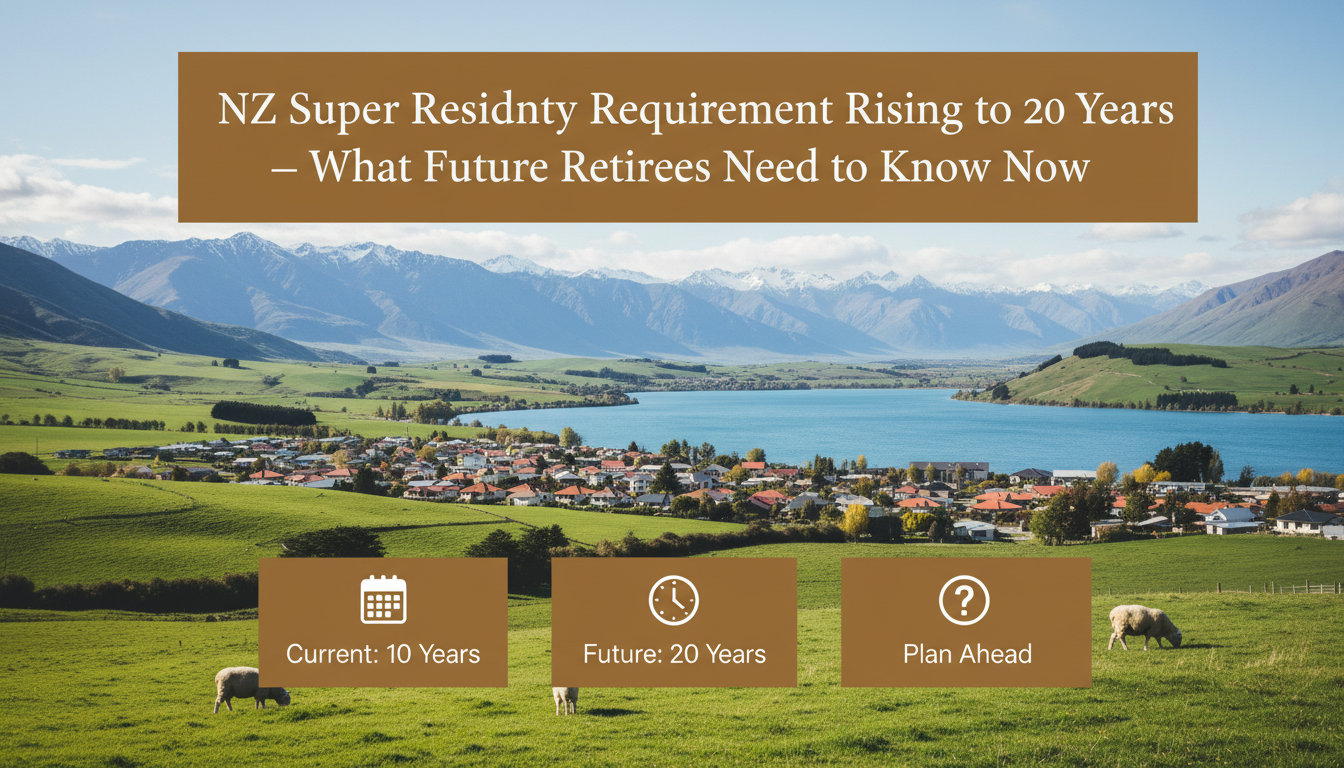
Elena’s situation reflects a reality that is not yet widely understood by the people it will affect most directly: New Zealand’s NZ Super residency requirement is in the middle of a gradual but significant increase, rising from the historical 10-year minimum to a final target of 20 years by 2042. That change, legislated and already underway, will define eligibility for hundreds of thousands of future retirees, particularly migrants who arrived in mid-life, New Zealanders who spent long working careers overseas, and anyone with an interrupted residency history.
Understanding the timeline, the mechanics of how the change works, and what it means for your specific situation is not optional planning. For people in the relevant position, it is the foundation of an accurate retirement plan.
How NZ Super Residency Has Always Worked
To understand what is changing, it helps to first understand what the previous rules were and why NZ Super’s eligibility structure has always been different from pension systems in most other countries.
New Zealand Superannuation is a universal pension. It is not based on employment history, not linked to payroll contributions, and not reduced based on income or assets. Any person who meets the age and residency criteria receives the full standard payment regardless of what they earned during their working life, how long they were employed, or what other income or savings they hold. This universality is one of NZ Super’s most distinctive and valued features, and it has not changed under the new residency rules.
What has always determined eligibility, alongside the qualifying age of 65, is residency. Under the rules that applied for many years, applicants needed to have lived in New Zealand for a total of at least 10 years since their 20th birthday, with at least 5 of those years occurring after their 50th birthday. The 5-year post-50 component was designed to ensure that applicants had a meaningful recent connection to New Zealand rather than simply having spent some period here decades earlier before living elsewhere.
For the generation of New Zealanders and migrants who planned their retirement under those rules, the 10-year threshold was a manageable requirement that most people with genuine and sustained ties to New Zealand could meet. Someone who migrated at 55 and was in good health could reasonably expect to qualify at 65 after 10 years of residence. Someone who had spent periods overseas during their working career could often still meet the threshold through a combination of earlier and later residence periods.
That framework has now been legislated to change.
The New Phased Increase: How the Timeline Works
The change to NZ Super residency requirements is not a single sudden shift. It is a phased increase that adds one additional year to the minimum residency requirement every two years, starting from a baseline of 10 years and ending at 20 years in 2042. The post-50 requirement of 5 years is being phased out as part of the reform, replaced by the higher total residency threshold.
The practical effect of this phased approach is that the requirement that applies to you depends on which year you turn 65. Two people who are currently the same age and in the same general situation can face meaningfully different residency requirements at retirement simply because one turns 65 two years before the other. This creates a level of individual specificity in planning that makes general statements about “the NZ Super residency requirement” less useful than understanding your specific position in the phase-in schedule.
The key milestones in the phase-in schedule are as follows. In 2024, the required residency was 12 years. In 2026, it has risen to 14 years. In 2028 it will be 15 years, in 2030 it becomes 16 years, in 2032 it reaches 17 years, in 2034 it is 18 years, in 2038 it increases to 19 years, and from 1 July 2042 onward the full 20-year requirement applies to all new applicants.
The Ministry of Social Development acknowledged the complexity this creates while defending the design: the phased increase ensures the long-term sustainability of New Zealand’s universal pension system while giving people ample time to plan. Critics of the approach note that “ample time to plan” is a description that applies only to those who know about the change and understand its implications, and that awareness of the phase-in schedule is not yet as widespread as it needs to be given the number of people whose retirement planning is affected.
Who Is Most Directly Affected by the Change
The residency change does not affect people who are already receiving NZ Super. Anyone currently on NZ Super was assessed under the rules that applied at the time of their application, and those payments are not affected by the new residency framework. The change is entirely forward-looking and applies only to people who have not yet reached the eligibility age of 65.
Within that group, the people most directly and significantly affected share a common characteristic: they have a residency history that falls short of the new and rising threshold at the point when they will turn 65.
Migrants who arrived in New Zealand during middle age are the most obviously affected group. Someone who immigrated at 50 will have accumulated exactly 15 years of NZ residence by the time they turn 65. Under the 2026 requirement of 14 years, they would qualify. But if they turn 65 in 2028 when the requirement has risen to 15 years, they are exactly at the threshold. If they turn 65 in 2030, they fall short of the 16-year requirement and will need to wait longer, or explore whether an international social security agreement provides any assistance with their eligibility.
The sensitivity of this calculation to small differences in timing is one of the most important and underappreciated aspects of the reform. A person who arrived in New Zealand at 51 rather than 50, all else being equal, has one fewer year of qualifying residence at age 65. In the early years of the phase-in, that one-year difference may not matter. As the requirement rises higher, it increasingly does.
New Zealanders who spent extended periods working overseas present a different but related challenge. Laura Henderson is a New Zealand citizen who returned home to Christchurch after 15 years working in Australia. She had assumed her return placed her back on track for a straightforward NZ Super eligibility pathway. “I came home thinking everything was straightforward,” she said. “It’s more complicated than I realised.” The years she spent in Australia do not automatically count toward her NZ Super residency requirement, and how much of that overseas period can be recognised through the Australia-New Zealand social security agreement depends on specific conditions that are not always clearly understood by individuals reviewing their own position.
People with interrupted residency histories, those who moved between countries multiple times for family, work, or other reasons, face the most complex calculation. The requirement is not simply total years of NZ residence at any point in life. It involves the specific calculation of years since age 20, and the interaction between different periods of residence and different international agreements can produce outcomes that are genuinely difficult to assess without professional assistance.
The Phase-In Schedule: What Year You Turn 65 Matters
| Year You Turn 65 | Required Years of NZ Residency |
|---|---|
| 2024 | 12 years |
| 2026 | 14 years |
| 2028 | 15 years |
| 2030 | 16 years |
| 2032 | 17 years |
| 2034 | 18 years |
| 2038 | 19 years |
| 2042 onward | 20 years |
Requirements increase by one year every two years. The post-50 requirement of 5 years is being phased out and replaced by the higher total residency threshold. Current NZ Super recipients are not affected. The eligibility age of 65 is unchanged.
Why the Government Made This Change
The policy rationale for increasing the NZ Super residency requirement rests on two main foundations: fiscal sustainability and fairness, and understanding both helps in assessing whether the reform is a reasonable one.
The fiscal argument is straightforward and genuinely compelling. NZ Super is funded entirely from general taxation in a pay-as-you-go model. There are no NZ Super contribution accounts, no accumulated fund, and no mechanism by which the pension is pre-funded through individual savings. The payments going out to today’s retirees are funded directly by the taxes collected from today’s working population. As the ratio of retirees to working-age taxpayers grows, which New Zealand’s demographic trajectory makes inevitable, the fiscal pressure on a taxation-funded universal pension increases substantially.
By 2040, approximately one in four New Zealand residents is projected to be over the age of 65. That demographic shift will produce a sustained and growing increase in total NZ Super expenditure at the same time that the working-age taxpayer base, relative to the retiree population, is under pressure. Treasury projections make clear that without changes to the pension system, NZ Super costs will consume a progressively larger share of government revenue over the coming decades.
The fairness argument is more contested. The government’s position is that people who have lived and worked in New Zealand for longer periods have paid more into the taxation system that funds NZ Super, and that requiring a longer residency period before accessing that system aligns entitlement more closely with contribution. Critics respond that NZ Super’s universal nature was never meant to be a reward for tax contributions, and that the fairness argument conflates a universal pension with a contributory one in ways that undermine the design principle that made NZ Super distinctive in the first place.
Retirement policy expert Dr. Hannah Collins occupies a nuanced position on this debate. “Even with a 20-year residency requirement, New Zealand’s system remains relatively accessible,” she says. “The main shift is ensuring longer-term attachment to the country before accessing taxpayer-funded retirement income. In a global context, it is still a more generous design than most.” Her view is that the reform is defensible as long as the universality and non-means-tested nature of the payment is preserved, which under current legislation it is.
Raj’s Calculation and What It Illustrates
Hamilton systems analyst Raj Mehta moved to New Zealand at age 50. He is now 62, which means he has accumulated 12 years of NZ residence and has 3 years until he turns 65. When he turns 65 in 2027, the residency requirement will be 14 years. He will have been resident for 15 years at that point and will qualify. But the calculation is uncomfortably close, and it is one he had not been tracking with the precision it deserved.
“I assumed I would qualify at 65,” he said. “Now I’m calculating whether I’ll meet the 14 or 15-year threshold when I apply. I’m fine, but only just. If I had arrived a year or two later, or if the threshold in my eligibility year were higher, the answer would be different.”
His situation illustrates two important points. The first is that many migrants who arrived in midlife are closer to the edge of the new eligibility thresholds than they realise, and calculating their specific position requires knowing both their arrival date and the specific threshold that will apply in the year they turn 65. The second is that the phase-in schedule creates a degree of inequity between cohorts that is difficult to avoid in any gradual reform but that is genuinely felt by individuals whose eligibility year happens to fall at a less favourable point in the phase-in curve.
Do Overseas Years Count? The Social Security Agreement Question
One of the most practically important and frequently misunderstood aspects of the NZ Super residency requirement is the role of international social security agreements in potentially supplementing New Zealand residence years toward the eligibility threshold.
New Zealand has social security agreements with a number of countries, including Australia, the United Kingdom, Canada, the Netherlands, Ireland, and several Pacific nations. Under these agreements, periods of residence or qualifying work in the partner country may be recognised toward the NZ Super residency requirement in limited circumstances. The mechanics of how this recognition works vary significantly by country and by the specific terms of each agreement.
The agreement with Australia is the one most commonly relevant, given the volume of movement between the two countries. However, the terms under which Australian residence periods can be counted toward NZ Super eligibility are specific and do not automatically apply to all periods spent in Australia. The payment amount that results from qualifying under an agreement rather than through purely NZ residence is also frequently adjusted, with proportional payments reflecting the mix of qualifying periods in different countries.
The key message for anyone who has spent significant time overseas and is planning their retirement timeline is to not assume that overseas years count without verifying the specific position with Work and Income. The agreements exist, they can help, but they are not a blanket recognition of all overseas time and the details matter enormously to whether they assist in any particular situation.
NZ Super by International Standards: Still Generous Despite the Change
One piece of context that is worth understanding when assessing the residency tightening is how NZ Super compares to pension systems in comparable countries, even with the new 20-year requirement fully applied.
Many OECD countries require decades of payroll contributions before a worker qualifies for state pension entitlement. In the United Kingdom, 35 qualifying years of National Insurance contributions are required for the full state pension. In Australia, the Age Pension is both means-tested and asset-tested, meaning many people who would receive full NZ Super in New Zealand receive little or nothing in Australia because of their superannuation savings or property assets. In the United States, Social Security entitlement is based on work credits accumulated over a lifetime of employment, with the payment amount directly linked to lifetime earnings.
Against these benchmarks, NZ Super with a 20-year residency requirement remains relatively accessible. It requires no employment contributions, no specific job history, no means or asset testing, and the 20-year residency period, while double the historical threshold, is still a lower barrier than what many countries impose through their contributory requirements. The universality of the payment, which is one of its most important features for social equity, is preserved under the new rules.
This does not make the change without impact. For the specific individuals whose residency histories place them near the new thresholds, the impact is real and requires genuine planning responses. But it does provide context for assessing the reform within the broader international landscape of retirement systems.
Financial Planning Responses for Those Affected
For people who identify that they will not meet the NZ Super residency requirement at 65 under the phase-in schedule, there are several planning responses worth considering, and the earlier those responses are implemented the more effectively they work.
The most straightforward response is simply to remain in New Zealand long enough to meet the threshold before claiming NZ Super. You do not have to claim NZ Super at 65. The payment is available from the time you qualify, which means if you are resident for long enough after turning 65 to accumulate the necessary residency years, you can apply at that point. This response works well for people who are in good health, not immediately dependent on NZ Super, and have sufficient alternative income or savings to bridge the gap.
For people who cannot or do not want to delay retirement income, KiwiSaver becomes the most important supplementary resource. If you have been contributing to KiwiSaver throughout your New Zealand working life and have accumulated a meaningful balance, you can begin withdrawals at 65 regardless of NZ Super eligibility. KiwiSaver is a separate system with its own eligibility criteria that are not linked to the NZ Super residency requirements.
Reviewing overseas pension entitlements is also important for anyone who spent significant working years in another country. Many countries have their own pension or social security systems that generate entitlements based on years of contributions or residence. Understanding what you are entitled to from those systems, and how those entitlements interact with NZ Super if you eventually qualify for it, is part of a complete retirement picture that many people with international work histories have not fully mapped out.
Documentation is practical and often underemphasised. Keep records of your arrival dates, departure dates, visa history, and tax filing history in New Zealand. When you apply for NZ Super, Work and Income will need to verify your residency history, and having clear and organised documentation of that history reduces the administrative burden and risk of delays at the point of application. For people who moved to New Zealand before maintaining detailed personal records was as easy as it now is digitally, reconstructing that history from available sources before it is needed at application is a worthwhile project.
The Broader Policy Debate
The residency tightening has attracted genuine disagreement from different parts of the policy debate, and those disagreements are worth acknowledging rather than simply accepting the government’s framing as the complete picture.
Supporters of the change argue that it protects the fiscal sustainability of a genuinely valuable system, that it creates a better alignment between contribution to the New Zealand tax base and entitlement to a tax-funded pension, and that the gradual phase-in provides adequate time for adjustment. They also point out that the universality and non-means-tested nature of the payment is preserved, which is the most important structural feature of NZ Super from an equity standpoint.
Critics raise several concerns that deserve engagement. The change disproportionately affects migrants, particularly those from countries without social security agreements with New Zealand, who may have contributed significantly to the New Zealand economy and tax base during their time here without being able to meet the rising residency threshold at retirement. There is also a concern about signalling effects on skilled migration, as the extended residency requirement before pension access creates a less attractive framework for mid-career professionals considering whether to build their future in New Zealand. And there is a philosophical objection from those who believe that the universality of NZ Super should be protected from requirements that effectively create tiers of entitlement based on residency duration.
These are not resolvable debates with a single correct answer. They involve genuine trade-offs between fiscal sustainability, equity, migration policy, and the values embedded in the design of the pension system. What matters for individuals is understanding the rules as they stand and planning within them.
Frequently Asked Questions
Does this change affect anyone already receiving NZ Super?
No. Current recipients were assessed under the rules that applied at the time of their application. Their payments are not affected by the new residency framework.
What is the NZ Super residency requirement if I turn 65 in 2026?
14 years of NZ residence since age 20.
What if I only have 12 years of NZ residence when I turn 65?
You would not meet the eligibility threshold at 65 and would need to wait until you have accumulated the required years, or explore whether an international social security agreement assists with your eligibility.
Can I delay claiming NZ Super until I meet the residency requirement?
Yes. There is no requirement to claim NZ Super immediately upon turning 65. You can apply once you meet the residency threshold, regardless of your age at that point.
Does time in Australia count toward the NZ Super residency requirement?
It may, under the terms of the New Zealand-Australia social security agreement. The conditions are specific and do not automatically apply to all time spent in Australia. Contact Work and Income for an assessment of your specific situation.
Does the eligibility age of 65 change under this reform?
No. The qualifying age remains 65. Only the residency requirement has changed.
Is NZ Super means-tested under the new rules?
No. NZ Super remains universal and is not income or asset tested regardless of the residency requirement changes.
What documents do I need to prove NZ residency?
Immigration records, passport entry and exit stamps, tax records, and official documentation of visa and residency status are all relevant. Keeping these organised and accessible is important for future applications.
Read More Latest News and Updates
Visit onetreegrill.site for More Updates
Know Where You Stand Before You Need To
Elena Petrov checked her position early enough to adjust. “I still have time to plan,” she said. “But I’m glad I know now.” That is exactly the right response and the right timing. The people for whom the residency tightening causes genuine hardship will be those who discover the issue at 64 rather than at 55, when the options for adjustment are limited and the ability to accumulate additional qualifying years before retirement is constrained.
The system is not retreating from universality. NZ Super will still be a non-means-tested, non-contribution-based universal pension when the 20-year requirement fully applies in 2042. It will still be more accessible than most comparable pension systems globally. What has changed is the length of the pathway to it, and for some people with specific residency histories, that longer pathway requires more deliberate navigation than the old one did.
The message from everyone who has engaged with this reform carefully is consistent: calculate your specific position now, understand the threshold that will apply in the year you turn 65, document your residency history, explore international agreement options if relevant, and build your retirement plan around the numbers as they actually are rather than as you assumed them to be.
If you are under 65 and have any question about whether your residency history will meet the threshold that applies in your eligibility year, contact Work and Income for an assessment now. The earlier you know, the more options you have.