
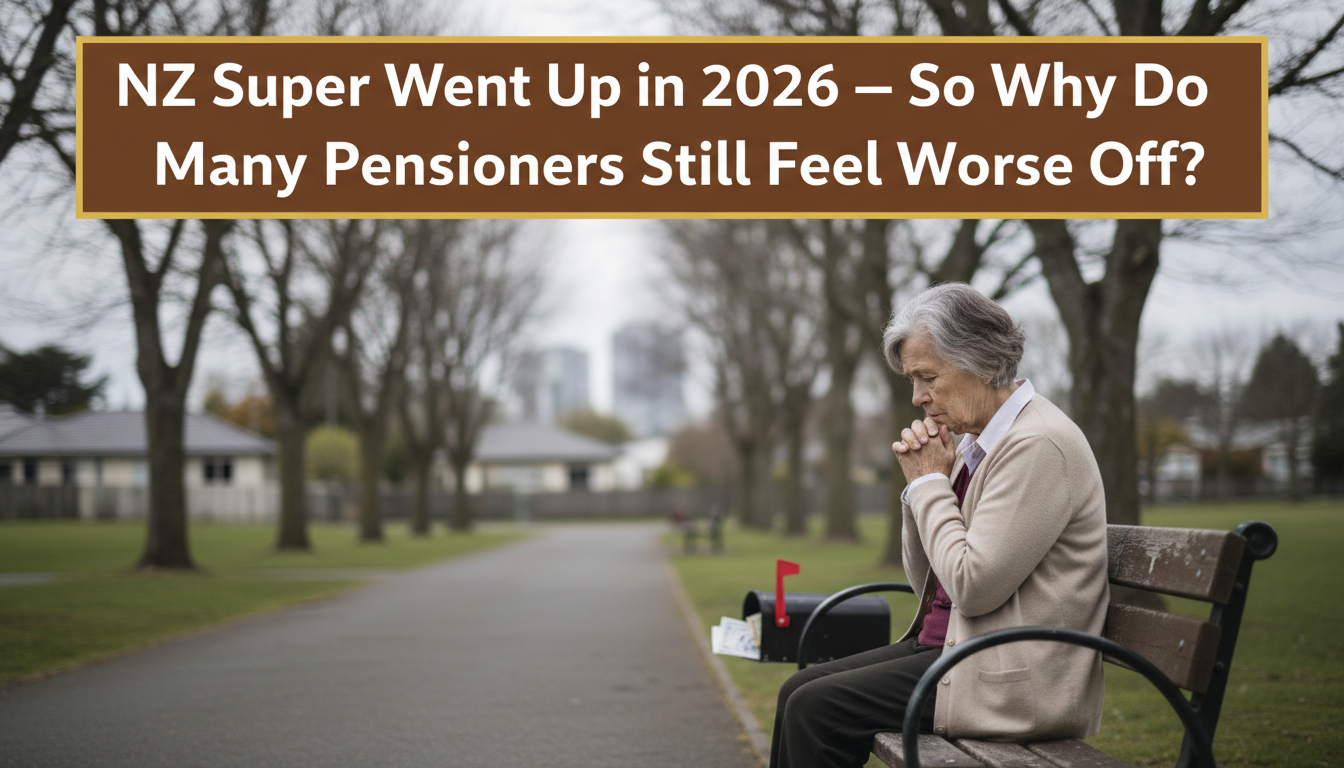
Auckland retiree John Fraser noticed his NZ Super payment rise in April 2026. It showed up clearly in his bank account. The number was higher than before.
A few weeks later, reviewing his household bills, something did not add up.
“Power’s up. Insurance is up. Groceries are still high,” he said. “Even with the increase, I don’t feel better off.”
John is not imagining it. Across New Zealand in 2026, a growing number of pensioners are discovering the same uncomfortable reality: NZ Super has increased on paper, but real purchasing power is still under pressure.
Understanding why this is happening matters for every retiree planning their budget this year.
The Payment Went Up. So What Is the Problem?
Every April, NZ Super is adjusted automatically to reflect wage growth. The 2026 increase applied to all categories, singles and couples alike.
Under New Zealand law, the combined rate for couples must sit between 65 and 72.5 percent of the net average wage after tax. Single rates are calculated relative to that couple rate. The system is indexed to wages, not specifically to the costs that retirees actually pay.
That distinction is where the problem begins.
Wages and Inflation Are Not the Same Thing
NZ Super rises with wage growth. Living costs rise with inflation. And the two do not always move together.
When wages grow at 4 percent but insurance premiums rise 12 percent, a pensioner’s payment increases but their budget tightens. The nominal payment is higher. The real purchasing power is lower.
A Treasury economist put it plainly: wage indexation protects relative income, but retirees experience inflation differently. Essential costs can rise faster than headline inflation.
Retirees spend a higher proportion of their income on utilities, groceries, healthcare, and insurance than the working-age population. When those specific categories surge, the wage-linked NZ Super adjustment does not keep up with what pensioners actually face.
The Costs That Are Rising Fastest for Retirees
Not all prices are rising equally. The categories that affect retirees most are the ones causing the most damage.
Council rates have increased above general inflation in most regions. Infrastructure investment, water reform, and climate resilience costs have pushed rate increases well beyond what wage growth covers. For fixed-income homeowners, rates now consume a noticeably larger share of their budget than five years ago.
Home and contents insurance has risen sharply. Climate risk reassessments, higher rebuilding costs, and changes in the reinsurance market have driven premiums up significantly nationwide. Many retirees report insurance increases of $300 to $600 or more in a single year.
Groceries remain elevated. Inflation in food prices has moderated, but absolute prices are substantially higher than pre-2022 levels. The reduction in the rate of increase does not restore what was lost in prior years.
Healthcare costs are rising quietly. GP fees, specialist consultation charges, and prescription costs have all moved upward. For retirees who see their doctor regularly and manage multiple conditions, these costs accumulate in ways that are difficult to reduce without affecting health outcomes.
Real Stories: The Budget Reality Behind the Headlines
Patricia Moana is a 72-year-old widow in Dunedin. Her April 2026 NZ Super payment increased, and she noticed it.
Then her house insurance renewal arrived. The premium had jumped by nearly $500 compared to last year.
“My payment went up,” she said. “But my house insurance jumped by nearly $500 this year. It cancelled out the increase and then some.”
In Tauranga, Bill and Heather Clarke are both retired and both receiving NZ Super. Their combined pension rose in April. Their council rates rose too, eating through most of the gain.
“You look at the bank balance and it’s higher,” Bill said. “But so are the bills.”
Neither couple has reduced their spending on luxuries. They are managing the same essential costs as before, paying more for them, and ending up with less disposable income despite a higher nominal pension payment.
A Simple Illustration of How Real Income Shrinks
Consider a retiree whose NZ Super payment increases by $780 for the year, roughly $30 per fortnight.
In the same year, their insurance rises by $500. Their council rates increase by $300. Electricity costs rise by $200. Groceries cost $300 more across the year.
Total additional costs: $1,300. Total pension increase: $780. Net position: $520 worse off in real terms despite a nominal payment increase.
This is what economists mean by the difference between nominal and real income. The number is higher. The purchasing power is lower.
Nominal vs Real Income: Understanding the Difference
| Measure | Nominal Income | Real Income |
|---|---|---|
| What it means | Dollar amount received | What that money can actually buy |
| NZ Super 2026 | Increased from April | Depends on specific expense growth |
| How it is protected | Wage indexation each April | No direct cost-of-living matching |
| What drives the gap | Not applicable | Insurance, rates, food rising faster than wages |
| How it feels day to day | Payment looks higher | Budget often feels tighter |
The distinction between nominal and real income is not an academic concept. For pensioners managing essential costs on a fixed income, it is the difference between feeling financially secure and feeling financially stretched despite receiving a higher payment.
Who Feels the Pressure Most
Not all retirees are equally affected. The gap between nominal and real income hits hardest in specific situations.
Single pensioners living alone carry fixed housing costs without a second income to share them. Council rates, insurance, and power bills for a single-person household are not proportionally lower than for a couple. The real income squeeze is more acute per person.
Renters face the sharpest housing cost pressure. NZ Super rental households have seen rent increases absorb most or all of their pension growth, leaving almost nothing from the nominal increase to improve their position.
Retirees in high-rates regions feel a specific geographic penalty. Parts of Wellington, Auckland, and Christchurch have seen rates increases among the highest in the country. For pensioners in those areas, the local government cost alone can reverse the entire benefit of a year’s NZ Super adjustment.
Older pensioners managing multiple health conditions face rising healthcare costs that younger retirees do not yet encounter. More frequent GP visits, specialist referrals, prescription costs, and private healthcare contributions all add to the real cost burden as people age.
Why the System Is Designed This Way
The wage indexation design of NZ Super is intentional and, in international context, is relatively generous.
Most pension systems link to price inflation only. New Zealand’s system links to wages, which means pensioners share in the rising prosperity of the working population rather than simply having their purchasing power maintained at a fixed historical level. That design choice is genuinely valuable for retirees over the long run.
The problem in 2026 is specific. It is not that the system is poorly designed. It is that the basket of costs retirees actually pay, particularly housing-related costs and insurance, has moved significantly faster than either wages or general inflation for several consecutive years. No wage-indexed system protects against that specific pattern of divergence.
Retirement policy specialist Dr. Karen Liu acknowledges both sides of this: NZ Super remains relatively generous by international standards. But rising fixed costs, particularly housing and insurance, are reshaping retirement affordability in ways that annual pension increases alone cannot fully address.
What Supplementary Support Is Available
For retirees whose real income position has worsened despite the April increase, there are supplementary mechanisms worth checking.
The Rates Rebate Scheme, expanded from July 2026, can significantly reduce the rates component of housing cost pressure for eligible homeowners. The expanded income thresholds mean more seniors now qualify than under the previous settings.
The Accommodation Supplement is available to eligible renters and some homeowners and provides targeted assistance with housing costs beyond what NZ Super covers. Many eligible retirees are not claiming it because they are not aware they qualify.
The Winter Energy Payment provides automatic support with heating costs during colder months. It does not fully close the energy cost gap for all retirees, but it represents a meaningful contribution to one of the fastest-rising cost categories.
Checking eligibility for these supplementary payments is one of the most practical responses available to retirees whose real income position has deteriorated despite the nominal NZ Super increase.
Practical Steps Retirees Can Take Now
Macroeconomic forces are not within individual control. But several practical actions can help protect real purchasing power at the household level.
Review your insurance policies at renewal rather than rolling them over automatically. Comparison shopping for home, contents, and vehicle insurance can produce meaningful savings, and some insurers offer senior discounts that are not automatically applied. Do not assume your current insurer’s renewal premium is the best available.
Apply for the Rates Rebate if you have not already. The expanded 2026 thresholds bring in many homeowners who did not qualify previously. The application is annual and must be lodged through your local council. Missing the application window means missing the rebate for that rating year.
Check your tax code. NZ Super is taxable income, and if you have additional income from part-time work, investment returns, or KiwiSaver withdrawals, your tax code should reflect your total income from all sources to avoid over-withholding throughout the year.
Review council rates instalment options. Most councils offer quarterly or monthly payment arrangements that can make rates costs easier to manage across the year without a single large annual payment creating a budget shock.
Consider a financial mentor. Community financial mentoring services are available free of charge in many parts of New Zealand. A session with a mentor who understands the retirement income landscape can identify entitlements, reduce costs, and improve the overall household financial position in ways that individuals often do not find on their own.
The Longer-Term Picture
The 2026 experience for New Zealand pensioners is not an isolated event. It reflects a structural challenge that will intensify as the population ages.
By 2040, approximately one in four New Zealanders will be over 65. The total cost of NZ Super will increase substantially, and the specific cost pressures that are currently reducing real purchasing power for retirees, housing, insurance, healthcare, and infrastructure-driven rates increases, show no sign of reversing on their own.
The government’s long-term response to this challenge will require structural policy work beyond the annual April adjustment. More targeted cost support, housing policy that addresses the specific financial position of fixed-income homeowners, and insurance market interventions to address climate-driven premium increases are all part of a policy conversation that is underway but has not yet produced the interventions needed at scale.
For individual retirees, the most useful framing is this: the nominal NZ Super increase is real and it matters. But it is not the complete picture of your financial position. The complete picture includes every cost that increased alongside it, and understanding that full picture is what allows you to take the specific steps that will actually improve your day-to-day situation.
Frequently Asked Questions
Has NZ Super actually been cut in 2026?
No. Payments have increased in line with wage indexation. The issue is that certain essential costs for retirees have risen faster than the payment increase, reducing real purchasing power.
Is NZ Super linked to inflation or wages?
Primarily to wages, with a statutory requirement that the couple rate stays within 65 to 72.5 percent of the net average wage. Consumer price inflation is also considered but wages are the primary driver.
Why does insurance keep rising so much?
Climate risk reassessments, higher rebuilding costs, and global reinsurance market changes have all contributed to premium increases in New Zealand that have consistently outpaced general inflation.
Can anything be done about council rates increases?
Rates are set by local councils and reflect their specific infrastructure and service costs. The Rates Rebate Scheme provides targeted relief for eligible low-income homeowners. Advocacy through local body elections is the primary democratic mechanism for influencing rates decisions.
Will there be another NZ Super increase before April 2027?
The standard annual adjustment cycle is April. Additional mid-year increases are not standard practice and would require a specific policy decision. The next scheduled adjustment is April 2027.
Should I be drawing more from KiwiSaver to compensate?
That depends on your KiwiSaver balance, your age, and your overall financial position. Drawing more now preserves current purchasing power but reduces what is available later. A financial adviser or free financial mentor can help assess the right balance for your specific circumstances.
Are single pensioners worse off than couples proportionally?
Generally yes in terms of housing costs. Fixed costs like insurance and rates do not halve for a single-person household. Single pensioners absorb those costs on one income rather than two, which makes the real income pressure more acute per person.
Read More Latest News and Updates
Visit onetreegrill.site for More Updates
The Number Is Higher. The Feeling Is Not.
John Fraser’s experience in 2026 is a useful summary of where many New Zealand retirees find themselves.
The April payment increase was real. It showed up in the bank. It reflected a system that is working as it was designed to work, linking pension income to the rising prosperity of the working population.
But the bills that arrived in the weeks that followed reflected a different economy. One where insurance premiums have been climbing for three years. Where council rates have outpaced wages in most regions. Where grocery prices are still substantially higher than they were before the inflation surge, even though they are rising more slowly now.
The number is higher. The feeling is not. And the gap between those two things is not confusion or ingratitude. It is an accurate reading of a household budget where costs have risen faster than income in the categories that matter most to retirement living.
Check your supplementary entitlements. Review your insurance. Apply for the Rates Rebate. Know your full financial picture. The payment increase is the starting point, not the whole story.