The UK’s cost-of-living crisis has produced a particular kind of consumer desperation. People are cold. Energy bills are still high. And millions of households are looking for any product that might take the edge off winter without adding significantly to their monthly outgoings.
Into that environment, Lidl has placed a compact plug-in thermo fan heater. The product itself is unremarkable. What is not unremarkable is the way it has been marketed.
The heater has been sold using the name and associated credibility of Martin Lewis, the nation’s most trusted financial expert and founder of MoneySavingExpert. And the reaction from consumers, industry experts, and rivals has been sharp.
Here is what is happening, why people are angry, and what UK households should understand before they consider buying this or any similar product.
What Lidl Is Actually Selling
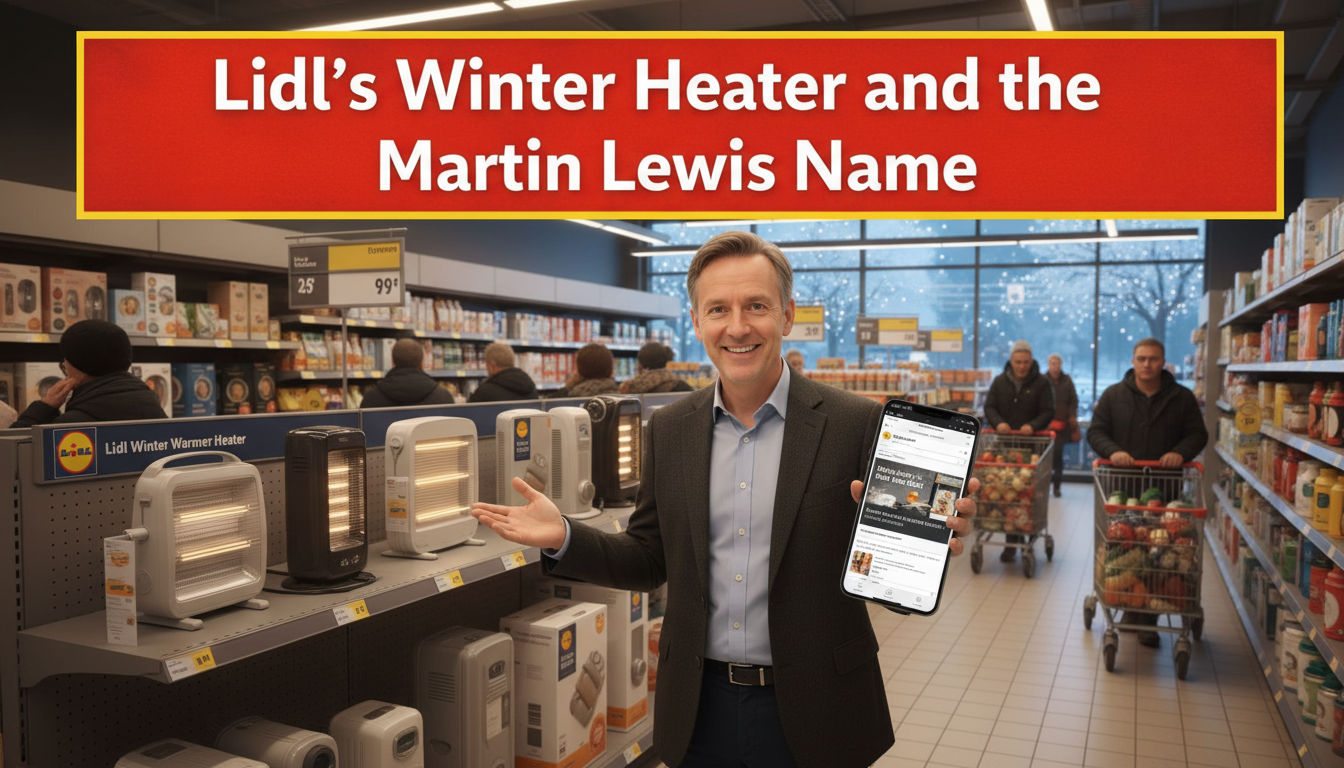
The product at the centre of this controversy is a plug-in thermo fan heater. It is compact, portable, and designed to warm a small room or personal space without requiring the central heating to run throughout the entire house.
Lidl markets it as a cost-effective winter heating solution. The device carries a 4.8-star rating on the retailer’s website and is described as capable of heating a room in minutes.
On its own, a small portable heater is not a controversial product. Budget retailers sell them every winter. The controversy is entirely about how Lidl has chosen to market this particular device, specifically by attaching the Martin Lewis name and associated brand credibility to the promotion in a way that critics say goes well beyond what is accurate.
The Martin Lewis Connection: What Is True and What Is Not
Martin Lewis is the founder of MoneySavingExpert and the most recognisable personal finance voice in Britain. Millions of people follow his advice on everything from energy tariffs to mortgage rates. His name carries enormous weight precisely because he has built a reputation over decades for genuinely putting consumer interests first.
Lidl’s marketing has used his name in connection with the heater in a way that strongly implies endorsement or approval. The framing suggests that Martin Lewis has assessed this product and found it worth recommending.
That is not accurate. The heater does not carry an official endorsement from Martin Lewis or his MoneySavingExpert organisation. Lidl has used his name to create the impression of approval from a trusted source without that approval having been formally given.
This is the core of what has made consumers and critics furious. Using the credibility of a trusted figure to imply a recommendation that does not exist is a marketing practice that many consumer advocates consider manipulative, particularly when the target audience is people already struggling financially.
Why This Matters During a Cost-of-Living Crisis
The specific timing and context of this controversy is important. This is not a minor marketing dispute in a normal economic environment.
UK households are entering another winter with energy bills that, while lower than the crisis peak of 2022, remain substantially higher than pre-crisis levels. For many families, the gap between what they can afford to heat and what they need to be comfortable is real and stressful.
In this environment, the promise of an affordable heating solution endorsed by Martin Lewis is not just appealing. For some households it feels like a lifeline. That is exactly why critics are so concerned about the marketing approach. The people most likely to be swayed by a Martin Lewis connection are those who can least afford to be misled about a product’s true running costs.
A consumer who buys a cheap plug-in heater believing it will reduce their bills and instead finds it increases them has lost money they could not spare. The emotional and financial damage of that outcome falls on people already under significant pressure.
The Real Cost of Plug-In Heaters: What the Marketing Does Not Tell You
The upfront cost of a small portable heater is genuinely low. That is what the in-store display shows and what first catches the eye.
What the marketing rarely makes prominent is the running cost. Plug-in electric heaters convert electricity directly into heat with no efficiency advantage. A 2,000 watt heater running for four hours uses 8 kilowatt-hours of electricity. At current UK electricity rates, that is a meaningful daily cost. Across a winter of regular use, the running cost of a portable plug-in heater can significantly exceed the purchase price.
Energy experts have consistently noted that cheap plug-in heaters are among the most expensive ways to heat a space when the full running cost is accounted for. A well-insulated room with a properly controlled central heating system will almost always be cheaper to heat than the same room with a portable plug-in device running as a primary heat source.
The appeal of these products is that they feel immediately controllable. Turn it on in the room you are using, turn it off when you leave. This logic makes intuitive sense. But the electricity rate per unit of heat produced by a plug-in device is higher than a gas central heating system in almost every scenario.
For households with gas central heating that is working properly, switching to plug-in electric heaters is very unlikely to reduce overall energy costs. It will, in most cases, increase them.
Sarah’s Situation: A Decision Made in Good Faith That Went Wrong
A household in the East Midlands, representative of thousands of similar situations across the UK, bought a plug-in heater last winter based on a social media post that linked the device to Martin Lewis energy-saving advice.
The family turned it on in the living room each evening to avoid running the central heating. They felt they were making a smart, cost-conscious choice.
Their next electricity bill told a different story. The additional cost of running the plug-in heater for four hours each evening had added meaningfully to their monthly electricity spend. The saving on gas had not compensated for the increase in electricity cost.
They had made the decision in good faith based on advice that was implied but not actually given. The product worked as described. The energy cost outcome was the opposite of what they had expected based on the marketing framing.
What Consumer Experts Are Saying
Emily Seymour, consumer affairs editor at Which?, was direct in her assessment.
Lidl’s use of the Martin Lewis brand, she said, is a clear attempt to exploit public trust in a respected financial expert. Consumers need to be wary of any products that claim to be energy-saving without independent, third-party verification of their true efficiency and running costs.
Sarah Coles, personal finance analyst at Hargreaves Lansdown, focused on the structural issue.
This situation highlights the urgent need for better regulation and consumer protection in the energy market, she said. Retailers should not be allowed to make misleading claims or use trusted figures to promote products that may ultimately cost customers more in the long run.
Dr. Iain Clacher, professor of finance and investment at the University of Leeds, placed the controversy in its broader context.
The cost-of-living crisis is creating an environment of desperation, he noted, where consumers are vulnerable to being exploited by businesses looking to profit from their struggles. We need to see more transparency and accountability across the energy sector.
The Impact on Lidl’s Loyal Customers
Lidl has built its UK presence on a specific promise: genuine value for people who are careful with money. Its core customer base includes a significant proportion of households that are budget-conscious by necessity rather than choice.
These are exactly the people for whom the Martin Lewis name carries the most weight. They follow his advice because they need it to work. They make purchasing decisions based on trust built through years of experience with genuinely useful recommendations.
Critics argue that by associating a product with Martin Lewis’s credibility in a way that overstates the actual connection, Lidl is effectively borrowing that trust and applying it to a situation where it has not been earned. For loyal Lidl customers who make a purchase based on that implied endorsement and find the product does not deliver the expected cost savings, the betrayal is specific and personal.
The concern extends to the long-term relationship between Lidl and its customer base. Retailers that exploit rather than earn consumer trust typically face a reckoning when customers realise what has happened.
The Pressure on Rival Retailers
The controversy extends beyond Lidl’s relationship with its own customers. Competitors in the budget retail space are watching the situation closely.
If Lidl’s use of implied celebrity endorsement drives sales of its heater, other retailers face pressure to match the promotional approach. This creates a dynamic where the marketing race to the bottom, using trusted names to imply endorsements that have not been formally given, becomes normalised across the sector.
The risk is that this erodes the overall integrity of consumer advice in a space where honest guidance is genuinely needed. When the Martin Lewis name becomes associated with products he has not assessed, the value of his actual recommendations is diluted. Consumers who see his name attached to multiple products of varying quality begin to discount the association entirely, which ultimately harms the households that most rely on trustworthy guidance.
What Lidl Has Said in Response
Lidl has defended the heater, stating that it provides great value and that the Martin Lewis branding is designed to highlight its cost-saving potential.
The retailer has not provided detailed independent energy efficiency data for the device. It has not clarified the specific basis on which the Martin Lewis association was created. And it has not committed to removing the branding or adjusting its marketing approach in response to the criticism.
Consumer advocates say this response is insufficient. Asserting that a product provides great value is not the same as demonstrating it through independent testing. And defending the use of a trusted name by reference to the product’s qualities does not address the fundamental concern that the endorsement implied is one that was not given.
Side by Side: What the Marketing Says vs What Experts Say
| Marketing Claim | What Experts and Critics Say |
|---|---|
| Martin Lewis approved heater | No official endorsement from Lewis or MoneySavingExpert exists |
| Energy-saving solution | Plug-in heaters are typically more expensive per unit of heat than central heating |
| Heats a room in minutes | True, but running costs accumulate quickly over hours and weeks of use |
| Great value for money | Upfront price is low but full running cost over winter may exceed expectations |
| Cost-effective winter heating | Gas central heating is usually cheaper for whole-room or whole-home warmth |
This comparison reflects the concerns raised by consumer organisations and energy experts. It is not intended as a verdict on the product itself, which functions as described. The concern is about the accuracy of the cost-saving claims made in the marketing, particularly as they relate to the Martin Lewis association.
How to Actually Save on Heating This Winter
With the controversy framing in mind, it is worth being direct about what genuinely effective winter heating cost management looks like.
If you have gas central heating that is working properly, using it efficiently is almost always cheaper than running plug-in electric heaters. Setting a thermostat timer to heat the home during the hours you are using it, and reducing the setpoint by even one degree, typically produces more saving than switching to a portable plug-in device.
Draught-proofing is one of the highest-impact low-cost interventions available. Gaps under doors, around window frames, and through letterboxes all allow warm air to escape and cold air to enter. Self-adhesive draught strips cost very little and produce an immediate and ongoing improvement in heat retention.
Loft insulation, if you own your home and it is inadequately insulated, is one of the best returns on investment available in home energy efficiency. Government schemes may cover part or all of the cost depending on your household income and circumstances.
For households in genuine fuel poverty, the Warm Home Discount, Cold Weather Payment, and Winter Fuel Payment are the mechanisms that provide meaningful support. These are actual government-backed payments and entitlements, not products requiring a purchase. Knowing whether you qualify for these and ensuring you are receiving them is a better use of energy cost management attention than evaluating portable heaters.
What Regulators Should Do Next
The Lidl heater controversy has prompted renewed calls for stronger regulatory intervention in how energy-saving products are marketed.
The Advertising Standards Authority has existing rules around misleading advertising. The specific question of whether using a trusted figure’s name to imply an endorsement they have not given constitutes a breach of those rules is one that consumer advocates are pressing.
Which? and other consumer organisations have called for mandatory, standardised running cost information to accompany any product marketed as energy-saving. A product that is cheap to buy but expensive to run is not an energy-saving product in any meaningful sense, and consumers deserve to see the running cost clearly displayed alongside the purchase price before they make a decision.
The broader regulatory question, about whether businesses can use the names and associated credibility of public figures to create implied endorsements without formal permission, is one that the current advertising framework does not address clearly enough. The Lidl situation may prove to be the catalyst for a sharper regulatory position on this practice.
What This Reveals About the UK Energy Market
This controversy is not really about a single product. It is about what the UK cost-of-living crisis has created in terms of consumer vulnerability.
Desperate households are not making carefully considered long-term investment decisions about heating. They are looking for anything that will reduce the pain of the next bill. That desperation is real, understandable, and being exploited.
The energy market in the UK has produced a cycle of distrust. Consumers who have felt let down by energy providers, retailers, and the government’s response to the crisis are looking for someone they can trust. Martin Lewis has occupied that position for years, which is precisely why his name carries so much commercial value to businesses seeking to borrow it.
The solution to this dynamic is not simply better consumer scepticism, though that matters. It is clearer regulation, stronger enforcement of existing advertising rules, and a requirement for genuine transparency about the running costs of products that are sold on energy-saving claims.
Frequently Asked Questions
Did Martin Lewis actually endorse the Lidl heater?
No. There is no official endorsement from Martin Lewis or MoneySavingExpert. Lidl has used his name in its marketing in a way that implies approval, but no formal endorsement was given. Lewis himself has historically been critical of misleading energy-saving product claims.
Are plug-in heaters actually more expensive to run than central heating?
In most cases, yes. Plug-in electric heaters use electricity to generate heat. Current UK electricity prices per unit of heat are higher than gas prices for households with gas central heating. Running a plug-in heater as a primary heat source typically increases total energy costs rather than reducing them.
When is a portable heater worth using?
There are specific situations where a portable heater makes sense. If you only need to heat one small space for a short period and leaving the rest of the house cold, a plug-in device used sparingly can be cost-effective. The problem arises when it is used as a substitute for central heating across normal household use.
What should I look for when evaluating energy-saving products?
Look for independent third-party testing and assessment. The Energy Saving Trust and Which? provide consumer-focused evaluations. Be sceptical of wattage claims without running cost calculations. A product’s purchase price tells you nothing about its true cost over a winter of use.
Is Lidl breaking any laws with its marketing?
That is a question for the Advertising Standards Authority to assess. Consumer advocates have raised concerns that the implied Martin Lewis endorsement may breach advertising rules around misleading claims. Whether formal regulatory action follows remains to be seen.
Where can I get genuine advice on energy saving this winter?
MoneySavingExpert itself is the best starting point for verified energy advice. The Energy Saving Trust provides guidance on home efficiency improvements. Your energy supplier may offer a free energy audit. Citizens Advice can help you check entitlement to Warm Home Discount and other support schemes.
What happens if I bought the heater and am unhappy with the running costs?
You have standard consumer rights under UK law. If the product was described as energy-saving and your experience suggests otherwise, you may have grounds for a complaint to Lidl’s customer services or a referral to the Advertising Standards Authority or Trading Standards.
Read More Latest News and Updates
Visit onetreegrill.site for More Updates
Know the Difference Between a Trusted Name and a Trusted Recommendation
Martin Lewis has spent decades building trust by putting consumers first. The value of his name comes directly from the consistency with which he has refused to let it be used in ways that do not genuinely serve the people who follow him.
When that name appears on a product in a way that implies his endorsement without his formal approval, it is not the product being validated. It is the trust he has built being borrowed without his consent and used to sell something to the very people he has spent his career trying to protect.
For UK households trying to stay warm this winter without breaking the bank, the most genuinely useful advice is this. Check your entitlement to Warm Home Discount and cold weather support payments. Draught-proof your home where you can. Use your central heating efficiently rather than replacing it with plug-in alternatives. And when you see a product marketed with a trusted name, ask whether that person has actually assessed and approved the product or whether their credibility is simply being borrowed.
The difference between a trusted name and a trusted recommendation is important. One is a marketing tool. The other is earned through genuine, independent assessment. Always look for the second one before spending your money.