
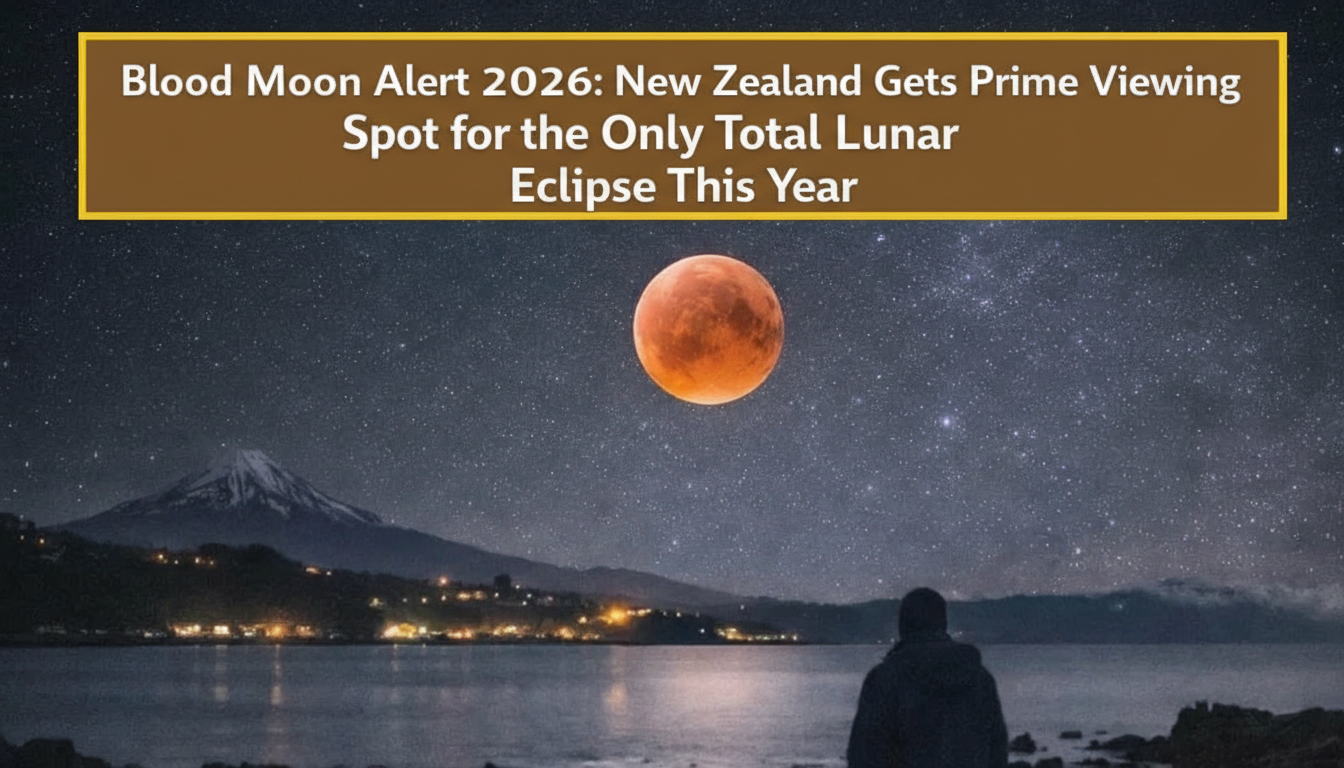
Skywatchers across New Zealand, mark your calendars — a breathtaking celestial event is coming, and it will not repeat again this year. Astronomers have officially confirmed that the only total lunar eclipse of 2026 will be clearly visible across Aotearoa, giving Kiwis what experts are calling a true “front-row seat” to one of nature’s most dramatic sky shows.
For one remarkable night, the Moon will glide into Earth’s shadow and transform into a glowing, deep red orb — what astronomers and sky enthusiasts around the world call a “Blood Moon.” This is not a partial or penumbral eclipse — it is the real deal, a full totality event. And New Zealand’s geographic position makes it one of the best-placed countries in the world to watch it unfold.
If you miss it, the next total lunar eclipse visible from New Zealand won’t arrive for several more years. Here’s everything you need to know.
What Exactly Is a Blood Moon?
A Blood Moon is not a separate astronomical object — it is simply what a total lunar eclipse looks like from Earth. During a total lunar eclipse, the Earth moves directly between the Sun and the Moon, blocking direct sunlight from reaching the lunar surface. However, Earth’s atmosphere acts like a giant lens, bending and filtering sunlight around the planet’s edges.
Here’s the science behind the stunning red color:
- Sunlight contains all colors of the visible spectrum.
- When sunlight passes through Earth’s thick atmosphere, shorter blue wavelengths scatter away.
- Longer red and orange wavelengths pass through and bend toward the Moon.
- The Moon then reflects this filtered red light back toward Earth, creating the iconic “Blood Moon” appearance.
It’s the same physics behind beautiful red sunsets — only in this case, it’s happening 384,000 kilometres away on the surface of the Moon. The shade can range from a deep copper orange to a vivid crimson red depending on atmospheric conditions on Earth at the time.
When Is the Blood Moon 2026? (Eclipse Phases Explained)
The 2026 total lunar eclipse will unfold in several distinct phases over a few hours. Each phase offers something different to observe. Exact local times vary by region, so we strongly recommend checking with Space NZ or Royal Astronomical Society of New Zealand (RASNZ) for precise timings in your city.
Here is a breakdown of the eclipse phases and what to expect during each one:
| Eclipse Phase | What Happens | What You’ll See | Duration (Approx) |
|---|---|---|---|
| Penumbral Phase Begins | Moon enters Earth’s outer shadow (penumbra) | Very subtle dimming — hard to notice with naked eye | ~1 hour |
| Partial Eclipse Begins | Moon enters Earth’s inner shadow (umbra) | A dark curved shadow visibly creeping across the Moon’s face | ~1 hour |
| Total Eclipse (Totality) Begins | Moon fully inside Earth’s umbra | 🔴 Moon turns deep red or copper — the famous “Blood Moon” | ~60–80 minutes |
| Maximum Eclipse | Moon at deepest point in shadow | Darkest, most vivid red color — peak of the event | A few minutes |
| Total Eclipse Ends | Moon begins exiting the umbra | Bright white light gradually returns on one edge | — |
| Partial Eclipse Ends | Moon mostly out of inner shadow | Nearly full Moon, shadow fading | ~1 hour |
| Penumbral Phase Ends | Moon completely exits Earth’s shadow | Normal bright full Moon restored | ~1 hour |
Note: The totality phase — when the Moon is fully red — is expected to last approximately 60 to 80 minutes. This is the must-see moment of the entire event.
Why New Zealand Has the Best View
Not every country gets to experience every lunar eclipse — it all depends on where you are on Earth when it happens. For the 2026 total lunar eclipse, New Zealand is in an exceptionally favorable position for several key reasons:
- Southern Hemisphere alignment: The geometry of this particular eclipse places southern hemisphere observers in the optimal viewing zone.
- Nighttime visibility: The eclipse occurs during late evening to early morning hours in New Zealand — perfect for dark-sky viewing.
- Moon elevation: The Moon will be high enough above the horizon to avoid obstruction from buildings, hills, or atmospheric haze near the ground.
- No light interference from the Sun: Unlike solar eclipses, which require totality paths, lunar eclipses are visible from anywhere on the night side of Earth — and NZ is right in that zone.
While parts of Australia and some Pacific Island nations may also catch glimpses of the eclipse, New Zealand’s timing is particularly favourable, making it one of the best locations globally to observe this event in 2026.
How to Watch the Blood Moon — Tips for the Best Experience
One of the greatest things about a lunar eclipse is that no special equipment is required. Unlike solar eclipses, it is completely safe to look at a lunar eclipse with the naked eye. Here’s how to make the most of the experience:
Choosing Your Viewing Location
- Find a spot away from city lights and light pollution for darker skies.
- Look toward the eastern sky after the Moon rises above the horizon.
- Open fields, hilltops, beaches, and rural areas offer the widest unobstructed views.
- Check local astronomy clubs — many plan public viewing nights for major events like this.
Equipment (Optional but Recommended)
- Binoculars: Great for seeing surface details and crater shadows during totality.
- Telescope: Reveals incredible surface texture and subtle color gradients during the red phase.
- Smartphone camera: Modern phones can capture the Blood Moon with night mode. Try a tripod for sharper shots.
- DSLR / mirrorless camera: Use a telephoto lens, low ISO, and slow shutter speed for professional-quality images.
Personal Comfort
- Dress warmly — nights in New Zealand can turn cool quickly, especially in autumn and winter months.
- Give your eyes at least 15–20 minutes to adjust to the dark before totality begins.
- Bring a blanket or camping chair for comfortable viewing over the 2–3 hour event.
Photography Guide: Capturing the Blood Moon
Want to photograph this once-in-a-year event? Here’s a quick settings reference for different types of cameras:
| Camera Type | Recommended Settings | Best For |
|---|---|---|
| Smartphone | Night mode ON, zoom 5–10x, tripod or steady surface | Quick, shareable shots |
| DSLR / Mirrorless | ISO 400–1600, f/5.6–f/8, shutter 1/2 – 2 sec, telephoto lens 300mm+ | High-quality detailed images |
| Point-and-Shoot | Manual or “Landscape” mode, no flash, stabilized surface | Easy beginner shots |
| Telescope + Camera | Afocal method or camera adapter, RAW format, manual exposure | Extreme close-up detail shots |
What If It’s Cloudy on the Night?
Unfortunately, New Zealand weather can be unpredictable, and cloud cover is the biggest risk for eclipse watchers. Here’s what to do if the sky doesn’t cooperate:
- Monitor forecasts closely: Weather can change rapidly — keep an eye on MetService NZ updates in the days leading up to the event.
- Travel if possible: If your region is forecast to be cloudy, consider driving to a clearer area. Eclipse chasing is a real and rewarding hobby!
- Watch live streams: Several observatories and astronomy organizations around the world stream major eclipse events online via YouTube and Facebook Live.
- Join online communities: NZ astronomy Facebook groups and Reddit communities often share real-time updates and photographs during events.
Is This Eclipse Rare? Will It Happen Again?
Total lunar eclipses are not extremely rare — they typically occur 2–4 times per decade. However, they are not visible from every location each time, and having only one total lunar eclipse in an entire calendar year is relatively uncommon. What makes 2026 extra special for New Zealand is the combination of:
- It being the only total lunar eclipse of 2026 globally.
- New Zealand having ideal geometry and timing for a clear full view.
- The totality lasting a generous ~60–80 minutes, giving ample time to observe and photograph.
If you miss this one, the next total lunar eclipse visible from New Zealand will not occur for several years. Astronomers strongly encourage anyone with even a passing interest in the night sky to step outside and experience this event.
Frequently Asked Questions: Blood Moon 2026 NZ
| Question | Answer |
|---|---|
| Is it safe to watch with the naked eye? | Yes, 100% safe. No special glasses needed — unlike solar eclipses. |
| What time does the eclipse start in NZ? | Exact times vary by region. Check RASNZ or local observatory websites for your city’s schedule. |
| How long does the Blood Moon (totality) last? | Approximately 60 to 80 minutes. |
| Will it be visible from the South Island? | Yes, weather permitting, the eclipse will be visible across both the North and South Islands. |
| Can children watch it safely? | Absolutely. It’s a wonderful educational experience for all ages. |
| Will it affect tides or animals? | No unusual effects — tidal patterns follow the normal full Moon cycle. Some animals may react to the temporary darkening. |
| Why is it called a Blood Moon? | Because the Moon turns a deep red or copper color during totality due to Earth’s atmosphere filtering sunlight. |
| Will Australia also see it? | Parts of eastern Australia may have partial or full visibility depending on the exact timing and local horizon. |
| What if I miss it? | You will need to wait for the next total lunar eclipse visible from New Zealand — likely several years away. |
| Is there a live stream available? | Yes, several international observatories and astronomy channels on YouTube plan to stream the event live. |
Final Summary: Blood Moon 2026 at a Glance
| Detail | Information |
|---|---|
| Event Type | Total Lunar Eclipse (Blood Moon) |
| Year | 2026 |
| How Many in 2026? | Only ONE total lunar eclipse this year |
| Visibility from NZ | Excellent — full totality visible nationwide |
| Duration of Totality | Approx. 60–80 minutes |
| Equipment Needed | None (naked eye is fine) |
| Is it Safe? | 100% eye-safe |
| Best Viewing Spot | Dark area, open sky, away from city lights |
| Next Chance After This? | Several years — don’t miss it! |
Don’t Miss New Zealand’s Celestial Moment of 2026
The 2026 Blood Moon is shaping up to be one of the most talked-about astronomical events in New Zealand in years. Astronomy clubs nationwide are already planning public viewing sessions, and observatories are expected to open their doors to give the public guided views through powerful telescopes.
Whether you’re an experienced stargazer or someone who has never paid attention to the night sky before, this is the kind of event that leaves a lasting impression. A vivid crimson Moon hanging silently in the dark New Zealand sky — it’s the kind of sight you’ll tell people about for years.
Set a reminder, find a dark spot, look up — and let the universe do the rest.