
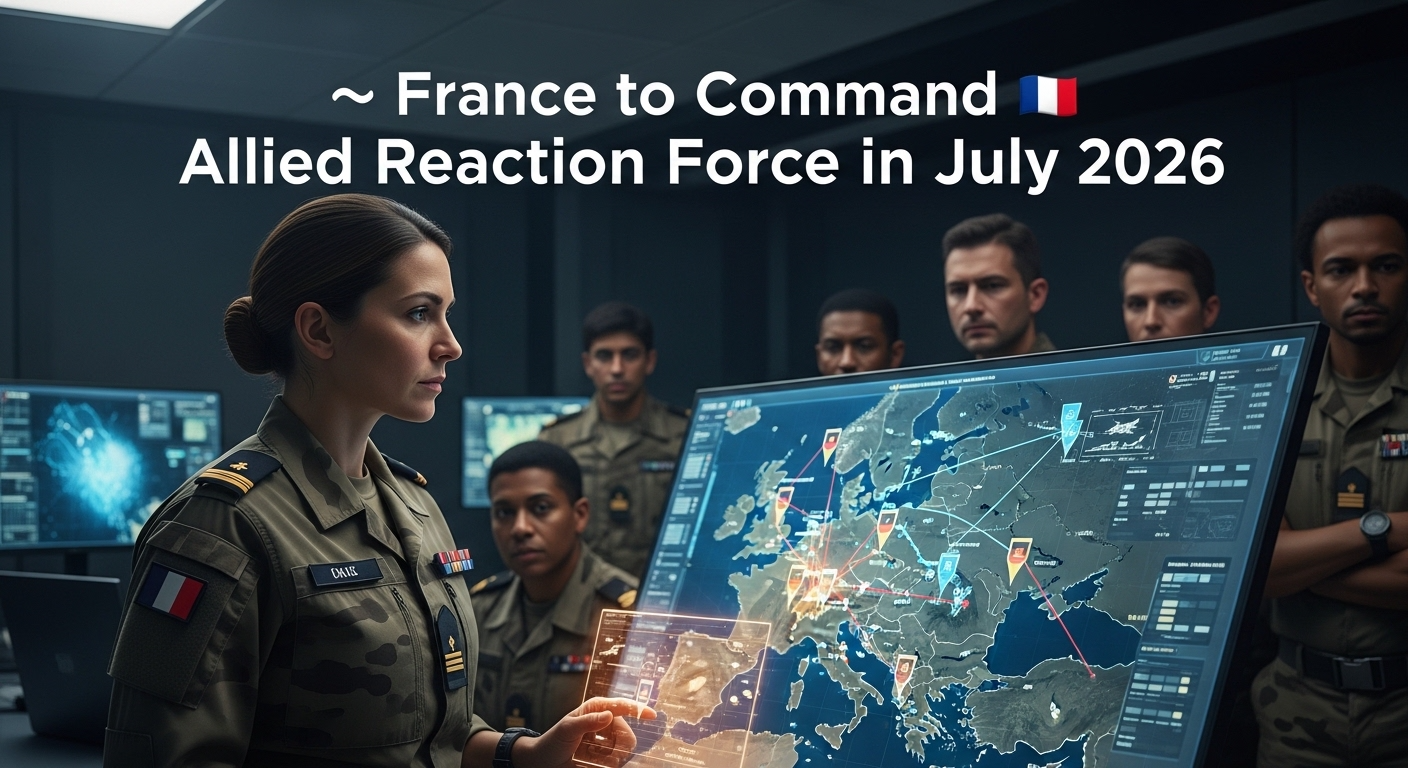
In July 2026, France will assume command of NATO’s most powerful rapid-deployment formation — the Allied Reaction Force (ARF). This marks a major milestone for both France and the alliance at a time of heightened tension along Europe’s eastern flank.
The move strengthens France’s leadership role within NATO and positions it at the center of the alliance’s rapid-response and deterrence posture.
What Is the Allied Reaction Force?
The ARF is NATO’s high-readiness, multinational force designed to deploy within days for:
- High-intensity warfare
- Crisis response
- Deterrence operations
- Disaster relief
It evolved from the former NATO Response Force (NRF). The shift from NRF to ARF reflects NATO’s adaptation to a renewed era of conventional military threats, particularly following Russia’s war in Ukraine.
The new ARF model emphasizes:
- Modular force packages
- Faster deployment cycles
- Stronger multinational integration
- Advanced technology and air-land coordination
Why This Is Strategically Important
France taking command is significant for several reasons:
Shift in NATO Leadership Balance
France is one of NATO’s strongest military powers, alongside the U.S., U.K., and Germany. Leading the ARF reinforces Paris’s ambition to be Europe’s central military actor.
Europe’s Eastern Flank Under Pressure
With tensions high in Eastern Europe, NATO needs credible rapid-response capability. The ARF is central to deterrence strategy.
Interoperability Challenge
Commanding a multinational force means coordinating:
- Different languages
- Different military doctrines
- Different technologies
This is one of the biggest operational challenges France will face.
The Role of the Steadfast Dagger Exercise
France has already been rehearsing this responsibility during NATO’s Steadfast Dagger exercise in Norway.
The drills tested:
- Multinational command integration
- High-intensity combat scenarios
- Logistics under pressure
- Rapid decision-making
These exercises are essential because interoperability often determines success in real operations.
France’s Air Command Advantage
A key asset supporting France’s ARF leadership is its modernized underground air operations center in Lyon:
Centre air de planification et de conduite des opérations (CAPCO)
This facility enables:
- Real-time data fusion
- Air-ground-maritime coordination
- Strategic-level command oversight
- Advanced digital decision-support systems
Air superiority and coordination will be crucial if the ARF ever deploys in a major crisis.
The Bigger Strategic Bet
France’s leadership of the ARF is about more than military command.
It signals:
- A stronger European pillar inside NATO
- Paris positioning itself as Europe’s primary military power
- Increased responsibility in alliance deterrence strategy
But it also carries risk:
- Political balancing among NATO members
- Operational credibility under real crisis conditions
- Maintaining readiness over long rotations
Failure would weaken influence. Success could significantly elevate France’s strategic standing.
Key Timeline
| Date | Event |
|---|---|
| 2023 | Steadfast Dagger multinational exercise |
| July 2026 | France assumes ARF command |
| Ongoing | Modernization of French air command systems |
Bottom Line
France taking command of the ARF in July 2026 is:
- A military milestone
- A geopolitical signal
- A test of European defense cohesion
If executed effectively, it will reinforce NATO’s deterrence posture and solidify France’s position as a central pillar of European security.
If you’d like, I can also break down how this compares to Germany’s or the UK’s role inside NATO, or explain how the ARF differs from NATO’s new regional defense plans.