When Michael and Hana packed up their Auckland apartment last year and headed south, they were not in crisis. They had jobs, they had savings, and they had a perfectly functional life in New Zealand’s largest city. What they did not have was breathing room. The commute, the cost, the density, and the persistent feeling that their income was being completely absorbed by the city around them had accumulated into something they could no longer ignore.
“We wanted less traffic, more nature, and a stronger sense of community,” Hana says. “Auckland is an incredible city. We just couldn’t afford to actually live in it the way we wanted to.”
Their story is not unusual in 2026. Across New Zealand, a genuine and sustained shift in where people choose to live is underway. The expansion of remote work has freed many workers from the requirement to be physically present in a major city. The persistent gap between major centre housing costs and regional alternatives has made that freedom financially compelling. And a broader reassessment of what a good life actually involves has caused many New Zealanders to weigh lifestyle, community, and pace of life more heavily than they previously did when deciding where to put down roots.
This guide looks at nine of the best places to call home in New Zealand in 2026, assessed across the full range of factors that shape where a life is actually well-lived: employment opportunities, housing affordability, lifestyle quality, community, healthcare, and the harder-to-quantify sense of a place that has energy and a future worth being part of.
What Is Driving Where New Zealanders Choose to Live in 2026
Before looking at individual cities and towns, it is worth understanding the broader forces shaping relocation decisions in 2026, because those forces directly explain why some locations are rising in appeal and others are declining despite their traditional reputations.
Remote and hybrid work is the single most significant structural change affecting where people choose to live. Workers who previously needed to be in Auckland or Wellington five days a week now have genuine flexibility, and many are using it. The ability to earn a major-centre salary while living in a regional area where housing costs a fraction of the equivalent urban property has made relocation financially transformative for households that can access it.
Housing affordability has become the defining constraint on life quality for many New Zealanders in their thirties, forties, and beyond. In cities where housing costs consume the majority of household income, the freedom and security that home ownership once provided has become largely inaccessible for all but the highest earners. Regional centres where ownership remains achievable are benefiting directly from this frustration.
Infrastructure investment in regional New Zealand has continued to close the gap between what cities and smaller centres can offer in terms of services, connectivity, and amenities. The digital infrastructure that supports remote work, the healthcare investment that has grown regional hospital and specialist capacity, and the retail and hospitality development that follows population growth have all made regional centres more viable as long-term homes than they were a decade ago.
1. Auckland
Auckland remains New Zealand’s dominant economic centre and it would be dishonest to rank it anywhere other than first when the criterion is employment opportunity and economic scale. The city generates a disproportionate share of New Zealand’s GDP, hosts the headquarters of most major New Zealand companies and most significant international business operations in the country, and sits at the centre of the country’s international connections through its airport.
The job market in Auckland spans every sector of the economy, but its strongest advantages are in technology, financial services, healthcare, construction, and the creative industries. For graduates entering the workforce and for career-stage professionals who need access to a large and competitive job market, Auckland provides something that no other New Zealand city can fully replicate at scale. The density of professional networks, the concentration of employers, and the international connectivity of the city create career development opportunities that are genuinely harder to access elsewhere.
The honest counterpoint is that Auckland’s quality of life for residents has been under sustained pressure from the same forces that make it economically dominant. Housing costs remain the highest in the country by a significant margin, and the proportion of household income consumed by accommodation in Auckland, whether through mortgage repayments or rent, leaves many residents with a standard of living that does not reflect what their income looks like on paper. Traffic and commute times, despite public transport improvements, remain a source of daily frustration for many Aucklanders.
For people at the right career stage and with sufficient income to manage the housing costs, Auckland remains a genuinely exciting and richly resourced city to live in. Its food scene, cultural diversity, access to beaches and the Waitematā Harbour, and the sheer scale of what the city offers as an urban environment are real and distinctive advantages. The key question for anyone considering Auckland in 2026 is whether their career stage genuinely requires being there, or whether the economic premium they are paying is buying them something they could access elsewhere at lower cost.
2. Wellington
Wellington is, by most measures, the most liveable city in New Zealand for people who want an urban lifestyle without the scale and sprawl of Auckland. It is compact in a way that makes everyday life genuinely more manageable. The central city, the waterfront, the major entertainment and cultural venues, the government precinct, and many of the city’s most desirable residential neighbourhoods are all within a relatively small geography that allows people to live close to where they work and spend their leisure time.
The capital’s economic base is anchored by government and public sector employment, which provides stability and a degree of insulation from private sector economic cycles. The film and creative industries, centred around Weta Workshop and the broader ecosystem that has developed around it, have made Wellington a significant destination for creative professionals. The technology sector has grown substantially, and the city’s cafes, restaurants, and arts venues have earned Wellington a national reputation for food and culture that extends well beyond its size.
Wellington’s one honest limitation is its weather. The city is famously windy, and the combination of wind and rain during the winter months is something that residents either make peace with or find genuinely difficult. It is worth spending time in Wellington across different seasons before committing to it as a long-term home, because the experience of the city in winter is different enough from its summer face to matter.
Housing costs in Wellington are significant but generally lower than Auckland, and the geography of the city means that many appealing suburban areas are a short commute from the central city. The public transport network, while imperfect, is more functional than in most New Zealand cities and reduces car dependence for many residents.
Best for: Government and public sector professionals, creative workers, people who want genuine urban culture without Auckland’s scale and cost.
3. Christchurch
Christchurch in 2026 is a city that has emerged from the long shadow of the 2010 and 2011 earthquakes with a rebuilt physical environment that in many respects is more modern, more functional, and more attractive than what existed before. The central city rebuild, whatever its frustrations and delays, has produced a more open, greener, and more deliberately designed urban core than most New Zealand cities possess. That physical environment now attracts people to Christchurch rather than deterring them.
For families in particular, Christchurch offers a combination of factors that is difficult to find elsewhere in New Zealand at its price point. Housing is significantly more affordable than Auckland or Tauranga, the school network is strong, parks and outdoor recreation are abundant and accessible, and the proximity to the mountains of the Southern Alps and the beaches of the Canterbury coast means that weekend outdoor activity options are exceptional. The city’s flat terrain makes it one of New Zealand’s most cycling-friendly urban environments.
The economic base has diversified significantly since the rebuild, with technology, engineering, and professional services joining the traditional Canterbury strengths in agriculture, construction, and logistics. Remote workers who have settled in Christchurch frequently cite the combination of good housing value, access to outdoor recreation, and the sense of a city that is still actively developing its identity as reasons for choosing it over other options.
Healthcare infrastructure has continued to improve, with Christchurch Hospital serving as the South Island’s largest and most comprehensively equipped medical facility. For families who want major centre healthcare proximity at a lower cost of living than Auckland or Wellington, Christchurch delivers that combination more effectively than any other New Zealand city.
Best for: Families, remote workers, outdoor enthusiasts who want major centre amenities at a significantly lower cost than Auckland or Wellington.
4. Tauranga
Tauranga’s appeal in 2026 extends well beyond its traditional reputation as a retirement destination. The city’s economic base has grown considerably, its population is younger and more diverse than it was a decade ago, and its combination of coastal lifestyle, economic activity, and accessible infrastructure has made it attractive to a wide range of life stages and household types.
The Bay of Plenty climate, warm and sunny with mild winters, is one of Tauranga’s most consistent advantages. It affects daily life in ways that are easy to underestimate until you live somewhere with genuinely good weather year-round. The ability to be outdoors, on the beach, walking coastal tracks, or simply in the garden, throughout the year rather than only in the summer months changes how people interact with their environment and their community.
The Port of Tauranga’s status as New Zealand’s busiest freight port anchors a substantial logistics and supply chain employment base. Combined with growing healthcare, retail, and professional services sectors, the employment landscape in Tauranga is now broad enough to support career-stage workers as well as those approaching or in retirement. Property values are above the national average but the range of options, from waterfront apartments to suburban family homes to inland properties at more accessible price points, means Tauranga is not exclusively a market for high-income buyers.
Best for: Retirees, remote workers, families seeking a coastal lifestyle with strong infrastructure and genuine employment opportunities.
5. Hamilton
Hamilton’s reputation has historically suffered from being compared unfavourably with Auckland and overlooked by people focused on coastal and scenic cities. In 2026, that reputation is increasingly out of date. Hamilton has grown into a genuinely functional and economically dynamic city that offers a quality of life that its detractors consistently underestimate.
The most straightforward case for Hamilton is financial. Housing costs are meaningfully lower than Auckland, Wellington, and Tauranga. For households who are priced out of those markets but do not want to move to a smaller or more remote community, Hamilton provides a realistic path to home ownership with a functioning urban economy around them. The median house price in Hamilton represents a significantly different financial reality for first home buyers and upgraders than the equivalent calculation in Auckland.
The University of Waikato and Waikato Institute of Technology anchor a substantial education sector, and Waikato Hospital serves as the region’s major medical facility with a comprehensive range of services. The regional economy draws strength from Waikato’s agricultural sector, from food processing and manufacturing, and from the growing service economy that serves the Waikato’s substantial population. Hamilton’s central location, roughly equidistant from Auckland and Tauranga, makes it a logical base for people with connections in multiple directions.
The city’s culture and hospitality scene has improved substantially in recent years and continues to develop. The River Walks along the Waikato River provide excellent recreational infrastructure through the heart of the city, and the range of parks, reserves, and outdoor spaces within easy reach means that Hamilton residents who invest in exploring their city’s environment often find it more rewarding than its flat-city reputation suggests.
Best for: First home buyers, families seeking affordability with urban amenity, workers who need regional employment flexibility.
6. Queenstown
Queenstown exists in a category of its own on this list, because the decision to live there involves a trade-off that is more explicit than in most other locations. Housing costs are extremely high relative to the employment options available locally. The dominant local industries, tourism, hospitality, and adventure activities, do not generate incomes that sit comfortably alongside Queenstown property prices for most workers. The people who live in Queenstown and are genuinely comfortable there are typically either high-income remote workers and business owners who have brought income from elsewhere, or people who have made a deliberate decision to prioritise lifestyle over financial optimisation.
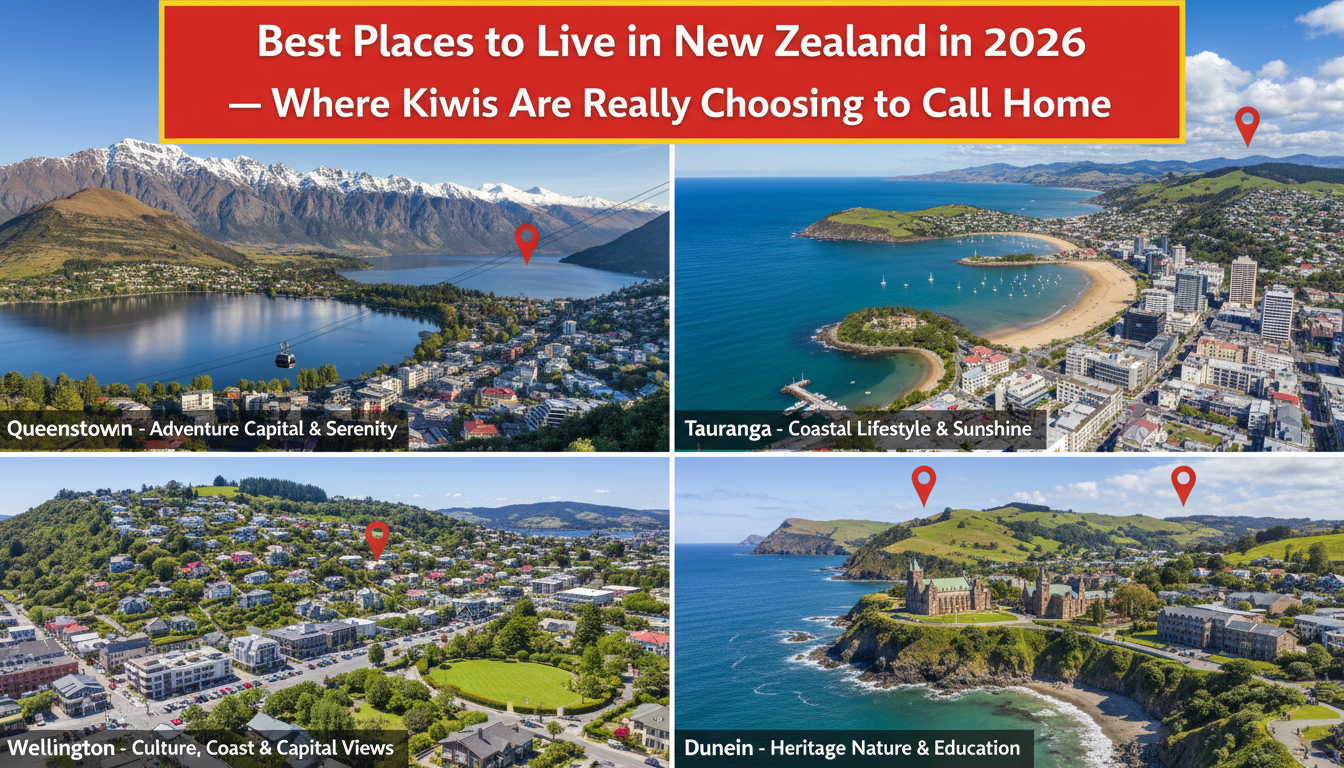
For those who can navigate the financial dimension, Queenstown offers an environment that is simply unlike anywhere else in New Zealand. The Remarkables range rising above Lake Wakatipu, the proximity to Fiordland and the broader Southern Lakes region, and the year-round outdoor activity options, skiing in winter, hiking, cycling, and water sports in summer, create a daily living environment that many people find genuinely extraordinary. The international character of the town, with a population that includes people from across the world who have come specifically for the lifestyle, creates a social environment that is diverse and energetic.
The practical limitations of Queenstown as a permanent home are real and should not be underestimated. The distance from major medical services means that serious health needs require travel. The cost of everyday goods and services is elevated. The rental market is extremely tight and expensive. And the town’s tourist economy creates a seasonal character that affects everything from traffic to restaurant availability to the overall pace of community life.
Best for: High-income remote workers, business owners, and those who prioritise lifestyle and outdoor environment above financial optimisation.
7. Dunedin
Dunedin is one of New Zealand’s most genuinely underrated cities as a place to live. It combines a property market that remains among the most affordable of any significant New Zealand urban centre with a cultural life, an educational infrastructure, and a physical heritage environment that give it a character and depth that few comparable-sized cities in the world can match.
The University of Otago, New Zealand’s oldest university, and Otago Polytechnic together create a large and active student population that generates the kind of energy, cultural programming, music, art, sport, and social activity that typically requires a much larger city. The presence of the Otago Medical School and Dunedin Hospital ensures that healthcare infrastructure in Dunedin is far more comprehensive than a city of its size would typically support.
For first home buyers, Dunedin offers something that has become extremely rare in New Zealand: the genuine possibility of purchasing a home at a price that is realistic on an average income without spending the majority of household earnings on the mortgage. That financial breathing room is not a minor consideration. It is the foundation of a different quality of life, one where housing costs do not crowd out travel, leisure, savings, and the other things that make life worth living.
The climate is cool and Dunedin winters are genuine. This is not a city where outdoor living is a year-round experience in the same way it is in Tauranga or Nelson. But for people who are drawn to the aesthetic of a historic stone city, who enjoy the distinct seasonality that Dunedin’s climate produces, and who find the intellectual and cultural energy of a university town stimulating rather than overwhelming, Dunedin delivers a quality of life that surprises many people who arrive with low expectations.
Best for: Students, academics, first home buyers, retirees seeking affordability, and anyone drawn to heritage character and university town culture.
8. Napier and Hastings
The Hawke’s Bay region, centred on the twin cities of Napier and Hastings, has been steadily growing in appeal as a place to live for a range of household types. The region’s most distinctive asset is its climate. Hawke’s Bay records more sunshine hours than most of New Zealand and is sheltered from the worst of the country’s weather by the ranges to the west. The result is a growing season and an outdoor lifestyle that explains both the viticulture for which the region is internationally known and the appeal it holds for people who want to live somewhere that genuinely feels warm and open.
Napier itself is architecturally remarkable. The city was rebuilt following the 1931 earthquake in Art Deco style and has maintained that heritage with a consistency that makes it one of the world’s most significant collections of 1930s urban architecture. Walking or cycling through Napier’s central streets is a distinctive experience that contributes to a genuine sense of place.
The economic base of the region is anchored by horticulture, viticulture, food processing, and the broader supply chain that serves those industries. Tourism related to the wine region has grown substantially. The service economy has expanded with the population. For families seeking a regional lifestyle with decent employment options, reasonable housing costs, and a genuine community feel, Napier-Hastings consistently delivers.
Healthcare access has improved alongside population growth, though for complex specialist services, travel to Wellington or Palmerston North may sometimes be required. The overall profile of the region suits people who are established in their careers or approaching retirement more than those at the very beginning of their professional lives looking for maximum career opportunity.
Best for: Families, retirees, hospitality and horticulture workers, and lifestyle-focused households who want sunshine and regional community at an accessible price.
9. New Plymouth
New Plymouth rounds out this list as a city that consistently punches above its weight in terms of what it delivers to residents relative to its size. The coastal setting at the foot of Mount Taranaki gives New Plymouth a physical environment that is genuinely spectacular, and the Coastal Walkway that runs along the waterfront for several kilometres provides a piece of urban infrastructure that most much larger cities would envy.
The city has made deliberate investments in its cultural infrastructure, including the Govett-Brewster Art Gallery and the associated Len Lye Centre, which have given New Plymouth a genuine reputation as a cultural destination within New Zealand. The Pukekura Park, one of the country’s most beautiful urban parks, and the surrounding regional landscape make New Plymouth a place where the quality of the physical environment that residents interact with daily is consistently high.
Housing in New Plymouth remains more accessible than in many comparable coastal cities. The combination of affordable relative to national averages, excellent infrastructure, a well-regarded hospital, and the distinctive lifestyle that the Taranaki region offers makes New Plymouth increasingly attractive to people looking for an alternative to more expensive coastal centres.
The main consideration for prospective residents is geography. New Plymouth sits on the Taranaki coast and while it is not remote, it is not close to other major centres either. For those with family or professional connections in Auckland, Wellington, or Hamilton, the distance requires either accepting less frequent travel or factoring in the cost and time of air connections. For households who are content to build their life within the region, that isolation is rarely felt as a problem and is often experienced as one of New Plymouth’s best qualities.
Best for: Families and working professionals who want coastal lifestyle, cultural richness, and accessible housing in a city with genuine character and excellent infrastructure.
How the Nine Cities Compare at a Glance
| City | Housing Cost | Job Market | Lifestyle Appeal | Best Life Stage |
|---|---|---|---|---|
| Auckland | Very high | Excellent | Diverse, urban | Career-stage professionals |
| Wellington | High | Very good | Compact, cultural | Government, creative workers |
| Christchurch | Medium | Good | Modern, outdoor | Families, remote workers |
| Tauranga | Medium to high | Growing | Coastal, sunny | Retirees, families |
| Hamilton | Medium | Good | Practical, accessible | First home buyers, families |
| Queenstown | Very high | Tourism-heavy | Spectacular outdoors | Remote workers, lifestyle seekers |
| Dunedin | Low to medium | Education and health | Heritage, university | Students, retirees, first buyers |
| Napier and Hastings | Medium | Regional, horticulture | Sunny, wine region | Families, retirees |
| New Plymouth | Medium | Regional, growing | Coastal, cultural | Families, professionals |
Housing cost ratings are relative to the national average and reflect general 2026 conditions. Individual suburb and property variations exist within each city. Lifestyle ratings reflect overall character rather than specific neighbourhood experience.
Things to Consider Before Making a Move
Relocation decisions made on the basis of rankings and general descriptions are always incomplete. The city that looks best on paper may not be the city that is best for your specific life, and the only way to close that gap is to do the work of investigating your actual options rather than accepting someone else’s general assessment.
Visit any city you are seriously considering at multiple times of year. Seasonal variation in New Zealand is real, and the experience of a city in January is genuinely different from its experience in July. The city that delights you on a summer holiday may be considerably less appealing during a cold and grey winter, and since you will spend at least some months of every year in winter conditions, knowing what those conditions feel like in your chosen location matters.
Investigate employment practically rather than theoretically. Look at actual job listings in your field in the city you are considering, talk to recruiters if your profession uses them, and understand what the real market looks like for your specific skills before assuming that a city’s general employment reputation will translate into opportunities for you. Regional economies can be strong overall while being thin in specific sectors.
Research the property market through the lens of your actual budget rather than through median price statistics. The median tells you about the middle of a market, but the properties available at your specific price point in a specific neighbourhood are what determine whether the market works for you. Spending time on property platforms looking at actual listings in your target price range gives you a much more accurate picture than headline statistics.
Think about your life in ten or fifteen years, not just today. A city that is excellent for your current life stage may present challenges at a later stage. Healthcare proximity matters more as you age. The ability to live without a car matters more as driving becomes less comfortable or viable. Family proximity may change in importance as circumstances evolve. Building some flexibility and foresight into a relocation decision produces better long-term outcomes than optimising purely for the present.
Frequently Asked Questions
Is Auckland still worth it for career development in 2026?
For specific sectors and career stages, yes. Auckland’s job market depth and professional network concentration are genuinely difficult to replicate elsewhere. For workers whose field has strong regional employment options, the premium paid to be in Auckland may not be justified.
Which city offers the best balance of affordability and lifestyle?
Christchurch and Hamilton both offer strong cases for this combination. Dunedin also scores well if a cooler climate is acceptable. The right answer depends on which lifestyle elements matter most to your household.
Can remote workers really live anywhere in New Zealand now?
Practically, yes, for those with stable remote employment. Connectivity infrastructure has improved across most of New Zealand, and the main practical constraints are healthcare access and the lifestyle preferences of the household. Financial and logistical considerations still vary by location.
Is the regional population shift in 2026 a long-term trend?
Most indicators suggest yes. The structural factors driving it, remote work flexibility, housing affordability gaps, and lifestyle reassessment, have not reversed and show limited signs of doing so in the near term.
What is the biggest mistake people make when relocating within New Zealand?
Deciding based on a holiday impression rather than an extended stay. A location that feels perfect for a week of leisure may feel very different as the setting for daily work, errands, social life, and routine. Extended visits before committing to a purchase are consistently the most useful preparation for a successful relocation.
Read More Latest News and Updates
Visit onetreegrill.site for More Updates
The Right Place Is the One That Fits the Life You Actually Want
Michael and Hana found their answer. They landed in a city that gave them the breathing room they were looking for, and the financial relief of housing costs that did not consume their entire income opened up a quality of daily life that Auckland had made feel out of reach. They are not necessarily right for everyone. Their city might be wrong for someone who needs Auckland’s career infrastructure, or someone who finds smaller centres isolating rather than freeing.
That is the point. New Zealand in 2026 offers a genuine range of choices, and the structural forces that are reshaping where people live, remote work, affordability pressures, and a reassessment of what actually matters in a life well-lived, have expanded what counts as a realistic and appealing option. The cities and towns on this list each have real strengths that make them worth serious consideration for the right household.
The work of finding the right one is yours to do. These rankings and descriptions can start the conversation. Visiting, researching, and honestly assessing your own priorities and constraints is what finishes it.
Whatever city or town you are considering in 2026, invest the time to know it properly before you commit to it. The right move, made thoughtfully, can genuinely change the quality of your daily life for the better.