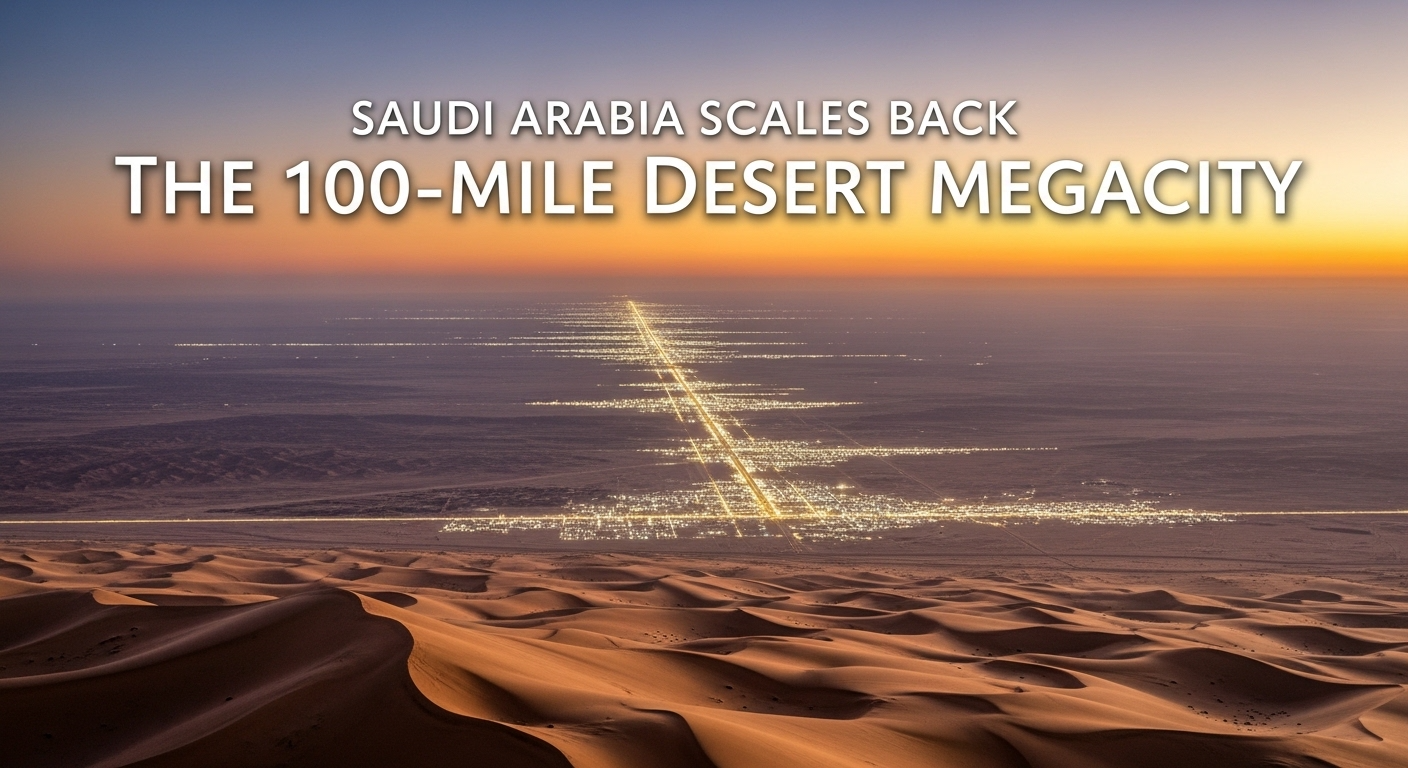
When Saudi Arabia unveiled The Line in 2021, it read like something lifted from a science fiction novel. A 100-mile-long city with no roads, no cars, and no carbon emissions, stretching across the desert like a gleaming ribbon of glass and steel. Residents would travel from one end to the other in 20 minutes on a high-speed underground rail. Everything would be walkable, sustainable, and powered entirely by clean energy.
It was one of the most audacious urban planning proposals in history. And now, it is being significantly scaled back.
The kingdom of Saudi Arabia is reassessing the scope, cost, and timeline of The Line as financial realities collide with visionary ambition. The story of what happened is a fascinating case study in the gap between what governments promise and what they can actually deliver.
What The Line Was Originally Supposed to Be
To understand the scale of the revision, you first need to understand the scale of the original promise.
The Line was not just a city. It was a statement. Saudi Crown Prince Mohammed bin Salman presented it as a model for how humanity should build urban environments in the 21st century, a rejection of traditional city planning built around cars and sprawl.
The concept involved two enormous parallel mirrored facades stretching 170 kilometres across the Tabuk region of northwestern Saudi Arabia. Inside those facades, stacked vertically, would be residential neighbourhoods, parks, schools, shops, and cultural venues, all connected by a single high-speed rail line running beneath the structure.
There would be no streets at the surface level. No traffic jams, no pollution, no urban sprawl eating into the desert. The entire city would be powered by renewable energy, with food grown on-site and water recycled within the system.
The projected population was eventually set at nine million people. The estimated cost reached as high as one trillion US dollars.
The Moment the Numbers Stopped Adding Up
A project of this scale was always going to face scrutiny, but for a time the sheer boldness of the vision seemed to carry its own momentum. International media coverage was enormous. Architects, urban planners, and technology companies from around the world engaged with the concept.
Behind the scenes, however, the questions were mounting. How do you actually build a 170-kilometre enclosed structure in a desert? How do you supply nine million people with food, water, and energy in one of the most arid environments on Earth? How do you evacuate it in an emergency?
And perhaps most pressingly: how do you pay for it?
Saudi Arabia’s finances are tied to oil revenues in ways that make large, long-duration capital projects vulnerable to the volatility of energy markets. When oil prices fluctuate, the budget for Vision 2030, the broader transformation programme of which The Line is a part, fluctuates with them.
Estimates for what had actually been built or committed financially versus what had been announced began to diverge sharply. Reports emerged of workers being laid off from the Neom development site, of construction targets being missed, and of internal debates about whether the original vision was achievable within any realistic timeframe.
The leadership had to make a choice. Continue committing to a trillion-dollar promise, or adapt.
What Is Actually Being Scaled Back
The revised plans represent a fundamental reduction in scope, not just a delay.
Rather than a 170-kilometre structure housing millions of residents, the current trajectory appears to focus on building a much smaller initial section, potentially just a few kilometres in length, that could function as a proof-of-concept or technology demonstration zone.
The pivot in purpose is equally significant. Rather than a residential megacity, the project appears to be shifting toward a data hub and technology-focused development, leveraging the infrastructure investment already made to position Saudi Arabia in the digital economy rather than the urban planning one.
| Original Vision | Scaled-Back Direction |
|---|---|
| 100-mile car-free megacity | Smaller initial section, technology-focused hub |
| Up to 9 million residents | Significantly reduced population target |
| Estimated cost up to $1 trillion | Major reduction in financial commitment |
| Completion across decades | Near-term deliverable section prioritised |
Dr. Sarah Al-Mubarak, an urban planning expert, described the decision as “a pragmatic response to the realities of cost pressures” and a demonstration of the kingdom’s ability to adapt when circumstances demand it.
Why a Data Hub Makes Strategic Sense
The pivot toward a technology and data-centred development is not simply a face-saving measure. It actually aligns with where Saudi Arabia wants to go economically.
Vision 2030, the programme that gave birth to The Line, has always been fundamentally about reducing Saudi Arabia’s dependence on oil revenues. Diversifying into technology, tourism, entertainment, and financial services has been the strategic goal from the beginning.
A technology park or data hub in the Tabuk region, built using some of the infrastructure already developed for The Line, advances that goal at a fraction of the original cost. It also has a clearer path to revenue generation and international investment than a residential megacity that would take decades to fill.
Regional economic analyst Ahmed Khalil pointed out that the pivot “aligns with the kingdom’s broader economic diversification goals”, framing it as a strategic realignment rather than a retreat.
Read More: https://onetreegrill.site
The Broader Neom Vision Is Still Alive
It is important to distinguish The Line from the wider Neom project, because not everything associated with Neom is being scaled back in the same way.
Neom is the overarching development programme for the Tabuk region, and it encompasses several distinct projects beyond The Line. These include Sindalah, a luxury island development in the Red Sea; Atiqa, an industrial and clean energy hub; and Magna, a coastal tourist destination.
Some of these components are progressing more smoothly than The Line, partly because they are more conventional in scope and more directly tied to near-term revenue through tourism and investment.
The kingdom is not abandoning its ambition to transform the Tabuk region. It is being more selective about which parts of that ambition it pursues first, and on what timeline.
What This Tells Us About Megaproject Ambition
The Line’s journey from announcement to scaled-back reality is not an unusual story in the history of megaprojects. It is actually a very common one.
Research on large infrastructure projects consistently finds that they run over budget, behind schedule, and under-deliver on their original promises at rates that are remarkably consistent across countries, sectors, and decades. The problem is not unique to Saudi Arabia or to The Line.
What makes The Line distinctive is the visibility and ambition of the original announcement. Most governments propose incremental expansions of existing cities or infrastructure. Saudi Arabia proposed building an entirely new type of city from scratch in the middle of a desert. The gap between that promise and deliverable reality was always going to be wider than most.
Urban development specialist Dr. Fatima Hamad framed it as a challenge that “governments must strike between ambitious visions and practical feasibility”, noting that the ability to adapt and pivot is itself a form of strategic intelligence, not a failure.
The Human Cost That Often Gets Lost
When coverage focuses on the architectural ambition and financial figures associated with projects like The Line, the human dimension can get overlooked.
The Tabuk region already has residents, some of whom were displaced to make way for the Neom development. Reports of forced relocations from the Huwaitat tribe, including documented cases of violence against those who refused to leave, attracted significant international criticism and drew attention to the human costs of the kingdom’s transformation agenda.
As The Line is scaled back and repurposed, the question of what happens to those who were displaced for a project that may now look quite different from what was originally promised becomes more pointed.
Accountability for the impacts of megaprojects on existing communities rarely features prominently in the announcements that accompany them. It should.
What Comes Next for The Line
The project is not dead. It has been redefined, and that distinction matters.
Saudi Arabia has invested billions in land preparation, infrastructure development, and global marketing for the Neom brand. Walking away entirely would represent a significant write-down of both financial and reputational capital.
The most likely near-term outcome is the completion of a smaller, commercially viable section of The Line that can serve as a working demonstration of some of the original concepts, particularly around technology integration and sustainability design. That section could attract business tenants, technology companies, and researchers in ways that generate returns on the investment already made.
Whether that constitutes a success or a failure depends heavily on how you define the original goal. If the goal was always to build a 170-kilometre city housing nine million people, then scaling back to a few kilometres of technology campus is a dramatic reduction. If the goal was to attract international investment, position Saudi Arabia as a technology leader, and diversify the economy, then a smaller, functional, profitable development still advances those aims.
The Line’s story is not over. But the chapter being written now looks quite different from the one that began with such fanfare a few years ago.
Frequently Asked Questions
1. What was The Line originally supposed to be? The Line was conceived as a 170-kilometre-long linear city in the Tabuk desert, completely free of roads and cars, powered by renewable energy, and housing up to nine million residents. It was one of the most ambitious urban planning proposals ever announced by any government.
2. Why is Saudi Arabia scaling back The Line? The primary reasons are the astronomical projected costs, estimated at up to one trillion US dollars, combined with oil price volatility that makes committing to long-duration trillion-dollar projects financially precarious. Questions about feasibility have also played a role.
3. What is The Line being replaced with? Current indications suggest the focus is shifting toward a smaller initial section with a technology and data hub orientation, rather than a residential megacity. This aligns more closely with Saudi Arabia’s economic diversification goals and represents a more achievable near-term deliverable.
4. How much has already been spent on The Line? Exact figures are difficult to confirm publicly, but billions of dollars have been committed to land preparation, infrastructure work, international marketing, and architectural development since the project was announced.
5. Is the wider Neom project also being scaled back? Not uniformly. Some Neom components are progressing more smoothly than The Line, particularly those tied more directly to near-term revenue generation through tourism and investment, such as the Sindalah island development.
6. What is Vision 2030 and how does The Line fit into it? Vision 2030 is Saudi Arabia’s national transformation programme designed to reduce economic dependence on oil revenues by diversifying into technology, tourism, entertainment, and other sectors. The Line was one of its most high-profile components, designed to demonstrate the kingdom’s commitment to innovation.
7. Were people displaced to make way for The Line? Yes. Members of the Huwaitat tribe in the Tabuk region reported forced displacements, and there were documented cases of violence against those who refused to leave. This has drawn significant international criticism and human rights concern.
8. How common is it for megaprojects like this to be scaled back? Very common. Research consistently shows that large infrastructure and development projects across all countries and sectors run over budget and under-deliver on their original scope at high rates. The Line’s trajectory is unusual in scale but not in pattern.
9. Is a data hub a viable replacement for a residential megacity? From a financial returns perspective, potentially yes. A technology campus can generate revenue through business tenants, research partnerships, and infrastructure services in ways that a half-built residential city cannot. Whether it justifies the original investment depends on how returns are calculated.
10. What does the scaling back of The Line mean for Saudi Arabia’s international reputation? It is a reputational challenge that the kingdom is managing carefully. The framing of the change as a strategic pivot rather than a failure is important to maintaining investor confidence in Vision 2030 and in the kingdom’s broader transformation agenda.
11. Could The Line still be built in its original form eventually? It seems highly unlikely in the near to medium term. The original vision required sustained political will, massive financial commitment, and technological solutions to problems that have not yet been fully solved. None of those conditions appear to be in place.
12. What technology was The Line supposed to showcase? The original design featured underground high-speed rail, autonomous transportation systems, AI-managed infrastructure, vertical farming, closed-loop water recycling, and 100 percent renewable energy generation. Some of these technologies remain central to whatever scaled-back version proceeds.
13. How does The Line compare to other ambitious city-building projects globally? Several governments have attempted purpose-built new cities in recent decades, including Egypt’s New Administrative Capital and Malaysia’s Putrajaya. Most have taken significantly longer to develop than planned and have struggled to attract the populations originally projected for them.
14. What are the implications for the construction and architecture firms involved? Significant restructuring of contracts and workforces has already been reported. Firms that oriented major divisions around the scale of the original Line project are having to adapt, and some reports indicate substantial layoffs from the broader Neom construction programme.
15. Is there a lesson here for other countries planning megaprojects? Several. The most important is probably that the gap between announcement and delivery in large urban development projects is almost always wider than planned, and that building in flexibility and staged deliverables from the beginning produces better outcomes than committing publicly to a final vision before the foundational work has been done.