
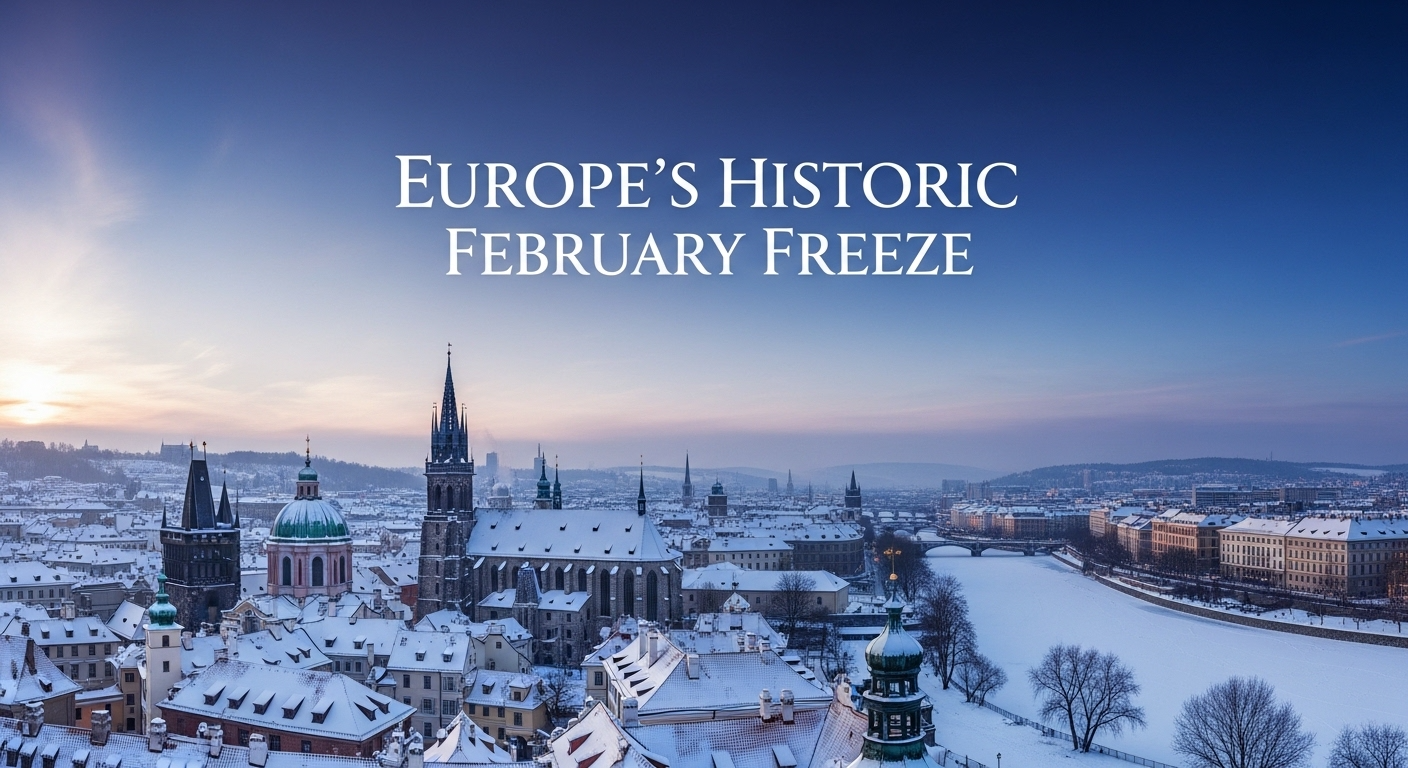
The streets of some of Europe’s most vibrant cities have fallen silent. Blanketed in ice and snow, the usual sounds of rush hour, market stalls, and outdoor cafes have given way to the crunch of frozen footsteps and the distant hum of overworked heating systems.
This is not a typical winter cold snap. What Europe is experiencing this February is something meteorologists are already describing as potentially historic, and the arguments about what caused it and what to do about it are every bit as intense as the freeze itself.
How Severe Is This Freeze?
The cold has reached across nearly the entire continent. From the Iberian Peninsula in the southwest to the Baltic states in the northeast, temperatures have fallen to record lows for this time of year in multiple locations simultaneously.
In the Netherlands, the famous canals have frozen over completely, drawing nostalgic ice skaters for the first time in years. Alpine ski resorts, which might normally be celebrating a cold snap, are instead largely deserted as travel disruptions keep visitors away. In southern European cities that rarely experience sustained freezing temperatures, infrastructure built for mild winters is struggling with conditions it was never designed to handle.
The scale and duration of the freeze is what separates this from an ordinary cold week. It is not lifting. And that is what has scientists, politicians, and energy companies watching with growing unease.
What Is Actually Causing This?
Meteorologists are not entirely in agreement on the precise drivers, which itself tells you something about the complexity of what is happening.
The leading explanation involves a significant weakening of the polar jet stream, the powerful ribbon of air that normally acts as a barrier keeping Arctic cold masses locked to the north. When the jet stream weakens or buckles, Arctic air can push much further south than usual, and that appears to be what has happened here.
La Niña is also being cited as a contributing factor. This cyclical cooling of surface temperatures in the central and eastern Pacific Ocean has ripple effects on weather patterns across the globe, and the current La Niña event is considered moderate to strong.
Some scientists are making a more controversial argument: that Arctic warming caused by climate change is itself destabilising the jet stream over the long term, making these kinds of cold intrusions into lower latitudes more likely, not less. This counterintuitive idea, that a warming planet can produce more extreme cold events in certain regions, is supported by a growing body of research but remains contested.
Climate scientist Dr. Lena Bergström framed the paradox carefully. “Events like this can actually be a symptom of a warming planet,” she said, cautioning against both overreaction and dismissal. The key, she argued, is avoiding knee-jerk conclusions in either direction.
The Climate Change Debate the Freeze Has Reignited
Every time an extreme weather event hits Europe, the same argument begins almost immediately. Is this climate change? Is this proof? Or is this just weather?
The freeze has reignited that debate with particular intensity. On one side, researchers point to the long-term trend of increasing weather extremes, including both heatwaves and anomalous cold events, as consistent with what climate models predict for a world where the Arctic warms faster than the rest of the planet.
On the other side, more cautious voices in the scientific community are pushing back against using any single weather event, however dramatic, as evidence for or against the broader climate trajectory. “The relationship between climate change and short-term weather is complex,” several researchers have noted, warning against conclusions that outrun the available evidence.
What both sides broadly agree on is that the frequency and intensity of extreme weather events is increasing over time. Whether this specific freeze belongs in that category or sits within historical natural variability is the question that remains genuinely open.
The Political Firestorm
While scientists debate causes, politicians across Europe are dealing with consequences. And the political arguments are significantly less measured than the scientific ones.
In several countries, leaders and commentators have seized on the freeze as an argument against ambitious green energy policies. The reasoning runs something like this: Europe has moved too fast toward renewables, left itself exposed on energy security, and is now watching its citizens struggle to heat their homes as a result. “We need affordable energy now,” the argument goes. “Environmental targets are a luxury we cannot afford in a crisis.”
The counter-argument, made with equal force from the other side, is that Europe’s dependence on imported natural gas is precisely the vulnerability the green transition was designed to eliminate. The freeze has exposed how exposed the continent remains to price spikes and supply disruptions in fossil fuel markets. The answer, in this reading, is to accelerate the shift to domestic renewables, not retreat from it.
Energy economist Markus Hoffmann tried to hold both realities at once: “The immediate priority must be to protect the vulnerable”, while not losing sight of the long-term imperative. A temporary loosening of some regulations might be necessary, he acknowledged, but the green transition cannot be abandoned.
It is a genuinely difficult tension with no clean resolution, and the political fights playing out in various European capitals reflect that difficulty honestly.
Read More: https://onetreegrill.site
The Economic Cost Is Already Enormous
Whatever the cause and whatever the political response, the economic damage is already substantial and accumulating by the day.
| Sector | Impact | Estimated Weekly Loss |
|---|---|---|
| Retail | Reduced foot traffic, widespread closures | €1.2 billion per week |
| Hospitality | Cancelled bookings and events | €750 million per week |
| Manufacturing | Supply chain disruptions, production halts | €500 million per day |
| Transportation | Delays, cancellations, logistics collapse | €300 million per day |
The retail and hospitality sectors are bearing the heaviest immediate burden, with many businesses already weakened by years of pandemic-related disruption now facing another crisis they had no capacity to absorb. Some fear this could be a final blow for operators who have been running on thin margins for years.
Manufacturing is facing a compounding problem. Supply chains disrupted by frozen roads and cancelled flights feed into production halts, which feed into delivery delays, which ripple outward to customers and downstream industries. The automotive sector has been particularly affected, combining its ongoing supply chain vulnerabilities with the additional pressure of frozen workforces and energy shortages.
Urban planner and climate adaptation specialist Isabelle Dupont described the broader picture bluntly: “We live in an increasingly unpredictable world”, and the infrastructure of many European cities and industries was designed for a climate that no longer reliably exists.
Europe’s Energy Dilemma
At the heart of the crisis is a question that European policymakers have been trying to answer for years and have not fully resolved: how do you keep the lights on and homes warm today while transitioning away from the energy sources that make that possible tomorrow?
The freeze has pushed that question from theoretical to urgent.
| Energy Source | Share of Europe’s Mix | Freeze Impact |
|---|---|---|
| Natural gas | 24% | Demand surge, supply constraints, price volatility |
| Renewable energy | 22% | Demand increase, some supply disruption from weather |
| Coal | 16% | Pressure to increase use despite environmental costs |
| Nuclear | 25% | Stable but limited capacity to meet peak surge demand |
Natural gas is the most immediate pressure point. With supplies already constrained by the ongoing conflict in Ukraine, the surge in heating demand has stressed the system further, sending prices upward and raising genuine concerns about availability in the coldest weeks ahead.
Renewable energy faces its own irony in a freeze: solar output drops in overcast conditions, and some wind turbines require de-icing protocols in extreme cold. Renewables remain essential to the long-term picture, but they are not without weather-related vulnerabilities either.
The spectre of increased coal use is hovering over the debate. Some governments are quietly considering whether short-term reliance on coal is unavoidable. Environmentalists are pushing back hard. Neither side has an easy argument when the alternative to burning coal might be people unable to heat their homes.
The Threat to European Unity
Beyond economics and energy, the freeze is testing something more fragile: European political cohesion.
The continent has spent years building consensus around shared climate commitments and coordinated energy policy. That consensus was always more fragile in some member states than others, and a crisis of this scale gives those who were already sceptical a powerful argument to break from the common framework.
Countries with different energy mixes, different economic vulnerabilities, and different political climates are responding differently. Some are doubling down on the green agenda, framing the freeze as proof that the transition needs to happen faster. Others are retreating toward national energy independence, even if that means reversing commitments made at the European level.
The risk of fragmentation is real. If individual nations pursue conflicting energy policies in response to the freeze, the common framework that has underpinned European climate strategy becomes significantly harder to sustain.
The divide between wealthy urban centres, which can generally absorb economic disruption more readily, and struggling rural and industrial regions, which often cannot, adds another layer of political tension to an already complicated picture.
What Comes Next for Europe
The freeze will end. It always does. But the questions it has raised will not resolve themselves when the temperature rises.
The debate about what caused this event and what it means for climate policy will continue long after the ice has melted. The economic damage will take months or years to fully assess. The political arguments about green policy versus energy security will intensify rather than fade as governments face elections and voters look for someone to hold accountable.
What the most constructive voices across the political and scientific spectrum are advocating for is not a choice between economic survival and environmental action, but a serious investment in making both possible simultaneously: better insulated housing, more resilient energy grids, faster renewable buildout, and smarter urban infrastructure that does not become paralysed every time the weather goes to an extreme.
Whether European governments have the political appetite for that kind of investment in the middle of a crisis is the central question. History suggests that crises either sharpen political will or fracture it. Right now, Europe is finding out which way this one goes.
Frequently Asked Questions
1. What is causing the historic February freeze in Europe? The primary drivers appear to be a significant weakening of the polar jet stream, which normally keeps Arctic air masses to the north, combined with the influence of a La Niña weather pattern. Some scientists also argue that long-term Arctic warming linked to climate change is making these cold intrusions more likely over time.
2. Does this freeze prove or disprove climate change? Neither. Single weather events cannot definitively confirm or refute long-term climate trends. What scientists do broadly agree on is that the frequency and intensity of weather extremes is increasing globally, and this event is consistent with that broader pattern, even if the precise causal link remains complex.
3. How significant is the economic damage? Substantial and accumulating. Estimated losses across retail, hospitality, manufacturing, and transportation exceed €2.5 billion per week across the most affected sectors, with some analysts expecting the final figure to be considerably higher once indirect effects are included.
4. Why is natural gas such a vulnerability during this freeze? Europe relies on natural gas for approximately 24 percent of its energy mix, and much of that supply is imported. With supplies already constrained by the ongoing conflict in Ukraine, the surge in heating demand during the freeze has pushed prices up and raised concerns about availability.
5. Could Europe face widespread blackouts? It is a genuine risk in the most severely affected areas. Power grids are operating near capacity in some regions, and a combination of extreme demand, frozen infrastructure, and supply constraints creates conditions where localised or broader outages become possible.
6. Are renewable energy sources reliable in extreme cold? They can be, but they are not without weather-related vulnerabilities. Solar output decreases under heavy cloud cover and snow, and some wind infrastructure requires maintenance in extreme cold. Nuclear provides stable output but cannot quickly scale up to meet a sudden demand surge.
7. Is there pressure to increase coal use during the freeze? Yes. Several governments are quietly considering whether short-term increases in coal use are unavoidable to meet heating demand. Environmentalists are strongly opposed, but the political pressure in some countries is significant.
8. What is the La Niña effect and how does it contribute? La Niña refers to a cyclical cooling of Pacific Ocean surface temperatures that alters atmospheric circulation patterns globally. The current La Niña event is considered moderate to strong and is believed to be contributing to the unusual cold across parts of the northern hemisphere this winter.
9. Is the jet stream weakening related to climate change? This is an active area of scientific research. A growing body of evidence suggests that rapid warming in the Arctic is disrupting the jet stream, making it more prone to the kind of buckling that allows cold air to spill southward into Europe. But this theory remains contested among climate scientists.
10. How is the freeze affecting the most vulnerable people in Europe? The elderly, those in poorly insulated housing, and people on fixed low incomes are disproportionately affected by both the cold itself and the energy price spikes that accompany it. Emergency services in several countries are reporting increased demand for welfare checks and cold-related medical emergencies.
11. What are European governments doing in response? Responses vary by country and reflect the underlying political debates. Some are expanding emergency energy subsidies and hardship payments. Others are exploring temporary regulatory relief for energy producers. A few are quietly increasing coal or fuel oil use to keep supply stable.
12. How does this affect Europe’s climate commitments? It creates significant political pressure against them. Some governments are using the freeze as justification to delay or soften emissions targets, while others argue it demonstrates precisely why the green transition needs to accelerate. The outcome of that debate will shape European climate policy for years.
13. What would a resilient European energy system look like? Experts broadly agree it would involve more domestic renewable generation, better grid interconnection between countries, higher energy efficiency standards in buildings, strategic gas storage reserves, and reduced dependence on any single imported fuel. Getting there requires investment that has so far moved more slowly than the targets demand.
14. How long is this freeze expected to last? Long-range forecasts suggest some relief is approaching, but the timeline varies by region. The deeper concern among climate scientists is not the duration of this individual event but the likelihood of more frequent extreme weather events, in both directions, in future winters.
15. What can individuals and businesses do to prepare for future events like this? Practical steps include improving home insulation, diversifying heating sources where possible, maintaining emergency supply reserves, and supporting local and national policy pushes for more resilient infrastructure. Businesses that have not yet conducted energy resilience assessments are being strongly encouraged to do so before next winter.