
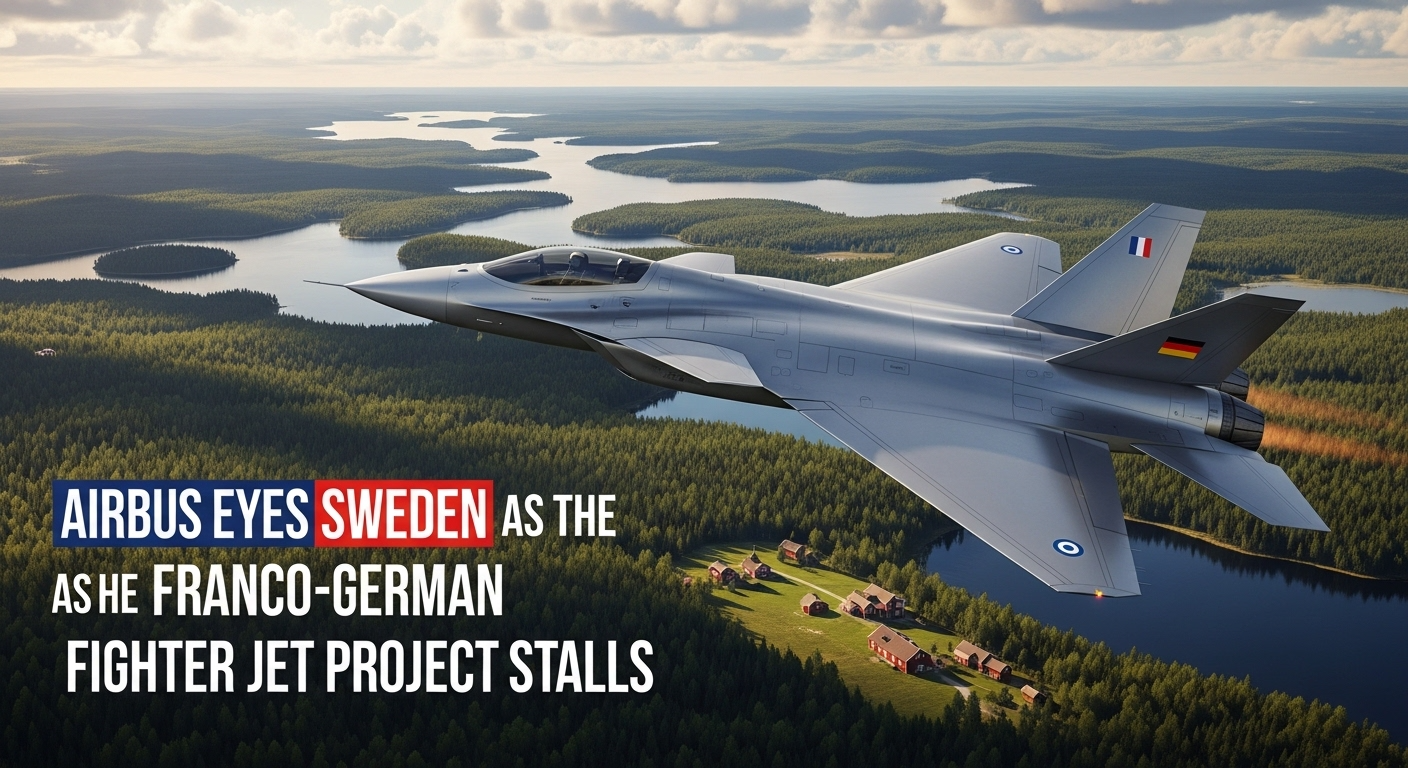
The grand vision of a unified European next-generation fighter jet was supposed to be a statement. A symbol of what France, Germany, and Spain could build together when they put aside national rivalries and pooled their industrial and engineering resources.
That vision is now a cautionary tale about what happens when political ambition and industrial reality fail to stay in step with each other.
As the Future Combat Air System, the flagship project at the heart of European air power ambitions, continues to be hampered by delays, cost disputes, and competing national interests, Airbus is reportedly looking north. And what it has found in Sweden may reshape the conversation entirely.
The Franco-German Project: What Went Wrong
The Future Combat Air System, commonly known as FCAS, was announced with considerable fanfare as a joint venture between France, Germany, and Spain. It was meant to replace ageing fleets of Rafale and Eurofighter jets from the mid-2030s onward, producing a sixth-generation combat aircraft that would keep Europe competitive with the United States, China, and Russia.
The ambitions were enormous. A next-generation manned fighter at the centre, supported by a network of unmanned combat drones, connected by a secure data cloud, all integrated into a system-of-systems architecture that would redefine how air superiority is achieved and maintained.
The execution has been considerably less impressive than the announcement.
Negotiations between Airbus, the French defence company Dassault, and the Spanish firm Indra have repeatedly stalled over fundamental questions: Who controls the most sensitive technology? Who gets the largest share of the industrial work? Who owns the intellectual property that will define the system’s capabilities for decades?
France, given Dassault’s status as the primary aircraft manufacturer, has insisted on leading the manned aircraft component. Germany has pushed back, unwilling to invest tens of billions of euros in a project where French industrial interests take precedence. Spain has found itself navigating between the two larger partners while trying to secure meaningful work for its own aerospace industry.
The result has been years of negotiations producing frameworks and memoranda of understanding rather than hardware and flight tests. Milestones have been missed. Budgets have been revised upward. And the confidence of those watching from outside the project has eroded steadily.
Why Airbus Is Looking North
Against this backdrop of frustration, Airbus has been doing what large industrial companies do when flagship programmes stall. It has been exploring alternatives.
Sweden presents an interesting proposition for several reasons. Saab, the Swedish aerospace and defence company, has a track record of building capable, cost-effective combat aircraft that punch well above the weight suggested by Sweden’s relatively modest size. The Gripen fighter is widely respected in the international defence market precisely because it was designed with operational practicality and export potential in mind, rather than primarily as a statement of national prestige.
More specifically, Saab has been developing a concept that aligns with where the future of air combat appears to be heading: the loyal wingman drone.
What the Loyal Wingman Concept Actually Is
The loyal wingman is not a new idea, but it is one whose time appears to be arriving faster than many expected.
The concept involves an autonomous or semi-autonomous unmanned aircraft designed to operate alongside a manned fighter, extending the pilot’s reach and capability without requiring additional human crews. These drones can fly ahead of manned aircraft into more dangerous airspace, carrying out reconnaissance, acting as decoys, delivering electronic warfare effects, or in some configurations carrying weapons payloads.
The United States has been developing its own loyal wingman programmes for years, including the Boeing MQ-28 Ghost Bat developed in collaboration with Australia. China has demonstrated similar capabilities. The risk for Europe is being left behind in a domain that may prove decisive in future high-intensity conflicts.
Saab’s approach to the loyal wingman concept is characterised by flexibility and modularity. Rather than designing a single expensive platform for a single role, the Swedish system is intended to be adaptable, capable of being configured for different mission types and integrated with different manned aircraft as partners.
For Airbus, this is precisely the kind of agile, near-term deliverable that the FCAS programme has so far failed to produce.
The New Axis: Berlin, Stockholm, Toulouse
The potential partnership between Airbus and Saab would create an interesting new alignment in European defence industry politics.
Airbus is headquartered in Toulouse, with major operations in Hamburg and Madrid. Saab is based in Linköping, Sweden. A formal collaboration between the two would create a working relationship that crosses the traditional Franco-German axis that has dominated European defence cooperation for decades.
| Old Framework | Potential New Dynamic |
|---|---|
| France, Germany, Spain leading FCAS | Airbus and Saab as a parallel or complementary partnership |
| Dassault, Airbus, Indra as primary industrial partners | Saab entering as a technology and unmanned systems contributor |
| Manned next-generation fighter as primary focus | Unmanned loyal wingman as near-term deliverable alongside longer-term manned programme |
| Delays measured in years | Saab drone potentially fieldable much sooner |
Sweden’s recent NATO membership adds a geopolitical dimension to this story. Sweden joining the alliance changes the calculus around defence industrial cooperation within Europe, making Swedish companies more natural partners for NATO-aligned programmes than they were during Sweden’s decades of formal neutrality.
The inclusion of Saab in a major Airbus programme would also challenge the traditional power dynamics of European aerospace, where French and German interests have historically set the terms of collaboration.
Read More: https://onetreegrill.site
What This Means for the Future of Air Warfare
The broader strategic significance of the Airbus-Saab discussion goes beyond industrial politics. It reflects a genuine shift in how military planners and aerospace engineers are thinking about air combat.
The sixth-generation manned fighter jet that FCAS promises remains relevant and important. Manned aircraft bring qualities to complex, dynamic combat environments that autonomous systems cannot yet fully replicate: human judgment, adaptability under ambiguous conditions, and the ability to make nuanced decisions when rules of engagement are unclear.
But the operational environment those manned aircraft will fly in is changing rapidly. Air defence systems are becoming more capable, making it increasingly dangerous for manned aircraft to penetrate contested airspace without support. The loyal wingman concept addresses this directly: by sending autonomous drones ahead or alongside, the risk to human pilots is reduced while the reach and effect of the overall force is extended.
The integration of artificial intelligence and machine learning into these autonomous systems takes the concept further still. A drone that can assess threats in real time, make targeting decisions within established parameters, and adapt its flight path and tactics to evolving battlefield conditions represents a qualitative shift in what air power can achieve.
Defence policy expert Dr. Emily Bauer framed the stakes clearly: “This partnership could position Europe as a leader in the rapidly evolving field of autonomous air warfare”, giving European forces capabilities that rivals would find difficult to counter.
The Ethical and Accountability Questions That Cannot Be Ignored
Any serious discussion of autonomous systems in combat has to confront the questions that make many people deeply uncomfortable. And those questions are legitimate.
When an autonomous drone makes a decision to engage a target, who is accountable if that decision is wrong? The programmer who wrote the targeting algorithm? The military commander who authorised the mission parameters? The government that procured the system? Or the company that built it?
International humanitarian law requires that attacks on military objectives distinguish between combatants and civilians, that they are proportionate, and that precautions are taken to minimise civilian harm. These requirements were developed with human decision-makers in mind. Translating them into machine-readable parameters that function reliably across the full range of combat scenarios is an enormously difficult technical and ethical challenge.
Military ethics expert Dr. Sarah Wilkinson identified the core tension: “We must carefully consider the ethical and accountability implications of autonomous systems in warfare.” The potential battlefield advantages of loyal wingman drones do not dissolve these concerns. They make engaging with them more urgent.
The development of clear legal frameworks, operational doctrines, and technical standards for autonomous military systems is running behind the pace of the technology itself. That gap needs to close before large-scale autonomous combat systems are fielded, not after.
What Happens to FCAS Now?
The FCAS programme is not dead, and it would be premature to write its obituary on the basis of Airbus’s interest in Sweden.
The political and industrial investment in FCAS is substantial, and all three partner nations have committed too much publicly to simply walk away from the programme without significant face-saving. France in particular has tied its defence industrial identity closely to the project.
What the Airbus-Saab discussions suggest is something more nuanced: that the path to European air power superiority may not run exclusively through FCAS, and that parallel development of near-term unmanned capabilities could proceed independently of the longer-term manned aircraft programme.
Aerospace industry analyst John Smith put the competitive logic of the Saab drone concisely: “A more nimble and adaptable solution that could be fielded much sooner” than the flagship project addresses a real capability gap in the near term, regardless of what happens to FCAS in the long term.
The two tracks are not mutually exclusive. A loyal wingman system developed through an Airbus-Saab collaboration could eventually be integrated into whatever the FCAS programme ultimately produces, assuming that programme reaches production. Or it could become the foundation of a separate unmanned combat capability that complements existing Eurofighter and Rafale fleets in the interim.
Where This Leaves the European Defence Industry
The broader picture of European defence is one of significant flux. Russia’s war in Ukraine has forced a rapid reassessment of military capabilities, spending levels, and industrial capacity across the continent. Countries that had allowed their defence industries to atrophy through decades of the post-Cold War peace dividend are now scrambling to rebuild.
In that context, the question of whether European aerospace can deliver credible next-generation air power on a timeline that matches the threat environment has become genuinely urgent. A flagship programme that continues to slip its milestones while geopolitical risks increase is not just an industrial embarrassment. It is a strategic liability.
The Airbus-Saab dynamic, if it develops into a formal partnership, represents one possible answer to that urgency: a pragmatic, near-term capability path that does not wait for the grand consensus to resolve itself before producing something that can actually be flown and fielded.
Whether it is the right answer, or whether it complicates the larger FCAS ambition more than it helps it, will depend on decisions being made right now in boardrooms in Toulouse, Stockholm, Paris, and Berlin.
Frequently Asked Questions
1. What is FCAS and why has it been delayed? FCAS, the Future Combat Air System, is a joint next-generation fighter jet programme involving France, Germany, and Spain. It has been delayed primarily by disputes over technology ownership, industrial work-share, and intellectual property rights between the partner nations and their respective aerospace companies.
2. What is Saab’s loyal wingman drone? It is an autonomous or semi-autonomous unmanned aircraft designed to operate alongside manned fighter jets, providing reconnaissance, electronic warfare, decoy, and potentially strike capabilities. The concept extends the reach and capability of manned aircraft while reducing risk to human pilots.
3. Why is Airbus interested in partnering with Saab specifically? Saab’s loyal wingman concept offers a near-term, flexible, and technologically sophisticated capability that contrasts with the stalled and complex FCAS programme. Airbus is attracted to the pragmatic, modular approach that Saab has developed.
4. Would an Airbus-Saab partnership replace FCAS? Not necessarily. The two could run in parallel, with the loyal wingman drone addressing near-term capability gaps while FCAS continues its longer-term development. Whether they would eventually be integrated or remain separate programmes is unclear.
5. How does Sweden’s NATO membership affect this situation? Sweden’s recent accession to NATO makes Saab a more natural partner for NATO-aligned European defence programmes than it was during Sweden’s decades of formal neutrality, removing political complications that might previously have made such collaboration more difficult.
6. What are loyal wingman drones used for in combat? Their primary roles include advance reconnaissance in contested airspace, electronic warfare and jamming, acting as decoys to exhaust enemy air defence systems, and in some configurations carrying weapons payloads for strike missions. They extend what a manned aircraft force can achieve without putting additional pilots at risk.
7. Which other countries are developing loyal wingman systems? The United States and Australia are the most advanced, with the Boeing MQ-28 Ghost Bat programme. China has also demonstrated loyal wingman capabilities. The risk for Europe is falling behind in this domain as other major powers accelerate their programmes.
8. What role does artificial intelligence play in these systems? AI enables the drone to process sensor data in real time, identify and classify targets, adapt flight paths to threats, and make tactical decisions within pre-set parameters. The degree of autonomy varies by design and by the rules of engagement under which the system operates.
9. What are the main ethical concerns about autonomous combat drones? The core concerns involve accountability when autonomous decisions cause harm, the technical difficulty of encoding humanitarian law requirements into machine decision-making, the risk of malfunction or hacking, and the potential for lowering the threshold for armed conflict by reducing the human cost of initiating it.
10. How does the Gripen fighter’s reputation inform confidence in Saab as a partner? The Gripen has been widely praised for cost-effective design, reliability, and export success in markets where value for money matters as much as raw performance. It demonstrates Saab’s ability to deliver capable, practical aerospace systems, which is precisely the quality Airbus is looking for in a partner given the FCAS experience.
11. What does a new Berlin-Stockholm-Toulouse axis mean for France? It potentially dilutes French influence in European defence cooperation by introducing a significant non-French partner into the Airbus ecosystem. How France responds to this dynamic will be an important variable in whether the Airbus-Saab partnership can develop without generating political friction.
12. Could the loyal wingman be integrated with existing European fighters like the Eurofighter or Rafale? That is one of the most strategically interesting possibilities. If the Saab-derived system can be designed to operate with current fleets rather than only with future ones, it could provide near-term capability enhancement to European air forces that are still years away from seeing FCAS aircraft.
13. What is the timeline for the Saab loyal wingman programme? Exact public timelines are limited, but the system is understood to be further along in development than the FCAS programme, which is one of the reasons it is attractive to Airbus as a near-term deliverable.
14. How does the war in Ukraine affect European appetite for autonomous military systems? Significantly. The war has demonstrated the operational effectiveness of unmanned systems at scale in a high-intensity conflict, including both commercial drones adapted for military use and purpose-built military UAVs. European militaries have watched this closely and drawn conclusions about the importance of autonomous capability.
15. What would a formal Airbus-Saab partnership actually look like? It could take several forms, from a joint development programme for a specific drone system, to a broader technology-sharing arrangement, to an equity stake or acquisition. The exact structure would depend on what each company wants to protect and what they are willing to pool, as well as the regulatory environment governing European defence industrial consolidation.