
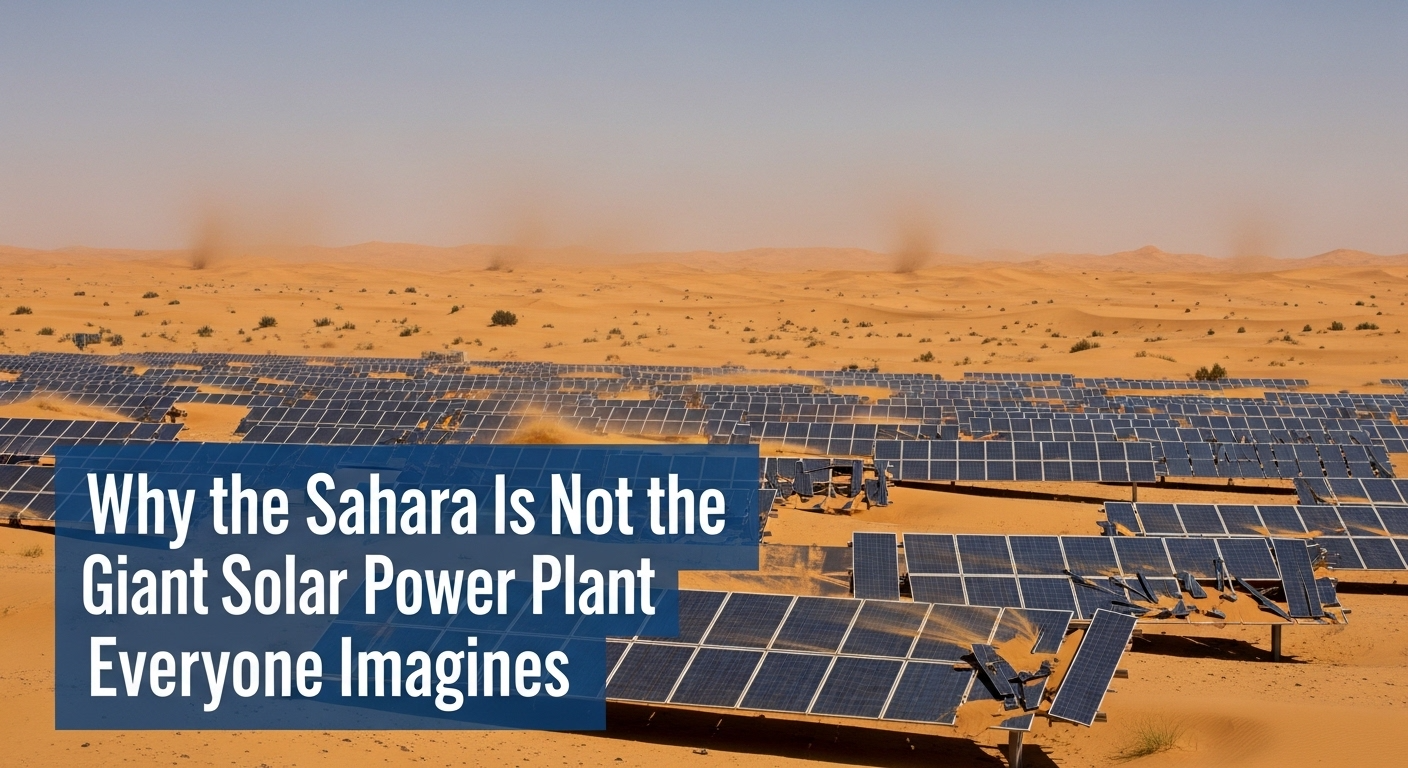
The pitch sounds almost too good to be true. The Sahara Desert receives more solar energy than any other place on Earth. It covers roughly nine million square kilometres of largely uninhabited land. Cover even a fraction of it in solar panels, the argument goes, and you could power the entire world many times over.
It is the kind of clean energy vision that gets shared enthusiastically, discussed in lecture theatres, and cited in climate optimism articles. And it is not entirely wrong. The solar resource is genuinely enormous.
But between that resource and a functioning power supply for Europe and Africa lies a distance that is not just geographical. It is technical, political, financial, and human. And that distance is considerably larger than the simple version of this story admits.
The Desert Is Not a Blank Canvas
The first thing worth understanding about the Sahara is that it is not a passive, empty space waiting to be developed. It is one of the most hostile environments on the planet, and it pushes back against large-scale infrastructure in ways that engineers and investors have repeatedly underestimated.
Temperatures in the Sahara can exceed 50 degrees Celsius in summer. Thermal cycling of that intensity stresses solar panel materials over time, accelerating degradation in ways that laboratory testing under more moderate conditions does not always predict. Warranties and performance guarantees designed for installations in Germany or California do not translate directly to the Tanezrouft Basin.
The dust problem is more serious than it initially appears. Saharan dust is fine, pervasive, and accumulates rapidly on horizontal and tilted surfaces. A solar panel coated in a thin layer of dust can lose a significant fraction of its generating capacity within days. Cleaning panels in a location with limited water supply, extreme heat, and minimal local infrastructure is not a trivial operational task. It requires water, labour, equipment, and a supply chain that does not currently exist at the scale that a gigawatt-level desert solar farm would demand.
Dr. Fatima Denton, Director of the United Nations University Institute for Natural Resources in Africa, captured the core issue precisely: “Realising the Sahara’s renewable energy potential requires a realistic and pragmatic approach” that honestly addresses the unique challenges of the desert environment rather than treating them as minor details to be resolved later.
The Infrastructure That Does Not Exist Yet
Even if the solar panels were installed and maintained perfectly, you still need to get the electricity somewhere useful.
The Sahara is remote not just in the sense of being far from population centres, but in the sense of being almost entirely absent of the infrastructure that modern energy projects depend on: roads for equipment access, water for cooling and cleaning, communications networks for monitoring and control, grid connections for export.
Building that infrastructure from scratch, across some of the most challenging terrain on Earth, before a single kilowatt-hour is generated, represents an upfront capital investment that fundamentally changes the economics of desert solar. Cost estimates for Saharan solar projects often focus on the panels themselves. The infrastructure required to make those panels operational and connected to consumers is sometimes treated as a secondary consideration. It should not be.
The transmission challenge compounds this further. Getting electricity from a solar farm in the Algerian desert to a household in Munich or Madrid requires high-voltage direct current transmission lines running thousands of kilometres, crossing national borders, marine environments, and the political jurisdictions of multiple sovereign states.
Each of those crossings requires negotiation, permitting, and ongoing cooperation. Each kilometre of transmission line represents capital expenditure and energy loss. Electricity does not travel for free, and by the time Saharan solar power reaches a northern European consumer, a meaningful fraction of what was generated has been lost in transmission.
The Politics Are Harder Than the Engineering
The Sahara spans more than ten countries, each with its own government, regulatory framework, economic interests, and relationship with the others. Getting a large-scale energy project approved in a single country is complex enough. Getting one approved that requires cooperation, land access, transmission rights, and revenue-sharing arrangements across multiple jurisdictions is a different order of difficulty entirely.
Land rights add another layer of friction. Large tracts of the Sahara that appear uninhabited on satellite maps are used by pastoral and nomadic communities whose traditional land-use practices and legal claims are not always reflected in national cadastres or property records. Displacing or disregarding these communities to build solar installations generates conflict, legal challenges, and reputational damage that has derailed projects at advanced stages.
The security environment in parts of the Sahel region, which borders the Sahara to the south, adds another layer of operational risk. Infrastructure projects in areas affected by terrorism, civil conflict, or political instability require investment in security measures that add cost and complexity, and that may still prove insufficient if conditions deteriorate.
Foreign ownership of energy infrastructure in a developing country also raises sovereignty concerns that are not always taken seriously by the project developers and European governments promoting these initiatives. The question of who captures the economic benefits of Saharan solar, and whether local populations and national governments receive a fair share, is a genuine issue of justice, not just a negotiating detail.
The DESERTEC Cautionary Tale
The most instructive case study for anyone excited about the Saharan solar vision is the DESERTEC initiative, launched in 2009 with enormous fanfare and the backing of major European corporations.
DESERTEC’s premise was straightforward: harness the solar and wind energy potential of North Africa and the Middle East, transmit it via undersea cables to Europe, and meet a substantial fraction of the continent’s electricity needs with clean desert power.
The initiative attracted serious investment and serious attention. It was not a fringe proposal. It had the backing of companies like Siemens, Deutsche Bank, and Munich Re, and the intellectual endorsement of prominent climate scientists and energy economists.
Within a few years, the major industrial backers had withdrawn. Siemens left in 2012. The project was restructured repeatedly. Some of the individual country projects within the broader DESERTEC framework continued in modified forms, but the grand vision of a North Africa-to-Europe solar power corridor never materialised.
The reasons were precisely those that sceptics had flagged from the beginning: costs were higher than projected, the political negotiations were more complex and slower than anticipated, the technology for long-distance transmission was less mature than assumed, and the business model required guarantees and commitments from European governments that were not forthcoming at the scale needed.
Dr. Ismaïl Mouline, Director of the Moroccan Agency for Sustainable Energy, drew the lesson carefully: “Ambitious grand schemes often falter”, and the path to sustainable energy development in the region runs through incremental, community-engaged, bottom-up approaches rather than top-down megaprojects.
Read More: https://onetreegrill.site
What Is Actually Working in the Region
None of this means that solar energy development in North Africa is futile or misguided. Some projects are working well, and they share common characteristics that distinguish them from the grand Saharan power plant vision.
Morocco’s Noor Ouarzazate solar complex is one of the most frequently cited examples. Located in the pre-Saharan region rather than the deep desert, it combines concentrating solar power technology with battery storage, can generate electricity around the clock rather than only when the sun shines, and was developed with serious attention to local employment and supply chain integration.
Crucially, it was designed primarily to serve Morocco’s domestic electricity needs rather than to export power to Europe. That alignment of incentives, where the host country benefits directly rather than primarily serving as an energy colony for richer nations, changes the political economy of the project fundamentally.
Smaller-scale solar installations serving rural communities that are currently off-grid represent another genuinely successful model. Bringing reliable electricity to communities that have never had it, using locally maintained solar systems, addresses a real and urgent need in ways that a continental power export project does not.
The rapid decline in solar panel costs over the past decade has made these smaller, distributed projects more financially viable than they were when DESERTEC was conceived. The economics that make local solar sensible today are genuinely different from the economics of 2009.
The Real Potential and the Realistic Path
The Sahara’s solar resource is not a myth. On a purely physical basis, the energy falling on the desert in a single day exceeds global electricity consumption for an extended period. That resource is real.
But energy resources and energy systems are not the same thing. Oil reserves in the ground are not petrol in a car. Solar radiation falling on sand is not electricity in a home. The gap between the resource and the usable energy involves infrastructure, technology, economics, politics, and institutional arrangements that the simple version of the Saharan solar story systematically ignores.
The more honest and ultimately more useful framing is this: the Sahara can and should contribute meaningfully to the energy future of North Africa and potentially of Europe, but it will do so through a collection of well-designed, well-governed, locally embedded projects rather than through a single grand scheme that treats the desert as an empty canvas for European energy ambitions.
| Challenge | Realistic Approach |
|---|---|
| Harsh desert environment | Desert-specific solar technology and maintenance protocols |
| Lack of infrastructure | Incremental investment tied to specific project needs |
| Geopolitical complexity | Regional cooperation frameworks, local ownership structures |
| Transmission costs and losses | Prioritise meeting local and regional demand before long-distance export |
| Land rights and community impacts | Community engagement and equitable benefit-sharing from project inception |
The path forward is slower, less dramatic, and less photogenic than the image of endless desert panels. But it is more likely to actually result in electricity reaching the people who need it, on timelines and terms that are sustainable over decades rather than promising on paper and then collapsing under the weight of problems that were foreseeable from the beginning.
Frequently Asked Questions
1. Could the Sahara theoretically power the entire world? In purely physical terms, the solar energy falling on the Sahara is far more than enough to meet global electricity demand. But theoretical resource potential and practical generating capacity are very different things, separated by all the technical, financial, and political challenges described above.
2. Why did DESERTEC fail? DESERTEC was undermined by a combination of factors: costs that exceeded projections, political negotiations that proved more complex than anticipated, insufficient commitment from European governments to purchase power at prices that made the business model viable, and the withdrawal of major corporate backers once the difficulties became clear.
3. What is the biggest practical obstacle to Saharan solar? Opinions differ, but transmission is arguably the most fundamental barrier. The electricity generated in the Sahara is not useful unless it can reach consumers, and doing that requires thousands of kilometres of high-voltage transmission infrastructure across multiple national borders, at enormous cost.
4. How does dust affect solar panels in the Sahara? Saharan dust is fine-grained and accumulates rapidly on panel surfaces. Efficiency losses from dust accumulation can be significant within days of cleaning. Regular cleaning requires substantial water, labour, and logistics in an environment where all three are difficult and expensive to provide.
5. Are there any Saharan solar projects that are actually working? Yes. Morocco’s Noor Ouarzazate complex is a well-regarded example. It serves domestic Moroccan electricity needs rather than primarily exporting to Europe, uses concentrating solar power with storage, and was developed with attention to local employment and supply chain development.
6. Who would benefit from large-scale Saharan solar exports to Europe? This is a contested question. European consumers and climate goals would benefit from the clean electricity. Whether the host countries and local communities would receive a fair share of the economic benefits depends heavily on the ownership structures, revenue-sharing arrangements, and regulatory frameworks governing specific projects.
7. Why do solar panels degrade faster in the Sahara than in Europe? The combination of extreme temperatures, intense ultraviolet radiation, thermal cycling, and abrasive dust creates a more demanding environment than the temperate conditions for which most standard commercial solar panels are designed and warranted.
8. What is concentrating solar power and how is it different from photovoltaic panels? Concentrating solar power uses mirrors or lenses to focus sunlight onto a receiver, generating heat that drives a turbine to produce electricity. Unlike photovoltaic panels that only generate electricity while the sun shines, concentrating solar power can store heat and generate electricity after sunset, addressing the intermittency problem.
9. Could undersea cables realistically transmit solar power from North Africa to Europe? The technology exists and is already used in some existing interconnectors. But the costs are substantial, the cable routes must navigate complex marine environments and national jurisdictions, and the energy losses over long distances reduce the efficiency of transmission. It is technically possible but economically challenging at the scale envisioned by projects like DESERTEC.
10. What role do local communities play in successful solar projects in the region? A central one. Projects that engage local communities from inception, incorporate local employment and supply chain development, and share economic benefits equitably with host communities have generally fared better than those that treat the land as an empty resource and the local population as peripheral.
11. How have solar panel costs changed since DESERTEC was launched? Dramatically. The cost of photovoltaic panels has fallen by more than 90 percent since 2009, making the economics of solar projects in the region fundamentally different from what they were when DESERTEC was conceived. Projects that were not financially viable then may be viable now, particularly those serving local demand.
12. Is the security situation in the Sahara a genuine risk for solar projects? In parts of the Sahel region bordering the Sahara, yes. Terrorism, civil conflict, and political instability in Mali, Niger, Burkina Faso, and Libya have created genuine operational risks for infrastructure projects. Northern Saharan countries like Morocco, Tunisia, and parts of Algeria present different and generally more stable security environments.
13. What does land rights mean in practice for Saharan solar development? Large areas of the Sahara that appear uninhabited are used by nomadic and pastoral communities for grazing, migration routes, and other traditional practices. These communities often have legal or customary land claims that must be addressed. Ignoring them creates conflict; addressing them properly takes time and changes project economics.