
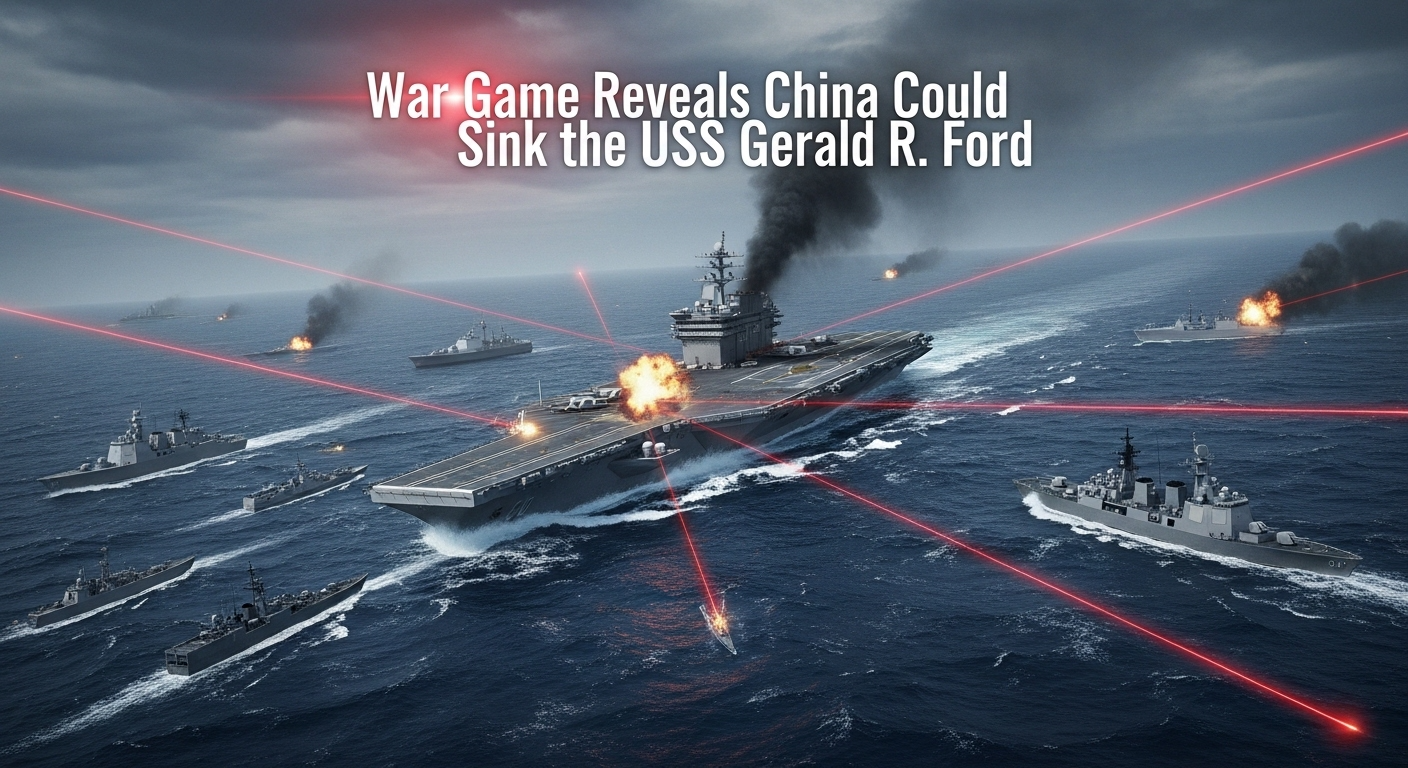
The USS Gerald R. Ford is a $13 billion engineering achievement. It is the most advanced aircraft carrier ever built, capable of launching and recovering more aircraft more quickly than any vessel in history, equipped with electromagnetic launch systems, advanced radar, and layers of defensive technology that would have seemed like science fiction a generation ago.
A leaked war game says it might not be enough.
The classified exercise, details of which were obtained by The New York Times, simulated a high-intensity conflict between the United States and China over Taiwan. The results left the Pentagon deeply uncomfortable. In the scenario, the Ford faced a coordinated assault combining anti-ship missiles, cyber weapons, and space-based interference, and it did not survive.
Inside the defence establishment, the findings have forced a reckoning with a question that was previously more theoretical than urgent: Is the aircraft carrier, the centrepiece of American global military power for eight decades, still viable against a peer adversary?
What the War Game Actually Simulated
The exercise was conducted jointly by the US Navy and Air Force and focused on a Taiwan conflict scenario, the contingency that defence planners increasingly treat as the most likely flashpoint for direct military confrontation between the United States and China.
In the simulation, the Ford was positioned in the Western Pacific as part of a carrier strike group responding to Chinese military action. What followed was a coordinated multi-domain attack designed not to overwhelm the carrier through sheer conventional firepower but to systematically dismantle its ability to defend itself before the killing blow was delivered.
The sequence moved through distinct phases. First, cyber intrusions targeted the carrier’s critical systems, compromising its ability to process information, coordinate its defensive weapons, and communicate with supporting ships and aircraft. Then came the missiles, dozens of them, arriving in patterns designed to saturate the carrier strike group’s interceptor capacity. Space-based systems degraded navigation and targeting throughout.
The combination proved devastating in the simulation. The Ford sustained crippling damage and ultimately did not survive the engagement.
China’s Anti-Ship Arsenal: The Weapons Designed Specifically for This
The weapons that featured in the war game are not hypothetical. They are real, tested, and increasingly capable.
China’s DF-21D and DF-26 ballistic missiles are often referred to in defence circles as “carrier killers”. They are designed with a specific purpose: to strike large naval vessels at ranges that keep the launching platform well outside the defensive perimeter of a carrier strike group.
The DF-21D has an estimated range of around 1,500 kilometres. The DF-26 extends that to approximately 4,000 kilometres. Both use manoeuvrable re-entry vehicles that can adjust their trajectory in the terminal phase, making interception significantly harder than against a conventional ballistic trajectory.
The logic of these weapons is straightforward. A carrier strike group is built around concentric defensive rings: the carrier’s own close-in weapons, escorting destroyers and cruisers with Standard Missile interceptors, and air patrol by F/A-18s. Anti-ship ballistic missiles are designed to penetrate or exhaust those rings through speed, manoeuvrability, and numbers.
China has also invested heavily in land-based anti-ship cruise missiles, submarine-launched weapons, and surface ship armaments that create overlapping threat envelopes across the Western Pacific.
| Weapon System | Type | Estimated Range |
|---|---|---|
| DF-21D | Anti-ship ballistic missile | ~1,500 km |
| DF-26 | Anti-ship ballistic missile | ~4,000 km |
| YJ-18 | Anti-ship cruise missile | ~540 km |
| CJ-10 | Land-attack / anti-ship cruise missile | ~1,500 km |
Why the Ford’s Design Creates Specific Vulnerabilities
It might seem paradoxical that the most advanced carrier ever built is also described as particularly vulnerable. The explanation lies in the relationship between capability and target value.
The Ford is large. Its flight deck is approximately 330 metres long. Its displacement is around 100,000 tonnes. These dimensions make it an easier target for precision-guided weapons than smaller, more dispersed platforms would be.
Its reliance on advanced electronics is simultaneously its greatest operational strength and a significant defensive weakness. The systems that allow the Ford to coordinate air operations at scale are also systems that can be disrupted by sophisticated cyber intrusion or electronic warfare. Degrading situational awareness does not have to destroy a carrier to make it far more vulnerable to the weapons that follow.
| Vulnerability | Operational Impact |
|---|---|
| Large physical profile | Easier to target with precision-guided munitions |
| Advanced electronics dependency | Susceptible to cyber attack and electronic warfare |
| Limited interceptor magazine depth | Insufficient against saturation missile tactics |
| High concentration of capability | Single target represents enormous strategic value |
The interceptor depth issue is particularly significant in the context of saturation tactics. The Ford’s carrier strike group has a finite number of Standard Missiles and other interceptors. A saturation attack designed to exhaust that inventory before the decisive strike arrives exploits this constraint directly.
A former senior Pentagon official quoted in the reporting was direct: “The Ford-class carriers are the centrepiece of US naval power, but this war game shows they may not be able to survive the kind of high-end fight we could see against China.”
The Kill Chain China Has Been Building
The war game scenario is best understood not as a collection of individual weapon systems but as a carefully designed sequential process in which each phase creates the conditions for the next.
Step one is intelligence, surveillance, and reconnaissance. China’s constellation of military satellites, over-the-horizon radars, and maritime patrol assets are designed to locate carrier strike groups in near-real time. You cannot target what you cannot find, and China has invested heavily in the finding part.
Step two is cyber and electronic warfare, the phase that degrades the carrier’s ability to detect, track, and respond to incoming threats. This does not need to be a complete shutdown. Degrading response time by even seconds in a saturation missile engagement can be the difference between successful interception and catastrophic impact.
Step three is the missile barrage itself, timed and sequenced to arrive in patterns that challenge the carrier strike group’s defensive coordination. Anti-ship ballistic missiles arriving on steep, fast terminal trajectories simultaneously with cruise missiles arriving on low, sea-skimming trajectories require different defensive responses, creating coordination challenges for the defending force.
Step four is space-based interference, which compounds the effects of steps two and three by further degrading navigation, targeting, and communication throughout the engagement.
The chain is designed to be more than the sum of its parts. Each element amplifies the effectiveness of the others.
Read More: https://onetreegrill.site
The Strategic Dilemma This Creates for Washington
The implications of the war game extend well beyond the fate of one ship. They go to the heart of how American military power has been structured and projected for eighty years.
The aircraft carrier is not just a weapons platform. It is the physical embodiment of the United States’ ability to project military power anywhere in the world within days. It is the instrument through which American presidents have signalled resolve, deterred adversaries, and intervened in crises from the Korean War to the Gulf War to countless smaller contingencies.
If that instrument is genuinely vulnerable to the weapons China has developed, the deterrent logic that underpins it is undermined. An adversary that believes it can sink an American carrier faces a fundamentally different calculation about the costs and risks of military aggression than one that does not.
A leading defence analyst framed the broader stakes starkly: “This war game is a wake-up call for the US. It shows that our traditional approaches to deterrence and power projection may not be sufficient.”
The industrial dimension compounds the strategic one. The Ford-class programme represents an enormous sunk cost. The Ford herself cost approximately $13 billion. Her sister ships, the John F. Kennedy, the Enterprise, and those still under construction, represent additional tens of billions. Abandoning or radically restructuring the programme is not a decision any administration makes easily or cheaply.
What the Pentagon Is Actually Considering
The war game findings have not produced paralysis. They have produced an accelerated conversation about what the US Navy needs to look like for the threat environment of the 2030s and beyond.
Several directions are being actively discussed within the defence establishment.
The first is distributed lethality: moving away from concentration of capability in a small number of very large, very expensive, and very visible platforms toward a larger number of smaller ships, each carrying meaningful strike and defensive capability. A fleet of 20 destroyers with long-range strike missiles is harder to saturate and more expensive to destroy than a single carrier.
The second is long-range strike from stand-off distances, reducing the need for carriers to operate within range of Chinese anti-ship missiles by developing weapons that can hit targets at ranges where those missiles cannot reach back. This includes hypersonic missiles, long-range bombers, and submarine-launched options.
The third is enhanced missile defence, both in terms of interceptor depth and in developing technologies capable of defeating manoeuvring ballistic re-entry vehicles more reliably than current systems can.
The fourth, and perhaps most long-term, is cyber and electronic warfare investment: both hardening US systems against the kind of intrusion the war game demonstrated and developing offensive capabilities that could disrupt China’s kill chain before it is completed.
What This Means for the Taiwan Question
The specific scenario of the leaked war game, a Taiwan conflict, is not chosen arbitrarily. Taiwan is the contingency that concentrates minds in both Washington and Beijing more than any other.
China considers Taiwan a province under its sovereignty that will eventually be reunified, by force if necessary. The United States maintains a policy of strategic ambiguity, neither formally committing to defend Taiwan nor ruling it out, while providing Taiwan with defensive weapons and maintaining a presence that signals the costs of military action would be high.
That calculus depends heavily on China believing the costs would indeed be high. If the war game findings suggest that China could sink the Ford, they simultaneously suggest that the cost to the United States of intervention might be greater than previously assumed, which has direct implications for whether American deterrence remains credible.
A defence policy expert summarised the dynamic: the war game findings mean the US needs to fundamentally rethink its strategy and force structure if it wants to maintain its edge in the Pacific, and that rethinking needs to happen at a pace that matches the timeline of the threat.
Key Terms You Need to Understand This Story
| Term | What It Means |
|---|---|
| Anti-ship ballistic missile | Precision-guided ballistic missile designed to strike large naval vessels at long range |
| Saturation attack | Overwhelming defensive systems by launching more weapons simultaneously than they can intercept |
| Kill chain | The sequential process linking target identification to weapon impact |
| Electronic warfare | Using electromagnetic energy to disrupt enemy sensors, communications, and weapons |
| Distributed lethality | Spreading military capability across many smaller platforms rather than concentrating it in a few large ones |
Frequently Asked Questions
1. What was the leaked war game and who conducted it? It was a classified simulation conducted jointly by the US Navy and Air Force designed to assess how a carrier strike group centred on the USS Gerald R. Ford would perform in a high-intensity conflict with China over Taiwan. Details were obtained by The New York Times.
2. Did the war game definitively prove that China can sink the Ford? No. War games are simulations with assumptions built in, and their outcomes are sensitive to those assumptions. What the exercise demonstrated is that under plausible conditions, China’s combination of anti-ship missiles, cyber capabilities, and space-based systems could overwhelm the Ford’s defences. It is a warning, not a certainty.
3. What are anti-ship ballistic missiles and why are they so threatening? They are ballistic missiles with manoeuvrable re-entry vehicles designed to strike moving naval targets at ranges of 1,500 to 4,000 kilometres. Their speed, manoeuvrability in the terminal phase, and the difficulty of intercepting ballistic trajectories make them a qualitatively different threat than conventional anti-ship cruise missiles.
4. How does cyber warfare fit into China’s anti-carrier strategy? Cyber intrusion into a carrier’s systems degrades its ability to detect, track, and respond to incoming threats. Even partial degradation of response time or situational awareness significantly increases the vulnerability of the ship to the physical weapons that follow.
5. What is saturation tactics and why do they work? Saturation involves launching more weapons than a defensive system has interceptors to engage. Every defensive system has a finite magazine. If you can exhaust it before your most important weapons arrive, the final missiles meet no defence.
6. How many Ford-class carriers does the US have or plan to have? The Ford herself is in service. The John F. Kennedy is nearing completion. The Enterprise is under construction. Additional hulls are planned. The total planned class size has been subject to budget debates, but the programme envisions replacing all Nimitz-class carriers over time.
7. What is distributed lethality and is the US Navy moving toward it? Distributed lethality is the concept of spreading offensive and defensive capability across a larger number of smaller platforms rather than concentrating it in a few large ones. There is active discussion and some movement in this direction within the Navy, but carrier programmes represent enormous institutional and industrial momentum.
8. Could the US defend a carrier strike group against the attack described? Potentially, under different conditions. Better early warning, more interceptors, more effective cyber defences, and different tactical positioning could all improve survivability. The war game presumably modelled specific conditions. Changing those conditions changes the outcome.
9. How does this affect American deterrence in the Pacific? Deterrence depends on an adversary believing that aggression will be met with a response whose costs outweigh the gains. If China believes it can sink an American carrier, the deterrent credibility of carrier-based power projection in the Western Pacific is reduced.
10. Is China’s military capability being overstated in this analysis? Some defence analysts do argue that war game outcomes can reflect assumptions that favour the challenging scenario, and that China’s military capabilities, while growing rapidly, also face significant limitations in areas like logistics, joint operations experience, and underwater warfare. The picture is not uniformly pessimistic for the United States.
11. What would the loss of a US carrier in combat mean politically? It would be the most significant naval loss the United States has suffered since World War Two. The political and psychological impact would be enormous, both domestically and in terms of how allies and adversaries assess American resolve and capability.
12. Are other nations’ navies also vulnerable to China’s anti-ship capabilities? Yes. Any surface warship operating within China’s anti-access area denial bubble faces risks from these weapons. This is a concern not only for the US Navy but for Japan, Australia, South Korea, and any other naval force that might operate in the Western Pacific in a conflict scenario.
13. What role do submarines play in countering these threats? Submarines operating in Chinese coastal and littoral waters pose a significant threat to China’s naval surface forces and potentially to its land-based infrastructure. The US submarine force is considered one of its strongest asymmetric advantages, and much Pacific strategy discussion revolves around how that advantage can be maintained and leveraged.
14. Is the Pentagon’s response to this war game public? Not fully. Official responses have been guarded, as the underlying exercise remains classified. What is publicly known is that discussions about distributed force structure, long-range strike, and the role of carriers in high-end conflict have intensified significantly in recent years, which is consistent with the concerns the war game raises.
15. Should the US stop building aircraft carriers? This is one of the most contested questions in US defence policy. Critics argue that carriers are too expensive and too vulnerable in the current threat environment. Defenders argue that carriers provide unique capabilities, presence, and flexibility that no other platform can replicate, and that the answer is better defence rather than abandonment of the concept. The debate is genuine, ongoing, and unresolved.