
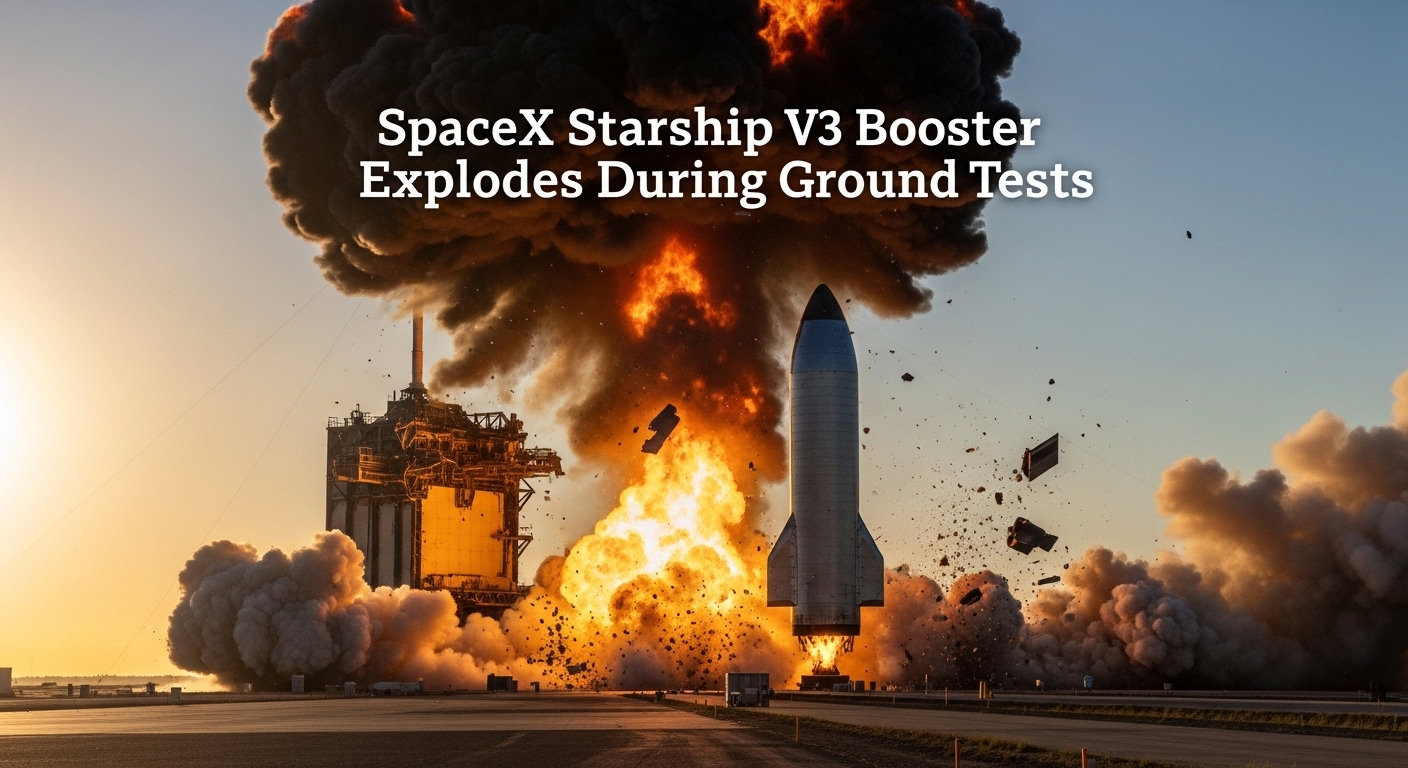
It took only seconds. A burst of pressurised gas, a flash at ground level, and then a thick rolling cloud of dark smoke swallowing the base of the launch stand.
SpaceX’s first Starship V3 booster, known as B18, was destroyed during what should have been a routine cryogenic pressure test at the company’s Starbase facility in Boca Chica, Texas.
No engines were loaded. No propellant was on board. No injuries were reported. But the loss of B18 has sent a significant ripple through the Artemis programme’s already pressured timeline and raised fresh questions about the pace of testing as Starship moves closer to carrying humans toward the Moon.
Here is what happened, why the V3 generation matters, and what this incident means for the race back to the lunar surface.
What Happened at Boca Chica
B18 had just been raised onto its test stand at Starbase for a series of cryogenic pressure tests. These tests are standard in rocket development. Engineers chill tanks and plumbing to extremely low temperatures using liquid nitrogen or similar inert substances, then apply pressure to check the structural integrity of welds, seals, and pressurisation circuits.
Footage captured by independent observers and space tracking communities showed the test proceeding apparently normally before a sudden energetic event at the base of the vehicle. The explosion-like release was followed by the dense smoke cloud that is now being widely circulated online.
SpaceX confirmed the incident, describing it officially as an anomaly during gas pressure tests. The company emphasised that no propellant was involved, which significantly limited the potential for a catastrophic outcome compared to a fuelled vehicle failure.
Early assessments from those who have reviewed available footage and sensor data suggest the problem originated in the ground support systems or pressurisation plumbing rather than in the core tank structure of B18 itself. However, SpaceX has not released a complete technical account, and analysis of the data is expected to take days or weeks.
Why No Propellant Matters
The absence of methane and liquid oxygen from B18’s tanks is a genuinely important detail, not a routine disclaimer.
A fully fuelled Starship carries enough liquid methane and liquid oxygen to produce an explosion with consequences measured in city blocks. A cryogenic pressure test using inert gas or nitrogen carries a fraction of that stored energy. The hardware damage from a test like this, while significant, is categorically different from what a propellant failure would produce.
This is also why SpaceX runs these tests before loading propellant. The entire point is to discover structural and system weaknesses while the consequences of failure are bounded and manageable. B18 did exactly what a developmental prototype is supposed to do: it revealed a problem in conditions where the cost is hardware and data, not lives and facilities.
That does not make the loss comfortable. B18 was the first V3 prototype, and the data it was meant to generate about the new pressurisation systems and structural configurations is now lost. The programme must continue without it.
What Starship V3 Was Designed to Achieve
Starship V3 is not simply a newer version of the vehicle. It is the first major redesign specifically oriented toward meeting NASA’s requirements for the Artemis human landing programme.
Previous Starship iterations were developmental. They proved propulsion concepts, demonstrated landing techniques, and pushed the limits of what a methane-fuelled super-heavy rocket could do at full scale. They were never expected to fly humans.
V3 changes that intent. This generation introduces reworked pressurisation systems designed to improve reliability across repeated operations. Structural modifications address the demands of launching, refuelling in orbit, and re-entering the atmosphere across multiple missions. The configuration is specifically designed to be compatible with the crewed lunar lander variant that NASA has contracted SpaceX to develop under the Artemis programme.
B18 was the first prototype of this generation. Its ground test campaign was meant to produce baseline data about how the new systems behave at full scale under cryogenic and pressure conditions. That data would have shaped subsequent V3 prototypes and the engineering decisions leading toward the first integrated V3 flight. Without it, the programme proceeds with a gap in the foundation.
What B18 Was Supposed to Accomplish in 2026
According to industry reporting, B18 was scheduled to contribute to a major Starship demonstration planned for early 2026. This demonstration was designed to show that the V3 generation could complete the complex operational sequences required for a lunar mission.
These sequences include on-orbit propellant transfer, the process by which a series of tanker Starship missions fill a waiting lunar lander with enough propellant for the journey to the Moon and back. They also include long-duration coast phases and controlled re-entry of key vehicle stages. None of these have been fully demonstrated at scale.
The demonstration was intended to provide NASA and the broader Artemis team with confidence that the hardware and operational concepts were maturing on schedule. With B18 gone, that milestone timeline is at risk of slipping.
SpaceX’s next V3 booster is presumably already in production given the company’s high manufacturing throughput. The question is how quickly it can be completed, tested safely, and moved through the milestones that B18 was meant to address first.
The Artemis Programme and What Is at Stake
NASA’s Artemis programme aims to return astronauts to the lunar surface for the first time since Apollo 17 in 1972. Artemis III is the mission planned to put humans on the Moon. Artemis IV follows with an expanded crew and longer surface duration.
Officially, these missions are targeted for late in the decade. Behind that official position, the timeline is already under significant pressure from multiple directions.
The Space Launch System rocket that will carry Artemis crews to lunar orbit has its own development history of delays and cost overruns. The spacesuits required for surface operations took longer than expected to certify. And the Starship-based lunar lander, which must be waiting in lunar orbit when the astronauts arrive, depends on a chain of prerequisite demonstrations that have not yet been completed.
Artemis III specifically requires Starship to complete a series of propellant transfer demonstrations in Earth orbit before a lander can be positioned at the Moon. Each of those tanker flights must be verified to work reliably before a crewed mission can depend on the result. The B18 loss does not directly remove any of those demonstrations from the schedule, but it slows the maturation of the hardware that must execute them.
Starship Programme Timeline: Key Elements and Current Risk
| Programme Element | Planned Role | Impact of B18 Loss |
|---|---|---|
| Booster B18 | First V3 cryogenic and pressure testing | Data gap, need for replacement booster |
| V3 configuration baseline | Foundation for all Artemis-related hardware | Potential design review and minor delays |
| 2026 demonstration flight | Showcase refuelling and long-duration operations | Risk of schedule slippage increases |
| Propellant transfer demos | Required before Artemis III lunar lander positioning | Dependent on V3 maturation, indirectly affected |
| Artemis III crewed landing | First lunar surface return since Apollo | Any V3 delay feeds into this timeline |
This table reflects the programme elements most directly affected by the B18 anomaly. The causal chain between a ground test failure and a crewed lunar mission is long, and many other factors will influence the ultimate Artemis III date. The B18 loss represents one additional friction point in an already pressured schedule rather than a decisive programme failure.
Why Cryogenic Tests Are Among the Most Unforgiving in Rocket Development
From outside the fence, a cryogenic pressure test is one of the least dramatic events in a rocket programme. No engines fire. No propellant burns. There is frost on the tanks, vapour drifting around the base of the stand, and not much else visible.
Inside the hardware, the conditions are extreme.
Tanks and plumbing are being chilled to temperatures approaching minus 200 degrees Celsius. The materials contract. Seals that are dimensionally correct at room temperature behave differently at cryogenic temperatures. Welds that looked clean under X-ray inspection may have micro-cracks that only propagate under the combination of thermal contraction and internal pressure.
Engineers deliberately push the system above its normal operating pressure during these tests to expose weak points before they appear during a real mission. If one element of the pressurisation circuit fails at these loads, the energy release can be nearly instantaneous.
V3 introduced new pressurisation routes and valve configurations that have not been tested at full scale before. Ground support hardware, including the feed lines and quick-disconnect systems connecting the facility to the rocket, can fail just as easily as the rocket structure itself. Small assumptions about how gas pockets form or vent can initiate cascades that the system was not designed to absorb.
In this context, a ground test failure, while painful, is the system working as intended at a philosophical level. The alternative is discovering the same failure mode during flight.
The Tension Between Rapid Iteration and Human-Rating
SpaceX’s development philosophy is built on a specific principle: build hardware faster than you can analyse it on paper, test it to destruction, learn from the failure, and build the next version incorporating what you learned.
This approach produced Falcon 9, which now has one of the most reliable launch records in the history of rocketry. It produced the early Starship prototypes that crashed on descent in spectacular fashion before achieving successful landings. In each case, the failures were fast, informative, and ultimately productive.
The challenge as Starship moves toward crewed use is that the tolerance for this kind of productive failure changes. NASA has formal human-rating requirements that include safety factors, redundancy standards, and failure mode analyses that take significant time to document and certify. The expectation of occasional dramatic ground-level anomalies sits uncomfortably with the institutional processes of a human spaceflight programme.
Congressional oversight adds further pressure. Each incident at Starbase generates questions about whether the agency has placed too much of the lunar programme’s dependency on a single contractor using an approach that produces visible failures on a regular basis.
SpaceX’s counter-argument is that the failures are happening before humans are involved, which is exactly the point of aggressive ground testing. NASA’s uncomfortable position is agreeing with that argument while defending it to legislators who read the footage differently.
Political and Regulatory Consequences
The B18 explosion follows an earlier incident in June 2025 in which debris from a separate Starship anomaly scattered beyond the immediate test area, including across the Mexican border. That event drew responses from environmental organisations and local residents and resulted in a period of regulatory review before testing could resume.
Each incident of this kind adds political weight to calls for slower, more documented testing pacing. The Federal Aviation Administration, which licenses commercial launches and test activities, has authority to require extended investigation periods following anomalies. How it responds to the B18 situation will affect how quickly the next V3 booster can be tested.
NASA officials face their own version of this pressure. The agency’s leadership must publicly defend the Artemis-Starship partnership while managing genuine uncertainty about when key milestones will be achieved. Every unplanned failure at Starbase becomes evidence for critics who argue the programme is structurally dependent on hardware that is not yet mature enough for the role assigned to it.
SpaceX’s Likely Response and Recovery Path
SpaceX has consistently demonstrated the ability to produce new hardware faster than outside observers expect. The company operates its own manufacturing facility at Starbase, and boosters are not built in small batches by outside contractors. When a booster is lost, the programme does not stop. Engineers begin extracting data from sensors and footage while manufacturing continues on the next vehicle.
B19, the next V3 booster, is presumably in some stage of production. The question is how the findings from B18’s failure will be incorporated into B19 before its own test campaign begins. If the anomaly was caused by ground support hardware rather than the rocket itself, the fix may be relatively straightforward and quick to implement. If the pressurisation system design itself contributed to the failure, more substantial engineering changes may be required.
The company’s track record suggests it will move quickly. The institutional pressure from NASA’s schedule, the congressional scrutiny of Artemis costs, and SpaceX’s own commercial motivations all push in the same direction. Prolonged investigation periods are expensive in ways that go beyond the direct cost of a lost booster.
What This Means for the Moon Landing Timeline
The honest answer to whether B18’s destruction pushes the next Moon landing further toward the 2030s is: probably slightly, but not definitively.
A single ground test failure does not cancel a programme or eliminate a decade of development. It adds friction to a timeline that was already under pressure from multiple sources. The cumulative effect of several such friction points, each adding weeks or months to specific milestones, is what ultimately shifts large programme completion dates.
Artemis III requires the following sequence to work: a Space Launch System launch delivering crew to lunar orbit, a Starship lander already waiting there after being positioned by earlier missions, and that lander having been filled with propellant through a series of tanker missions all of which have been successfully demonstrated. Every element of that chain must mature on schedule for the mission date to hold.
B18’s loss does not break any single link in that chain directly. It slows the maturation of the hardware that must eventually forge those links. The difference between Artemis III launching in 2029 or 2031 may ultimately come down to whether incidents like this one accumulate faster than SpaceX’s production and iteration rate can compensate for them.
The Bigger Picture: SpaceX’s Position in the Space Race
Despite the B18 incident, SpaceX retains a commanding lead in heavy-lift launch capability. Falcon 9 is the most reliable operational rocket in the world by launch cadence. Falcon Heavy has no commercial equal for large payloads to geosynchronous orbit. And no other vehicle under development approaches Starship’s target payload capacity for both lunar and eventual deep space missions.
China’s lunar programme is progressing on its own timeline, with the Long March 10 heavy-lift rocket and a proposed crewed lunar lander on a trajectory that could place taikonauts on the Moon within the same general timeframe as Artemis. Whether that constitutes a race depends partly on what definition of the word is applied, but the political framing of a competition has real effects on budget decisions and schedule pressure in both programmes.
For the international partners involved in Artemis, including the European Space Agency, the Japan Aerospace Exploration Agency, and the Canadian Space Agency, the reliability of Starship’s development timeline is not an abstract concern. Their contributions to the programme are scheduled around milestones that Starship must achieve. Each slip in Starship’s readiness has downstream effects on the contributions and commitments of allied space agencies.
Frequently Asked Questions
Was anyone hurt in the B18 explosion?
No. SpaceX confirmed that no injuries occurred. The test was conducted without propellant loaded, which significantly limits the energy involved in any anomaly. Personnel at Starbase follow safety protocols that keep people clear of the test stand during active pressure testing.
What is cryogenic pressure testing and why is it necessary?
It is a standard rocket development procedure in which tanks and plumbing are chilled to extremely low temperatures and then pressurised to check for structural weaknesses, poor welds, and seal failures before a vehicle is used with real propellant. Finding these problems during ground testing is the entire point of the process.
How long will the investigation take?
SpaceX has not published a timeline. Similar anomaly investigations in the past have taken weeks to months depending on the complexity of the failure mode and whether regulatory review is required. The FAA may also conduct its own review before authorising resumed testing.
Will this delay Artemis III?
It adds pressure to an already tight schedule. Whether it produces a measurable delay in Artemis III depends on how quickly SpaceX can roll out the next V3 booster, what the investigation reveals about the V3 pressurisation system, and whether regulatory review extends the gap between tests.
What is Starship V3 compared to previous versions?
V3 is the first Starship generation designed specifically to meet NASA’s human landing requirements under Artemis. It includes revised pressurisation systems, structural changes for repeated operations, and configurations compatible with the crewed lunar lander variant. Previous versions were primarily developmental.
How does this affect the competition with China’s lunar programme?
China is pursuing its own independent timeline for a crewed lunar landing. Whether the B18 incident changes the relative positioning of the two programmes depends on how quickly SpaceX recovers and whether the delay feeds into broader Artemis schedule slippage. In isolation, a single ground test failure does not significantly alter the competitive picture.
What happens to the Artemis programme if Starship is significantly delayed?
NASA would face very difficult choices. There is no currently available alternative to Starship for the lunar lander role, as Starship was selected in a competitive process and awarded contracts accordingly. A significant delay would likely force schedule revisions for Artemis III and potentially congressional budget debates about alternative approaches.
Read More Latest News and Updates
Visit onetreegrill.site for More Updates
One Booster Lost. The Moon Still Waiting. The Race Continues.
B18 is gone. The data it was supposed to provide is gone with it. Engineers at Starbase are already measuring what remains and working through what the sensor logs recorded in the final milliseconds before the anomaly.
The next V3 booster is in production. The next test window will appear on the schedule. The Artemis programme continues to move, more slowly than its most optimistic projections and faster than its critics predicted it would collapse.
SpaceX has survived more dramatic failures than this one and emerged with a stronger programme on the other side. NASA has managed contractor setbacks before and ultimately reached the Moon with Apollo despite losses that seemed decisive at the time.
The difference now is that the political and competitive context is more compressed than it was in 1969. China is not waiting. Congressional patience has limits. International partners have their own schedules to maintain.
A single booster lost in a ground test does not end the Moon race. But it is a reminder that the race is real, the hardware is hard, and the margin between the schedule that officials announce and the schedule that the physics will allow is thinner than either side of this story would prefer to admit.