
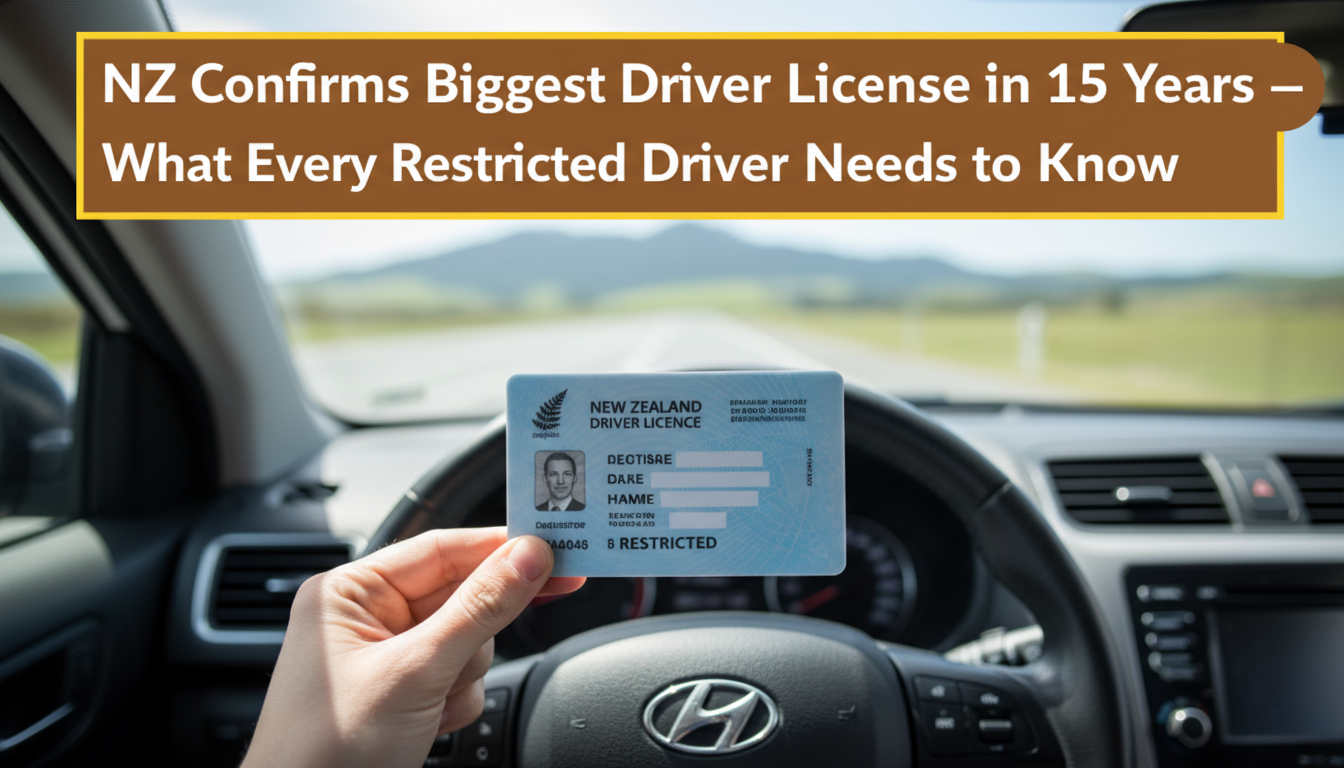
After months of consultation, the New Zealand Government has officially confirmed the most significant overhaul of the driver licensing system in 15 years. The changes affect hundreds of thousands of learner and restricted drivers across the country and will reshape how New Zealanders progress to a full licence.
Transport officials say the reforms are designed to modernise the Graduated Driver Licensing System, clear long-standing testing backlogs, and improve road safety outcomes without duplicating assessments that evidence suggests are no longer necessary at the final stage.
Here is everything you need to know about what is changing, who it affects, and when it begins.
The Single Biggest Change: No More Full Licence Test
The headline reform is the removal of the mandatory practical driving test for eligible restricted licence holders progressing to a full licence.
This is not a small adjustment. It removes a requirement that has defined the final stage of the licensing process for a generation of New Zealand drivers. For those who qualify, completing the restricted licence period with a clean record is now enough to obtain a full licence. No booking, no assessor, no nerve-wracking final assessment.
The learner and restricted practical tests remain fully in place. Only the final transition test is affected.
Who Qualifies for the Test-Free Pathway
Not every restricted driver qualifies automatically. The test-free progression applies to drivers who meet all of the following conditions.
You must have completed the required minimum period on your restricted licence, which is generally 18 months, or 12 months if you have completed an approved advanced driving course. You must have maintained a clean driving record throughout that period with no serious traffic offences. Dangerous driving, excessive speeding, and alcohol-related incidents are all considered serious and would disqualify a driver from the automatic pathway.
Drivers who do not meet these conditions may still be required to sit a practical assessment before progressing. NZTA retains the ability to require a test where safety concerns are identified.
Why Officials Made This Decision
The evidence case behind the reform is strong. Testing centre queues for full licence appointments have stretched to months in many parts of New Zealand. The failure rate at the full licence test stage is very low, meaning the vast majority of drivers sitting it were passing anyway. And the financial cost of repeated test attempts has been a genuine barrier for drivers on tighter budgets.
A transport spokesperson stated the position plainly: the evidence shows most drivers who complete their restricted period safely are ready for full licensing without another assessment. The restricted period itself, 18 months of real-world driving with its conditions and constraints, is a more comprehensive competency demonstration than a 30-minute final test.
Officials also point to rural equity. Drivers in smaller towns and farming communities often travel hours each way to reach a testing centre. Removing the final test removes that burden entirely for eligible drivers.
When the Changes Take Effect
The reform rollout begins in 2026 with a phased nationwide implementation. Drivers who already hold a restricted licence when the reforms take effect may qualify under the new rules depending on their eligibility status at that point.
NZTA has confirmed that transition arrangements will apply for drivers who have already booked full licence tests. If your test is booked and you may be eligible to progress without it, confirm your situation with NZTA before cancelling the appointment. Depending on timing and circumstances, you may be eligible for a refund of your test fee.
The learner and restricted practical tests remain mandatory and are not part of this reform.
Old System vs New System at a Glance
| Licence Stage | Previous Requirement | 2026 Reform |
|---|---|---|
| Learner to Restricted | Practical test required | Practical test still required, unchanged |
| Restricted to Full (eligible) | Mandatory practical test | No test required |
| Restricted to Full (high-risk) | Mandatory practical test | Additional assessment may still apply |
| Compliance monitoring | Standard checks | Increased compliance tracking |
| Minimum restricted period | 18 months (12 with approved course) | Unchanged |
The most significant shift is the removal of the final practical test for eligible drivers. All other core requirements remain in place. Drivers with offences or safety concerns may still be required to sit an assessment.
Emma’s Story: Months of Waiting, Finally Over
Emma is 22 and lives in Hamilton. She has been on a restricted licence longer than she planned. Booking a full licence test appointment meant waiting months, and that waiting was not cost-free. It meant continuing to drive under restricted conditions, organising her life around those limits, and paying for a booking that kept getting pushed out by availability problems.
“I’ve been waiting months for a test slot,” she said. “If I can progress without another exam, that’s a huge weight off my shoulders.”
Her experience is common. The testing backlog is real, it affects real people in real ways, and the reform directly resolves it for the majority of restricted drivers who have completed their period without incident.
The Road Safety Debate
Not everyone has welcomed the reform without question. Some road safety advocates argue that removing the final practical test weakens a safety checkpoint that provides value even for drivers who are likely to pass it.
The counterargument from officials is that 18 months of incident-free restricted driving is itself a superior safety assessment to a 30-minute observed test. A driver who has driven daily across varied conditions, weather, and traffic scenarios for a year and a half has demonstrated something a short formal assessment cannot replicate.
New Zealand operates under a Vision Zero road safety framework targeting the elimination of fatal and serious crash injuries. Officials say the reform is consistent with that framework because it concentrates safety scrutiny at the earlier stages where inexperience risk is highest, rather than at the final stage where evidence of competency already exists.
Crash data will be monitored following implementation, and the framework can be adjusted if evidence emerges that the change is affecting safety outcomes negatively.
Stronger Compliance for Serious Offenders
The removal of the final test does not mean reduced scrutiny across the board. Part of the 2026 reform package is increased compliance monitoring for serious driving offences.
Drivers who have accumulated significant demerit points, been convicted of drink driving, or committed dangerous driving offences during their restricted period will not be eligible for the automatic full licence pathway. NZTA retains authority to require additional assessment for any driver whose record gives cause for concern.
The reform is designed to reward safe behaviour during the restricted period, not to reduce accountability for unsafe behaviour. The two sides of that equation are intentional and work together.
What Restricted Drivers Should Do Right Now
The most useful step any restricted driver can take today is to establish clearly where they stand in relation to the eligibility conditions.
Find out exactly when your restricted licence was issued and whether you have completed the minimum holding period. Check your driving record honestly. If you have had any infringements, demerit points, or incidents during your restricted period, understand how those affect your eligibility before assuming you qualify for the automatic pathway.
If you have a test booked, do not cancel it until you have confirmed your eligibility with NZTA directly. Depending on the timing of your booking and your specific licence history, the right course of action will vary. Official NZTA channels are the only reliable source for eligibility confirmation.
Continue to drive responsibly between now and when you apply for your full licence. The clean record requirement applies up to the point of application, not just up to a historical date.
Rural Drivers: A Specific Benefit
For drivers in rural and regional areas, the removal of the final practical test has disproportionately significant practical value.
In many rural communities, the nearest testing centre is a long drive. The cost and time involved in attending a full licence test, potentially more than once if the first attempt is unsuccessful, has been a genuine and inequitable burden on rural drivers relative to their urban counterparts.
Removing that requirement removes the burden entirely for eligible rural drivers. A person on a farm outside Masterton or in a small town in Northland can now complete their restricted period and progress to a full licence without the logistics and costs that the testing requirement imposed.
For communities where driving is not a convenience but a necessity for daily life, reducing barriers to full licence access is a meaningful equity improvement.
Advanced Driving Courses Still Matter
One important detail that many drivers miss is the continued relevance of approved advanced driving courses under the new system.
Completing an approved course can still reduce the minimum restricted licence period from 18 months to 12 months. That means a driver who invests in an advanced course and completes it within the first few months of their restricted period can potentially be eligible for a full licence six months earlier than a driver who does not.
With the final practical test removed, the financial and time calculation around advanced courses changes slightly. But for drivers who want to progress as quickly as possible, a course that shortens the mandatory waiting period by six months still represents good value.
Frequently Asked Questions
Is the full licence test removed for everyone?
Only for eligible restricted drivers who meet the time and clean record conditions. Drivers with serious offence history or safety concerns may still be required to sit an assessment.
Do learner drivers skip any tests?
No. The learner practical test and the restricted practical test remain mandatory and unchanged.
What counts as a serious offence?
Dangerous driving, excessive speeding, drink driving, and other significant traffic violations. Minor infringements are assessed differently from serious offences.
I already have my full licence test booked. What should I do?
Contact NZTA or the testing centre directly before cancelling. Depending on your eligibility and the timing of your booking, you may be entitled to a fee refund or you may be better positioned to sit the test as planned.
Will this change my insurance premium?
No official guidance has been issued on this. Check directly with your insurer if you have concerns about how obtaining a full licence through the new pathway might affect your policy.
Does this apply to overseas licence conversions?
No. Overseas licence conversions follow a separate process with different rules and are not affected by this reform.
How do I confirm my eligibility?
Through NZTA’s official services, either online or by contacting them directly. Your eligibility depends on your specific restricted licence start date and your driving record, both of which NZTA can access and assess.
Can NZTA still require a test even if I meet the conditions?
Yes. NZTA retains the authority to require additional assessment in specific circumstances where safety concerns are identified.
Read More Latest News and Updates
Visit onetreegrill.site for More Updates
A Reform That Rewards Safe Drivers
The 2026 licensing overhaul is not about making it easier to get a full licence. It is about removing a redundant step for drivers who have already demonstrated what the step was testing.
Eighteen months of incident-free restricted driving is real evidence. A final 30-minute test conducted in familiar conditions adds almost nothing to the picture for a driver whose record is already clean. The reform acknowledges that reality and acts on it.
For Emma in Hamilton, for rural drivers who would have faced a long trip to a testing centre, and for the thousands of restricted drivers who have done everything right throughout their restricted period, the change delivers something straightforward and fair. Less administrative burden at the end of a process they have already completed with care.
Check your restricted licence start date, review your driving record, and confirm your eligibility with NZTA. If you qualify, your full licence is closer than you think and the process to get it is simpler than it has ever been.