When Sydney grandmother Elaine Turner collected her monthly prescriptions in January, she braced herself for the usual sting at the pharmacy counter. Multiple medications every month for arthritis and high blood pressure add up fast. But this year, her total was noticeably lower, and she was not complaining.
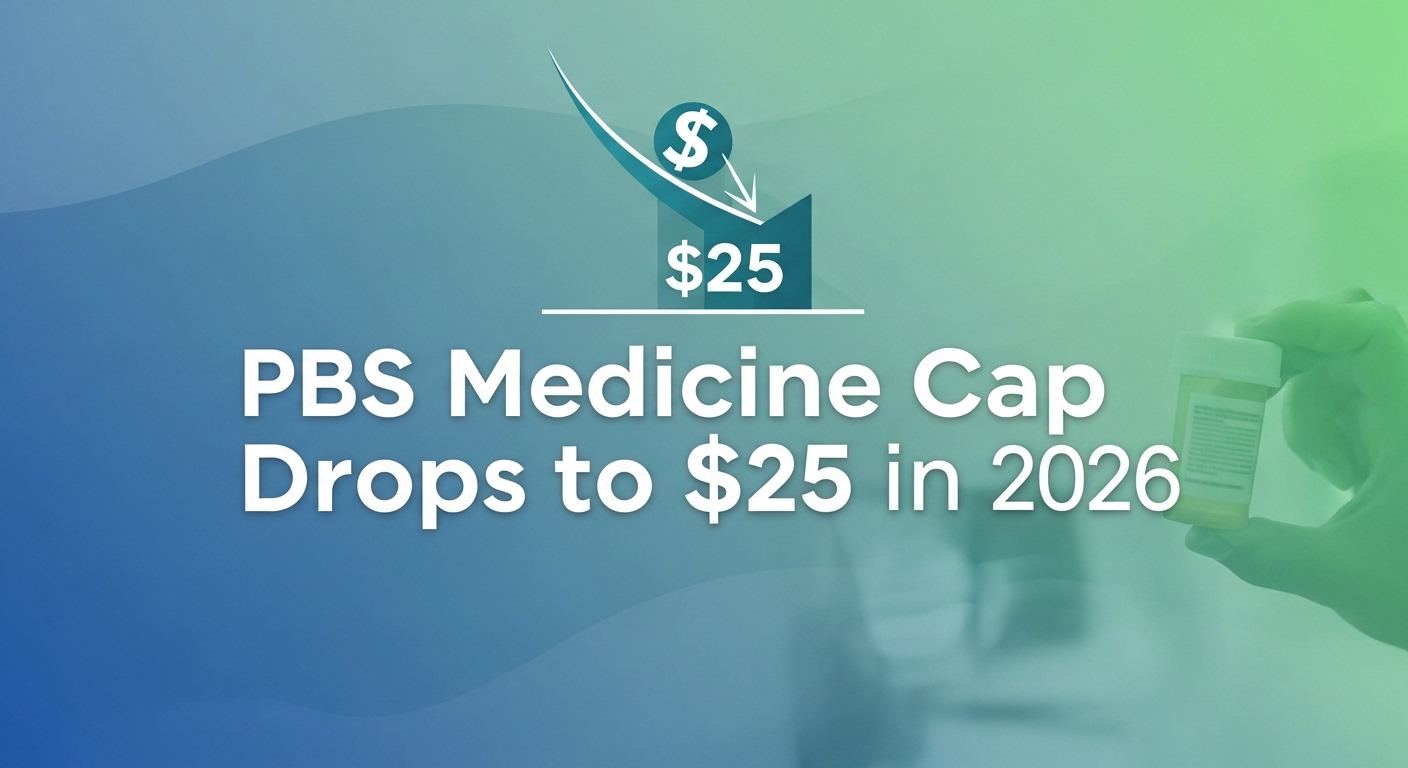
That drop came from one of the most practical cost-of-living changes introduced in Australia in 2026. The maximum price for PBS-listed medicines has fallen to $25 per script for general patients, down from the previous $30 cap. For households managing chronic conditions and multiple prescriptions, the savings across a full year can be substantial.
This guide explains exactly what has changed, who benefits most, and what you need to do to make sure you are paying the right price at the counter.
What Is the PBS and Why Does the Cap Matter?
The Pharmaceutical Benefits Scheme is Australia’s government program that subsidises the cost of essential medicines for all Australians. Without it, many common medications would cost hundreds of dollars per prescription rather than the capped amount patients pay today.
Under the PBS framework, the government negotiates prices directly with pharmaceutical companies and covers the gap between the actual medicine cost and what the patient pays. The patient pays only the co-payment, which is the capped contribution, and the government handles the rest.
The maximum co-payment is the number that matters most for everyday Australians. In 2026, that figure has moved from $30 to $25 for general patients, and concession card holders continue to pay around $7 to $8 per script.
What Has Actually Changed in 2026?
The new PBS pricing structure took effect in 2026 under updated government pricing rules. The key changes across the two patient groups are as follows.
General patients, meaning those without a concession card, now pay a maximum of $25 per prescription for any medicine listed on the PBS. That is a $5 reduction from the previous $30 cap that had been in place.
Concession card holders already pay a heavily discounted rate of around $7 to $8 per script, and that continues in 2026. The change delivers the most noticeable financial benefit to working Australians and retirees who do not qualify for concession pricing.
No application is required. The lower cap is automatically applied at the pharmacy counter whenever you fill a PBS-listed prescription.
Who Benefits Most From the $25 PBS Cap?
The change delivers the biggest financial benefit to a specific group of Australians who have historically fallen into the middle ground of the system. They earn enough to miss concession card eligibility but still feel the pressure of regular prescription costs.
The households likely to see the most meaningful savings include the following.
- Working Australians without concession cards who manage ongoing health conditions
- Families with children requiring regular medications for conditions like asthma or diabetes
- Retirees on NZ Super or self-funded retirement incomes who do not hold a concession card
- Middle-income earners managing chronic conditions requiring multiple monthly prescriptions
Economist Dr. Rachel Ng has noted that lowering the PBS cap is a direct way to support working households who may not qualify for concessions but still feel cost-of-living strain. The $5 reduction is modest per script, but across a full year and multiple prescriptions, it becomes a real number.
Real Story: What the Saving Looks Like in Practice
Elaine Turner fills four prescriptions every month. Under the previous $30 cap, her maximum monthly medicine bill was $120. With the new $25 cap, that drops to $100 per month.
“That is $20 saved every month,” she says. “Over a year, that is groceries for a week.” For a retiree managing a fixed income, that kind of practical saving is exactly what the policy was designed to deliver.
For a family with two members on ongoing medication, the annual savings climb even higher. The table below shows how the numbers stack up based on how many scripts you fill each month.
| Prescriptions Per Month | Old Maximum Cost ($30) | New Maximum Cost ($25) | Annual Saving |
|---|---|---|---|
| 1 | $30 | $25 | $60 |
| 3 | $90 | $75 | $180 |
| 5 | $150 | $125 | $300 |
These figures represent the maximum co-payment scenario. If any of your medicines are already priced below $25, you pay the lower listed price regardless.
Does Every Medicine Cost $25 Now?
No, and this is an important point to understand. The $25 figure is the maximum co-payment for general patients, not a flat price applied to every script. Some PBS-listed medicines cost less than $25 at full price, and in those cases you simply pay the lower amount.
Medicines that are not listed on the PBS are not subsidised and may cost significantly more than $25, depending on the drug. Your pharmacist can confirm whether your specific prescriptions are PBS-listed.
Generic alternatives are worth asking about too. In many cases, a generic version of a brand-name medicine is available at a lower price point, and pharmacists are required to inform you when a cheaper equivalent exists.
Read More: https://onetreegrill.site
The PBS Safety Net: How It Works in 2026
The PBS Safety Net provides an additional layer of protection for households that spend heavily on prescriptions across the calendar year. Once you reach the annual spending threshold, your out-of-pocket costs drop significantly for the remainder of that year.
For general patients who reach the safety net threshold, the cost per script drops to a reduced rate for all remaining prescriptions in that calendar year. For concession card holders who reach their lower threshold, medicines may become free for the rest of the year.
One practical note for 2026: because the per-script cost is now $5 lower, some households will take slightly longer to reach the safety net threshold than they did under the previous $30 cap. However, the overall annual medicine spend is still expected to be lower for most patients, even accounting for this shift.
Keep your pharmacy receipts throughout the year. Your pharmacist tracks your PBS spending and will notify you when you are approaching or have reached the safety net threshold. You can also check your progress through Medicare online services.
Why the Government Made This Change in 2026
Healthcare costs have been one of the fastest-growing household expenses in Australia over the past five years. Australian Bureau of Statistics data shows that out-of-pocket medical costs have climbed steadily, particularly for specialist visits and diagnostic testing.
Reducing prescription co-payments is one of the most direct tools the government has for delivering cost-of-living relief to a broad group of Australians. A spokesperson from Australian Treasury described the measure as targeted cost-of-living relief that directly reduces health expenses for millions of households.
Health officials have also pointed to a practical public health reason behind the reduction. Research consistently shows that higher prescription costs lead to lower medication adherence, particularly among middle-income earners who do not qualify for concession pricing. When people skip or delay medications because of cost, health outcomes deteriorate and the long-term burden on the healthcare system increases.
Lowering the cap removes a financial barrier that was causing some Australians to make the wrong decision about their health simply because of price.
Impact on Pharmacies and What Changes at the Counter
The reform does not change anything about how you access your prescriptions. You still need a valid prescription from a doctor or authorised prescriber. Consultation fees for GP visits remain unchanged and are separate from PBS co-payments.
Pharmacies continue to receive government reimbursements for the gap between what patients pay and the full cost of the medicine. The pharmacy dispensing process is identical to previous years, with the new cap applied automatically by the PBS pricing system.
Pharmacists across Australia have noted that the change has reduced financial stress at the counter, particularly for patients collecting multiple scripts in a single visit. The practical experience for patients is straightforward: you pay less, the government covers more, and nothing else changes.
What You Should Do Right Now
You do not need to take any action to access the lower cap. It applies automatically. But there are a few practical steps worth taking to make sure you are getting the full benefit of the 2026 PBS changes.
- Confirm that your current prescriptions are PBS-listed by asking your pharmacist or checking the PBS website
- Keep receipts for all PBS prescriptions throughout 2026 to track your progress toward the safety net threshold
- Make sure your Medicare card and concession card details are current and up to date if applicable
- Ask your pharmacist about generic alternatives where they are available and appropriate for your condition
- Check your Medicare online account to monitor your cumulative PBS spending across the year
If you forget your concession card at the pharmacy and pay the general rate, you can claim a refund later by presenting your card and receipt. Do not assume you have simply missed the saving.
Frequently Asked Questions About the PBS $25 Cap in 2026
Q1. What is the new PBS co-payment for general patients in 2026? The maximum co-payment for general patients is $25 per prescription for PBS-listed medicines, reduced from the previous $30 cap.
Q2. When did the $25 cap take effect? The new pricing applies in 2026 under updated PBS pricing rules. It has been in effect since the start of the year.
Q3. Do concession card holders benefit from this change? Concession card holders already pay a heavily discounted rate of around $7 to $8 per script. Their co-payment remains at that level and is not directly affected by the general patient reduction.
Q4. Do I need to apply or register for the lower price? No. The $25 cap is applied automatically at the pharmacy whenever you fill a PBS-listed prescription. No action is required from you.
Q5. Does the $25 cap apply to all medicines? Only medicines listed on the PBS are subsidised. Medicines not listed may cost more than $25. Some PBS medicines already priced below $25 are charged at their lower price, not bumped up to the cap.
Q6. What if my medicine costs less than $25? You pay the lower listed price. The $25 figure is a maximum, not a fixed price for all scripts.
Q7. How does the safety net work in 2026? Once your annual PBS spending reaches the safety net threshold, your per-script costs drop for the rest of the calendar year. Concession card holders who reach their lower threshold may receive medicines free for the remainder of the year.
Q8. Will the lower cap affect when I reach the safety net? The lower per-script cost means some patients will take slightly longer to reach the safety net threshold. However, overall annual medicine spending is still expected to be lower for most patients.
Q9. Are children’s prescriptions included in the $25 cap? Yes, if the medicine is PBS-listed. Children’s prescriptions follow the same co-payment rules as adult prescriptions under the PBS.
Q10. Does this apply in every state and territory? Yes. The PBS is a national program administered by the Australian Government Department of Health and Aged Care. The $25 cap applies in every state and territory equally.
Q11. Can pharmacists charge additional fees on top of the PBS co-payment? Standard dispensing fees apply, but pharmacies must follow PBS pricing rules. The co-payment structure is set by the government and applies consistently across all approved PBS dispensing pharmacies.
Q12. Are over-the-counter medicines included in the PBS cap? No. The PBS co-payment only applies to medicines that require a prescription and are listed on the PBS. Over-the-counter products are priced independently by retailers.
Q13. What if I paid $30 for a script after the new cap took effect? This should not happen if your prescription was processed correctly under the updated PBS pricing. If you believe you were overcharged, raise it with your pharmacist or contact Medicare.
Q14. How much could a family with multiple prescriptions save in 2026? Savings depend on how many PBS scripts your household fills each month. Based on the $5 per script reduction, a family filling five scripts per month could save up to $300 across the full year.
Q15. Will the PBS cap drop further in future years? No further reductions have been announced for the PBS general patient cap beyond the 2026 change. Any future adjustments would be subject to government budget decisions and policy review.
For Elaine Turner and the millions of Australians who fill PBS prescriptions every month, the move to a $25 cap is exactly the kind of practical, immediate relief that makes a difference to a weekly budget.
It is not a dramatic overhaul of the healthcare system. It is a targeted reduction that quietly puts money back in the pockets of households managing real health needs. Over a full year, across multiple prescriptions, those savings add up to something genuinely useful, whether that is a week of groceries, a reduced credit card balance, or simply a little less financial anxiety every time you walk into a pharmacy.