
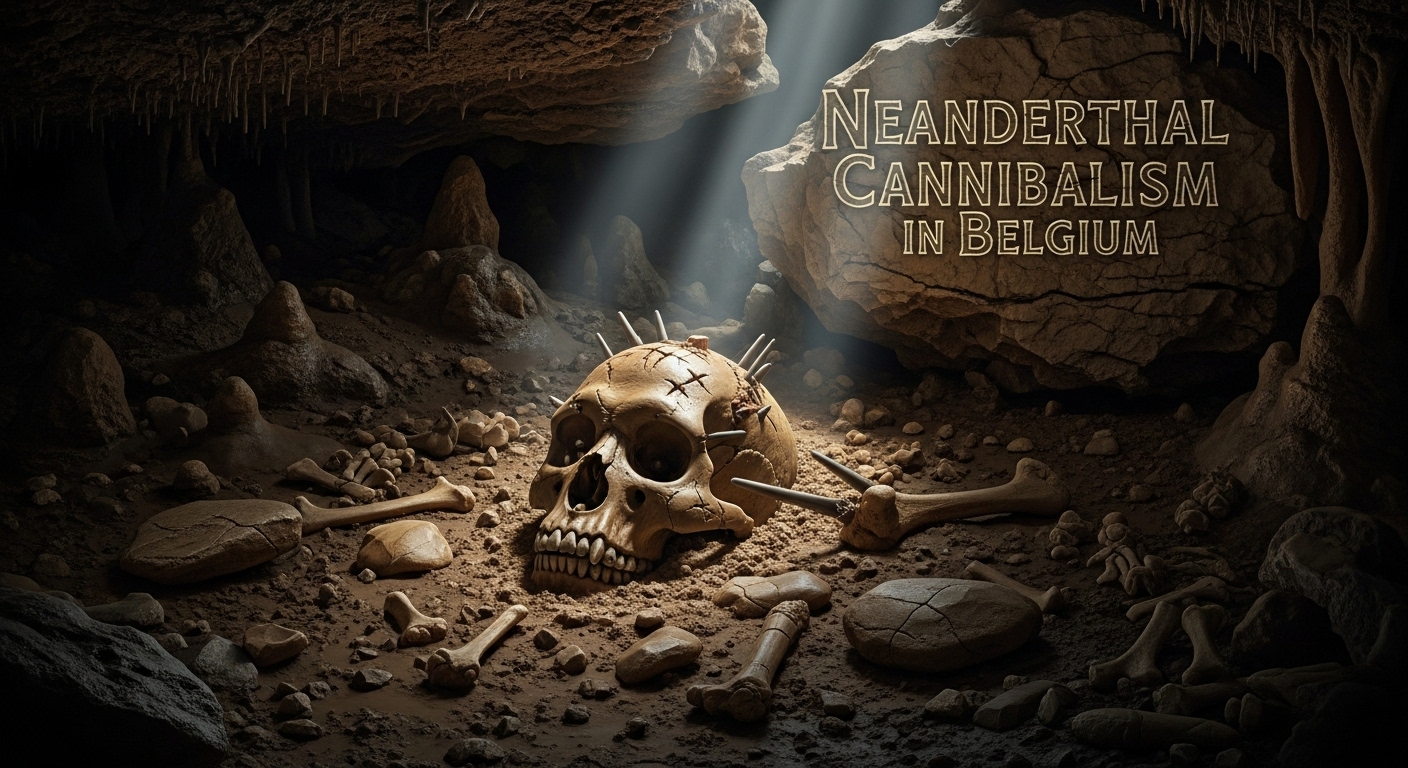
The bones had been sitting in museum storage boxes for decades. Excavated from the Goyet cave complex in Belgium since the 19th century, they were catalogued, studied, and largely set aside as part of the broad and messy record of Ice Age life.
Then a multidisciplinary research team re-examined 101 human bone fragments from one chamber of the cave system, applied modern analytical techniques, and found something that changed the interpretation of the site completely.
The bones showed the unmistakable signatures of systematic butchery. The victims were predominantly women and children. Isotopic evidence suggested they had come from somewhere else. And their bones had been processed the same way Neanderthals processed the carcasses of reindeer and horses.
What the Goyet cave data reveals is not simply cannibalism. It appears to be targeted, intergroup violence with a specific demographic pattern that researchers are still working to fully explain.
The Goyet Cave Complex: A Site That Has Kept Revealing Secrets
The Goyet cave system sits near Namur in Belgium and has been an archaeological site since excavations began in the 19th century. Over the decades, its sediments have yielded animal bones, stone tools, and traces of Neanderthal presence spanning a significant stretch of the Middle Palaeolithic.
For most of its excavation history, the Neanderthal remains from Goyet were treated as part of the general record. They were stored, analysed at the level of technology available at the time, and incorporated into broader discussions of Neanderthal behaviour without any special distinction.
The chamber known as the third cave of Goyet changed that picture when a research team applied a full battery of modern techniques to its human bone assemblage. Ancient DNA extraction, isotopic analysis, microscopic examination of surface marks, statistical modelling of demographic profiles, and taphonomic study of fracture patterns all pointed in the same direction.
The bones told a story of systematic, targeted violence that the original 19th century excavators had no way of reading and that earlier 20th century analysis had not revealed.
What the Cut Marks and Fractures Show
The most basic evidence of what happened at Goyet is visible on the bones themselves. The human remains bear the same butchery signatures that appear on hunted game animals from the same cave layers.
Long bones were smashed while still fresh, before the marrow inside could dry and become less nutritious. The fracture patterns that result from breaking a fresh bone are distinct from those produced by bone breaking after decomposition. The Goyet human bones consistently show fresh-break patterns.
Cut marks appear in positions consistent with meat removal. Slicing and scraping marks are located at the attachment points of major muscle groups, exactly where a skilled butcher would work to remove flesh from a carcass efficiently.
Some bone fragments were shaped into tools. This is the detail that perhaps most clearly illustrates the treatment of these individuals. Neanderthals used animal bones as raw material for specific tool types, and bone tools made from animal remains appear throughout the Goyet layers. The human bones from the third cave were shaped in identical ways, treated as a raw material no different from the reindeer and horse bones excavated from the same context.
Bodies were not buried. They were not left to decompose. They were processed thoroughly and then repurposed.
The Demographic Pattern That Points to Selection
Once the research team moved beyond the physical evidence of butchery and into the question of who the victims were, the data became significantly more disturbing.
By combining ancient DNA analysis with anatomical study of the bone fragments, the team identified at least six Neanderthal individuals in the assemblage. Four were women or adolescent girls. Two were children. No clearly identified adult males appeared in the sample.
For a prehistoric context, this distribution is statistically anomalous. Natural mortality patterns in hunter-gatherer populations tend to produce a more even spread across ages and sexes. Famine-related cannibalism, where a group is reduced to consuming its own dead to survive, also typically produces a distribution that reflects the group’s actual composition rather than a strong skew toward particular types of individuals.
The research team compared the Goyet demographic profile against other Neanderthal sites where cannibalism or unusual bone treatment has been documented, including El Sidrón in Spain and Chagyrskaya in Siberia. Those sites show more typical distributions with both men and women, adults and children represented in proportions closer to what population models predict.
Goyet’s over-representation of young female individuals and children is statistically distinct from what chance or natural mortality would produce. Someone appears to have selected these individuals specifically.
Women With Different Bodies and Different Origins
The women identified in the Goyet assemblage share physical characteristics that add another layer to the interpretation. Their skeletal measurements look different from the typical image of Neanderthals.
Measurements of the tibia and femur, the major long bones of the lower limb, show smaller stature and more slender limbs than the robust frame most commonly associated with Neanderthal populations. The physical profile of the Goyet women resembles some of the least stocky Neanderthal individuals known from sites in Spain and France, suggesting they came from a population with a different body type than the local Goyet group.
Isotopic analysis of the bones added a critical finding. The ratios of sulphur and nitrogen isotopes preserved in bone reflect the environment in which an individual grew up and the diet they consumed during childhood and adolescence. These isotopic signatures are essentially a geological record of where a person spent their formative years.
The women and children at Goyet shared isotopic signatures with each other but showed distinct profiles from what the local environment around Goyet would have produced. They grew up in the same kind of environment as each other, but that environment was not the Sambre-Meuse valley where Goyet is located.
The combination of shared non-local origin, similar physical type, and evidence of movement to the Goyet region produces a working hypothesis that these individuals were brought there from elsewhere, likely not voluntarily.
Exocannibalism: Consuming Outsiders
Anthropologists distinguish between two broad categories of cannibalism based on the relationship between the people eating and the people being eaten.
Endocannibalism involves consuming the bodies of people from within one’s own group, typically the recently deceased. This appears in funerary and ritual contexts across many documented human societies. The act is often surrounded by ceremony and symbolic meaning, and the bodies are treated with respect before and sometimes after consumption.
Exocannibalism involves consuming individuals from outside one’s own group. It typically appears in contexts of conflict, raiding, or warfare. The bodies are not treated with ritual care. The act carries a different social meaning, often related to power, dominance, or the destruction of an enemy group’s capacity to recover.
The Goyet evidence aligns with exocannibalism on multiple grounds. The victims appear genetically unrelated to the local Goyet group based on DNA analysis. Their isotopic data places their origins in a different region. There is no evidence of funerary treatment, symbolic care, or ceremonial context around the remains. The bodies were processed like animal carcasses and the bones were subsequently used as tools.
Every line of evidence points toward outsiders brought to Goyet and consumed in a context that bears no resemblance to mortuary ritual.
Who Were the Cannibals? Neanderthals or Early Humans?
| Question | Current Evidence | Confidence Level |
|---|---|---|
| Who were the victims? | Non-local Neanderthal women and children | High, confirmed by DNA and isotopes |
| Who were the cannibals? | Probably Neanderthals, Homo sapiens cannot be fully ruled out | Moderate, based on associated artefacts |
| Primary motivation? | Nutritional, within a context of intergroup conflict or raiding | Moderate to high based on pattern analysis |
| Were victims related to each other? | Shared isotopic origin suggests common background | Moderate, genetic relationship unclear |
| Was this a single event? | Unclear, multiple individuals suggest repeated or organised activity | Under investigation |
These assessments reflect the current state of the research based on published findings. The question of Homo sapiens involvement remains genuinely open. The timing of the Goyet events overlaps with a period when early modern humans were present in parts of Europe, and researchers continue to work through the implications of that overlap. The absence of clear symbolic behaviour at Goyet currently favours a Neanderthal perpetrator interpretation.
The Possibility of Homo Sapiens Involvement
The events at Goyet took place during the late Middle Palaeolithic, a period that overlaps in time with the known presence of Homo sapiens in parts of Europe. At sites like Ranis in Germany, modern humans have been confirmed in Europe during approximately the same broad timeframe.
This proximity raises an uncomfortable question. Could the cannibals at Goyet have been early Homo sapiens targeting Neanderthals rather than Neanderthals targeting other Neanderthals?
The research team considers this scenario seriously but reaches a tentative conclusion that favours Neanderthal perpetrators. The primary evidence is the absence of symbolic behaviour. The Goyet site shows no ornaments, no engravings, no structured or intentional burials, none of the markers that characterise early Homo sapiens occupation sites from this period in Europe.
The use of human bone as raw material for tools is also significant. This practice appears at other Neanderthal sites where cannibalism has been documented. It is not well recorded among early modern humans in Europe. The combination of these two absences, no symbolic behaviour and no comparable tool-use pattern in early Homo sapiens sites, currently makes the Neanderthal perpetrator scenario more plausible, though not proven.
A Frontier Zone and the Archaeology of Tension
The Sambre-Meuse valley where Goyet is located was not an isolated or static location during the late Middle Palaeolithic. Archaeological evidence from the broader region shows the overlapping presence of different stone tool traditions, a pattern that suggests cultural fragmentation and possibly competing groups with different origins and histories occupying adjacent territories.
Classic Mousterian stone tool technology, long associated with Neanderthals across western Europe, appears in the region alongside Keilmesser tools, a style connected with central and eastern European traditions. The presence of multiple tool traditions in the same area is typically interpreted as evidence of different groups operating in proximity, sometimes sequentially and sometimes simultaneously.
In anthropological terms, frontier zones with overlapping or competing group territories are environments where intergroup conflict is most likely to occur. Resources in such areas may be contested. Territorial boundaries may be unclear or disputed. Encounters between unfamiliar groups carry higher risk of violence than encounters within established social networks.
The Goyet evidence fits into this broader picture. The valley appears to have been a convergence zone for groups with different cultural backgrounds during a period when Neanderthal populations were already under pressure. Competition over hunting grounds, water sources, shelter, and mating opportunities in such an environment could readily produce the kind of violent intergroup encounter that the Goyet bones suggest.
Why Women and Children Were Targeted
The deliberate over-representation of women and children in the Goyet victim profile, if the statistical analysis is correct, requires an explanation that goes beyond simple opportunism.
Ethnographic records of intergroup raiding in small-scale societies across various cultures and time periods provide some comparative context. Raiding parties in these documented cases sometimes focused specifically on reproductive-age women and children. The motivations varied across documented cases. Some raids aimed to capture women and children and incorporate them into the raiding group, providing labour, reproductive capacity, or social integration. Others aimed to destroy the demographic potential of a rival group by removing the individuals most central to its future reproduction and growth.
At Goyet, there is no evidence that the women and children were incorporated into the local group. They were consumed. The demographic damage this would have inflicted on whichever group these individuals came from was real and significant.
A group that loses multiple reproductive-age women and children in a single event or series of events faces serious consequences for its long-term viability. In a context where Neanderthal populations were already under pressure and group sizes were small, the targeted removal of women and children through violence and cannibalism could have been an effective, if brutal, strategy for weakening a rival group.
Three Types of Cannibalism and Which Category Goyet Fits
Cannibalism in prehistoric contexts is not a single phenomenon with a single explanation. Archaeologists approach it as a behaviour with several distinct potential motivations, each leaving a different pattern in the archaeological record.
Survival cannibalism occurs when a group consumes its own dead during extreme resource stress. The bodies consumed are typically those already dead from other causes. The demographic profile of victims reflects the group’s natural mortality rather than any selection pattern. There is often evidence of desperation in the broader site context.
Ritual or funerary cannibalism involves consuming the dead as part of mortuary practices. The bodies may receive ceremonial treatment before, during, or after consumption. Cut marks appear in specific culturally meaningful patterns. There is evidence of symbolic intent in the broader context of the site.
Conflict-related cannibalism involves killing outsiders and consuming them within a context of intergroup violence. The victim profile shows a non-random or selection-based pattern. Bodies are treated as resources rather than persons. There is no ritual care. Food value is clearly part of the motivation but so is the act of targeting specific enemy individuals or categories.
The Goyet evidence fits conflict-related cannibalism far better than either of the other categories. The victims are outsiders. The demographic pattern shows selection. The bodies received no funerary treatment. The processing was thorough and food-focused. The bones were subsequently used as raw material, indicating that even the non-consumable parts of the victims were extracted for utility rather than disposed of respectfully.
How Modern Techniques Read Violence in Ancient Bone
The Goyet findings illustrate how dramatically the analytical capacity of archaeology has advanced beyond what was available to the original excavators of the cave in the 19th century.
Ancient DNA extraction from bone fragments can now identify species, biological sex, and family relationships even from heavily degraded material tens of thousands of years old. The DNA from the Goyet bones identified the sex of individuals and confirmed their species identity as Neanderthals, neither of which the original excavators had access to.
Isotopic analysis extracts chemical signatures from bone mineral and collagen that reflect the environment and diet of an individual during their lifetime. Different geological regions have distinct isotopic compositions that are absorbed into the food chain and eventually into bone. Comparing isotopic profiles between individuals and between individuals and their supposed local environment can reveal whether someone grew up locally or came from elsewhere.
Taphonomy, the systematic study of what happens to bodies after death, provides the framework for interpreting cut marks, fracture patterns, and surface modifications on bone. Taphonomic analysis can distinguish between marks made by stone tools, marks made by animal teeth, and marks produced by post-depositional geological processes. The Goyet bones show human-made cut marks that are unambiguous when examined microscopically.
Statistical modelling allows researchers to compare the demographic profile of a site against what random or natural processes would predict. The Goyet assemblage was compared against multiple other Neanderthal sites and found to deviate significantly from expected natural distributions. That statistical deviation is one of the most powerful pieces of evidence that selection, rather than chance, produced the Goyet victim profile.
What Goyet Tells Us About Neanderthal Social Complexity
One of the persistent themes in the scientific and popular understanding of Neanderthals has been the question of how socially and cognitively complex they were. For much of the 20th century, they were presented as simple, marginal beings who lived quiet lives before being outcompeted by the arrival of modern humans.
The evidence has been moving steadily away from that picture for decades. Neanderthals used pigments. Some buried their dead. Some made ornaments. They traded raw materials over long distances. They hybridised with modern humans extensively enough that a significant proportion of non-African human DNA today has Neanderthal ancestry.
The Goyet evidence adds a darker dimension to Neanderthal social complexity. Organising or participating in raids on outside groups, selecting specific categories of victims, processing and consuming them, and using their remains as raw material are all behaviours that require social coordination, planning, and the capacity to identify and act on intergroup dynamics.
None of these behaviours are simple. All of them are, in their own way, evidence of a socially complex species operating in a complicated social landscape. Goyet does not make Neanderthals worse than they seemed before. It makes them more recognisably human, including in the most uncomfortable dimensions of what humans are capable of.
The Broader Archaeological Context of Neanderthal Violence
Goyet is not the only site where Neanderthal cannibalism has been documented. El Sidrón in northern Spain contains the remains of at least 13 Neanderthal individuals showing butchery marks consistent with cannibalism. Krapina in Croatia, one of the earliest recognised Neanderthal sites, has also been interpreted as showing evidence of cannibalistic processing of human remains.
What makes Goyet different is the specificity of the demographic evidence and the isotopic data pointing to non-local victims. Most other sites with Neanderthal cannibalism evidence are interpreted as endocannibalism, possibly funerary or survival-related, within a single family or local group. The non-local origin of the Goyet victims is the detail that most strongly pushes the interpretation toward exocannibalism and intergroup conflict.
Gran Dolina in Spain, a much earlier site associated with the Homo antecessor species rather than Neanderthals, has been interpreted through a similar lens of intergroup violence and cannibalism. The pattern of targeting outsiders appears to have deep roots in hominin behaviour that precede both Neanderthals and modern humans.
Frequently Asked Questions
Where is the Goyet cave and when was it excavated?
The Goyet cave complex is located near Namur in Belgium. It has been an active archaeological site since the 19th century. The bone fragments central to this new research were excavated over a long period and stored in collections before modern re-analysis was conducted.
How do researchers know the victims were non-local?
Isotopic analysis of the bones revealed chemical signatures that reflect the geological environment in which the individuals grew up. The signatures from the Goyet victims are distinct from what the local Sambre-Meuse valley environment would produce and cluster together in a way suggesting the victims shared a common non-local origin.
Could the demographic bias be a result of sampling rather than selection?
The research team addressed this possibility through statistical modelling that compared the Goyet demographic profile against multiple other Neanderthal sites. The Goyet distribution is statistically distinct enough from natural mortality expectations that random sampling alone is an unlikely explanation, though the authors acknowledge this as a consideration in the study.
Does this change how we understand Neanderthal extinction?
The Goyet findings contribute to a growing body of evidence that Neanderthal social life involved intergroup conflict as well as cooperation. Whether intergroup violence was a significant factor in Neanderthal demographic decline is a larger question that this single site cannot answer. It does confirm that the social environment of late Neanderthals was more complex and competitive than earlier models assumed.
What is the difference between endocannibalism and exocannibalism?
Endocannibalism involves consuming the dead from within one’s own group, typically in funerary or ritual contexts. Exocannibalism involves consuming individuals from outside one’s group, typically in conflict contexts. Goyet’s evidence fits exocannibalism based on the non-local origin of victims and the absence of ritual treatment.
Are similar patterns seen at other prehistoric sites?
Other sites including Gran Dolina in Spain show evidence of targeted consumption of outside individuals in a much earlier period. El Sidrón in Spain and Krapina in Croatia show Neanderthal cannibalism, but with demographic profiles more consistent with endocannibalism within a local group. Goyet’s exocannibalism interpretation is currently one of the clearest cases for intergroup violence and cannibalism in the Neanderthal record.
How confident are researchers in these conclusions?
The physical evidence of butchery at Goyet is considered robust and not seriously contested. The demographic interpretation and the exocannibalism hypothesis are supported by multiple independent lines of evidence but involve statistical modelling with acknowledged uncertainty. The question of whether the perpetrators were Neanderthals or early Homo sapiens remains genuinely open. The authors present their conclusions as the most probable interpretation of the current evidence rather than certainty.
Read More Latest News and Updates
Visit onetreegrill.site for More Updates
The Bones Told the Story. The Story Changed Everything We Thought We Knew.
The Goyet bones sat in museum boxes for over a century before modern techniques could read what was written in them. What they recorded was not a quiet extinction, not a gradual fading away, not the simple story of a less intelligent species replaced by a more capable one.
They recorded violence. Selection. Organisation. The targeting of women and children from outside the local group, brought to a cave in Belgium and processed the same way a hunter processes a kill, their bones eventually shaped into tools and left in the same layers as the remains of reindeer and horses.
Neanderthals were not simple. They were not peaceful. They operated in fractured social landscapes under real resource pressure, forming alliances, defending territories, and in some cases attacking neighbouring groups with deliberate and organised intent.
In that picture, they are less alien than the old caricature suggested, and more recognisable as beings whose social complexity included exactly the kind of intergroup competition and violence that characterises humans across documented history.
Goyet does not resolve the question of what Neanderthals were. It deepens it, and in deepening it, reminds us that even 40,000 years ago, power, scarcity, and fear could drive beings very much like us to treat each other as prey.